Table of Contents
- Why Identifying Ant Trails Matters Before Taking Action
- What to Look For: Recognizing Visible Ant Activity
- How to Follow an Ant Trail to Its Source
- Tiny Ants in Kitchen Identification: Species and Appearance
- Kitchen-Specific Inspection: Where Trails Hide
- Signs of Ants in Walls: When Trails Lead Inside
- Ant Identification Chart: Quick Reference by Appearance
- Finding Food and Water Sources That Attract Ants
- Frequently Asked Questions
Last Updated: October 16, 2026
Why Identifying Ant Trails Matters Before Taking Action
Learning how to identify ant trails in kitchen spaces is your first real clue about what you’re dealing with. Most people see a few ants and panic, but the ants you see are just workers.
Homeowners who take time to map the ant trail before acting often solve the problem faster and more completely.
The difference between a one-visit fix and a recurring problem often comes down to whether you identified the trail correctly.
What to Look For: Recognizing Visible Ant Activity
Ant trails aren’t random. Worker ants follow pheromone paths laid down by scouts who found food. Once you know what to look for, spotting these trails becomes straightforward.
Spotting marching patterns and foraging workers
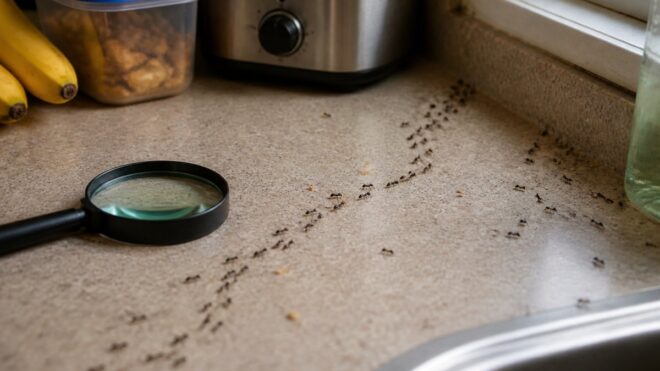
Look for lines of ants moving with purpose. They won’t scatter when you get close, they’ll keep marching. Worker ants move in organized columns, single file or in tight groups, following an invisible chemical road.
The ants you see on a trail are all the same size and moving in the same direction.
Watch for timing. Active trails show heavy traffic during certain hours. Many kitchen ant species are most active early morning or late evening.
Distinguishing a pheromone trail from random crossing
Not every ant you see is on a trail. Single ants wandering across your counter are scouts. A trail is different: it’s a highway.
The key difference is consistency. A pheromone trail stays in the same location. Ants will follow it repeatedly, sometimes for days or weeks, until the food source runs out or the trail gets disrupted.
Pheromone trails also have edges. If you look closely, ants stay within a narrow band, maybe a quarter-inch wide. They don’t spread out across the countertop. This tight organization is the chemical trail at work.
How to Follow an Ant Trail to Its Source
Following a trail takes patience and observation. You’re not trying to kill ants yet. You’re gathering intelligence.
Step 1: Observe movement patterns without disturbing
Don’t spray, don’t wipe, don’t touch the trail. For at least 24 hours, just watch. Note where the trail starts and where it goes. Does it come from under the sink? Along the backsplash?
Observe at different times of day. Morning, afternoon, evening, and night. The intensity of the trail changes.
Watch for branches. A main trail might split into smaller paths leading to different food sources. If you see ants dividing, follow the larger group first, that’s usually the primary food source.
Step 2: Map the trail from food source to entry point
Start where the ants are feeding. This is usually on a countertop, inside a cabinet, or near the sink. Mark this spot mentally or with a piece of tape on the cabinet side (not where food is).
Follow the line backward. Where does it go? Does it run along the backsplash? Down the side of the cabinet? Along the floor? Trace it to the point where it disappears into a wall, under the sink, or behind an appliance.
This path is your map. The endpoint is where the nest is likely located or where they’re entering from outside.
Step 3: Document timing and activity levels
Note when you see the heaviest traffic. Morning, afternoon, evening? Write it down. This tells you when the colony is most active and helps a professional plan treatment timing.
Count roughly how many ants you see in a 30-second window. Is it 5 ants per 30 seconds or 50? More ants means a larger colony and a stronger pheromone trail.
Note what they’re carrying. Are they collecting crumbs? Attracted to a spill? Heading toward a water source? This tells you what’s drawing them and what you’ll need to eliminate.
Tiny Ants in Kitchen Identification: Species and Appearance
Identifying the species matters because different ants behave differently and respond to different treatments. The tiny ants in kitchen spaces are usually one of a few common types.
Body segments, antennae, and size comparison
All ants have three body segments: head, thorax (middle), and abdomen (rear). The abdomen often looks like a small bump or node. Look at this shape, it’s one of the first things to identify a species.
Antennae are elbowed in most ant species. They bend at an angle, not straight. Count the segments if you can see them with a magnifying glass. This is how experts tell species apart.
Size matters too. Worker ants are usually between 1/16 inch and 1/4 inch long, depending on species. Pharaoh ants are tiny, almost invisible. Carpenter ants are much larger.
Common kitchen ant species and their behavior
Pharaoh ants are the tiniest. They’re pale yellow or light brown and almost transparent. They’re attracted to sweet foods and water.
Pavement ants are small and dark brown or black. They nest under floors and in cracks. They’re attracted to both sweet and protein foods. Pavement ants are common in older buildings.
Carpenter ants are large and dark. They don’t eat wood, but they tunnel through it.
Odorous house ants smell like rotten coconut when crushed. They’re small, dark, and attracted to sweet foods. They’re common in the Northeast and establish trails quickly.
Kitchen-Specific Inspection: Where Trails Hide
Ants don’t just walk across open countertops. They use highways that follow edges, corners, and protected pathways.
Countertops, backsplashes, and cabinet corners
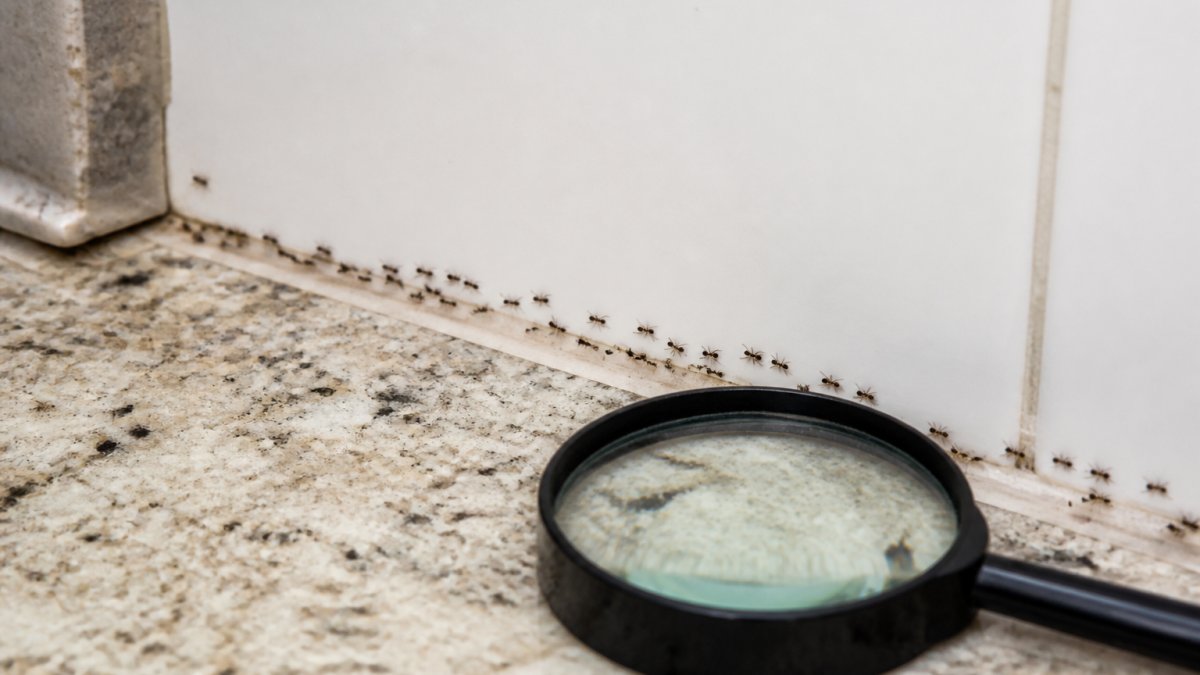
Inspect the line where your backsplash meets the counter. This is a natural highway for ants. They use the edge as a guide and the gap as protection.
Check cabinet corners, especially the inside corners where two cabinets meet. Ants often run trails along these edges. Open cabinet doors and look at the top inside edge where the cabinet meets the wall.
Examine the underside of cabinet overhangs. Ants will run along the bottom edge of a cabinet that extends over a gap. Shine a flashlight and look for trails.
Kitchen floor cracks, baseboards, and wall gaps
Get down and look at the baseboards. Any gap between the baseboard and the floor is an ant highway. These gaps are perfect for ants because they’re protected and lead directly to the wall.
Check where pipes enter the wall under the sink. Ants use these openings as entry points. Look for trails running along the pipe or in the gap around it.
Inspect the floor itself. Cracks in tile grout or gaps in hardwood are ant pathways. If you have a crack that runs toward the kitchen from another room, follow it.
Signs of Ants in Walls: When Trails Lead Inside
Sometimes the trail disappears into a wall. This is where the colony might be nesting, or it’s where they’re entering from outside.
Nesting areas and hidden activity behind walls
If a trail leads to a crack in the wall and stops, the nest is likely inside. You won’t see the nest from the outside, but you know it’s there.
Listen for activity. Put your ear near the crack where the trail disappears. A large colony makes noise. You might hear a faint rustling or ticking sound. This confirms there’s significant activity inside the wall.
Look for exit points. If ants are nesting in the wall, they’ll emerge at multiple spots, not just one. Check the wall in a 3-foot radius from where the main trail disappears.
What to do when the trail disappears into a wall
Don’t drill or cut into the wall. You’ll just spread the colony and make the problem worse. Instead, focus on the entry point. Even if the nest is inside the wall, ants must exit to forage.
Seal cracks and gaps around the entry point if possible. Use caulk or foam sealant. This forces ants to find new routes and disrupts their established trail system.
If the trail disappears into a wall and you can’t identify an entry point from outside, the nest is likely established inside. This is when professional treatment becomes important.
Ant Identification Chart: Quick Reference by Appearance
Use this chart to quickly identify what you’re dealing with based on what you see.
| Ant Species | Size | Color | Body Shape | Common Location |
|---|---|---|---|---|
| Pharaoh Ant | 1/16 inch | Pale yellow | Small, uniform | Kitchens, bathrooms |
| Pavement Ant | 1/8 inch | Dark brown | Grooved thorax | Under floors, cracks |
| Carpenter Ant | 1/4 inch | Dark brown/black | Large, smooth | Wood trim, windows |
| Odorous House Ant | 1/8 inch | Dark brown | Small, rounded | Kitchens, walls |
Finding Food and Water Sources That Attract Ants
Ants don’t come to your kitchen by accident. Something is attracting them. Find it and remove it, and you remove the reason they keep coming back.
Crumbs, spills, and food residue inspection
Check under appliances. The space under the refrigerator, stove, and dishwasher collects crumbs and spills. This is an ant buffet. Pull out appliances and clean thoroughly. Use a vacuum and then wipe with soapy water.
Inspect inside cabinets where you store dry goods. Open boxes of cereal, crackers, and flour are ant magnets. Transfer dry foods to sealed containers. Check the shelves for spills or crumbs.
Look at countertops after meals. Even small crumbs attract ants within hours. Wipe down all surfaces with soapy water. Don’t just wipe, clean thoroughly enough that you remove the pheromone trail.
Water sources: leaks, condensation, and standing moisture
Ants need water as much as food. Check under the sink for leaks.
Inspect the area around your dishwasher. Water can accumulate here, especially in older homes. Wipe and dry this area daily.
Look at windowsills and the area around air conditioning units. Condensation creates moisture that ants are attracted to. Wipe these areas dry regularly.
Check for standing water in plant saucers, pet water bowls, or anywhere else moisture collects. Empty and refill pet water daily.
Identifying ant trails in your kitchen is the foundation of solving the problem.
Frequently Asked Questions
How do you follow an ant trail back to its entry point?
Start by observing where ants are most active without disturbing them. Follow the densest line of worker ants as they move between food sources and their nest. Mark the path mentally or with a small piece of tape on nearby walls or countertops. Trace the trail as it leads toward baseboards, cabinet gaps, or wall cracks. If the trail splits or becomes unclear, focus on the direction with the most foraging activity. Patience is key, watch for 10-15 minutes to confirm the direction before attempting to map the complete route.
What do tiny ants in kitchen identification look like compared to other household pests?
Kitchen ants typically measure 1/16 to 1/8 inch long with distinct body segments: head, thorax, and abdomen. They have bent antennae and six legs. Pharaoh ants, a common kitchen invader, are pale yellow or reddish and move quickly in erratic patterns. Carpenter ants are larger (1/4 to 1/2 inch) and darker. Unlike termites, ants have a visible waist (petiole) between their thorax and abdomen. Use a magnifying glass to confirm these features when inspecting suspected trails.
How can you tell if ants are nesting in your walls?
Signs of ants in walls include trails that disappear into cracks, gaps around baseboards, or holes in drywall. You may hear faint rustling sounds inside walls, especially at night. If you see worker ants emerging from the same wall location repeatedly over several days, a nest is likely present. Moisture damage, water stains, or soft spots in walls can also indicate nesting activity, as ants prefer damp environments. If you cannot locate the entry point after following visible trails, the nest is probably behind the wall, and professional inspection is recommended.
Why do ants walk in a line, and how does this help identify a trail?
Ants follow pheromone trails, chemical signals laid down by worker ants as they move between food and the nest. This organized marching allows thousands of ants to navigate efficiently using the same route. A true pheromone trail shows consistent, directional movement with ants traveling in both directions (foragers heading out, loaded workers returning). Random ants crossing an area will move erratically without forming a defined line. Observing this organized, bidirectional flow for several minutes confirms you’ve found an active trail worth following back to its source.
