Table of Contents
- Why Ants Keep Coming Back to the Same Kitchen Spot
- What Destroys Ant Pheromones on Contact
- Step-by-Step: Cleaning Kitchen Surfaces to Remove Ant Pheromones
- How to Find Ant Entry Points in Kitchen
- Natural Ant Deterrents for Kitchen Counters
- How to Stop Ants From Coming Back
- Frequently Asked Questions
Last Updated: September 15, 2026
Why Ants Keep Coming Back to the Same Kitchen Spot
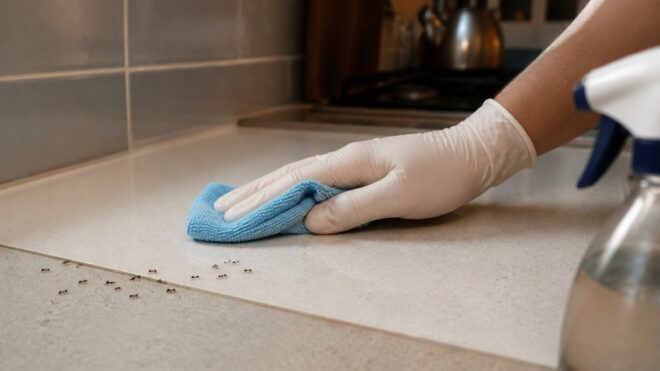
If ants return to the same strip of countertop every morning, the surface itself is the problem. Ants navigate by laying down ant pheromones, invisible chemical trails that tell the rest of the colony exactly where to walk (Checking your browser). Killing the ants you can see leaves those trails intact, so a new shift of foragers follows the same route within hours.
Ant pheromones are chemical scent markers deposited by foraging ants to guide nestmates to food and water sources. They are not visible to the eye, but they persist on tile, grout, laminate, and wood until something physically breaks them down.
That is the part most homeowners miss. You are not fighting the ants you see. You are fighting the scent highway they built, and it survives every paper towel wipe you have tried so far. We see this constantly in Metro Boston apartments and multi-family buildings: the same corner, the same trail, week after week.
Below, we’ll show you exactly how to clean kitchen surfaces to remove ant pheromones, which cleaners actually break the trail, and how to keep it from being rebuilt.
What Destroys Ant Pheromones on Contact
White vinegar is the most reliable household option because its acidity degrades the pheromone compounds and erases the scent marker. It is not a poison. It is a trail eraser, and that distinction matters.
The mechanism is straightforward. Pheromone trails are fatty acid deposits, and acetic acid breaks them down on contact (pubmed.ncbi.nlm.nih.gov). When the chemical signal is gone, foraging ants lose the map. You will still see scouts wandering in, but they will not find the highway, and the colony’s recruitment stops.
A few practical notes from experience:
- Plain white vinegar, not apple cider or cleaning vinegar blends with additives
- Water first, vinegar second; the dilution matters more than the brand
- One pass is never enough on grout, caulk lines, or textured laminate
Ants often re-mark a trail within 24 hours of a single wipe. Do two passes, one immediately after the other, and let the surface air dry instead of toweling it off. The residual scent is what keeps working.
White Vinegar Dilution Ratio That Works
A 1:1 mix of white vinegar and water handles most light trails. For heavy, repeated activity, use undiluted vinegar on non-porous surfaces, then follow with a clean water wipe.
| Surface Type | Vinegar Mix | Method | Caution |
|---|---|---|---|
| Sealed granite or quartz | 1:1 with water | Spray, sit 2 min, wipe | Avoid undiluted on unsealed stone |
| Laminate countertop | 1:1 with water | Spray and wipe dry | Prolonged wetting can lift edges |
| Stainless steel | 1:1 with water | Spray, wipe with grain | Dry immediately to prevent streaks |
| Grout and tile | Undiluted | Spray, scrub with brush | Test in a hidden spot first |
| Wood butcher block | 1:4 with water | Light mist, dry fast | Never soak; re-oil after |
Step-by-Step: Cleaning Kitchen Surfaces to Remove Ant Pheromones
Total Time: 20-30 minutes
Difficulty: Beginner
What You’ll Need:
- White vinegar and a spray bottle
- Clean microfiber cloths (two or more)
- Small scrub brush for grout
- Dish soap for the initial degrease
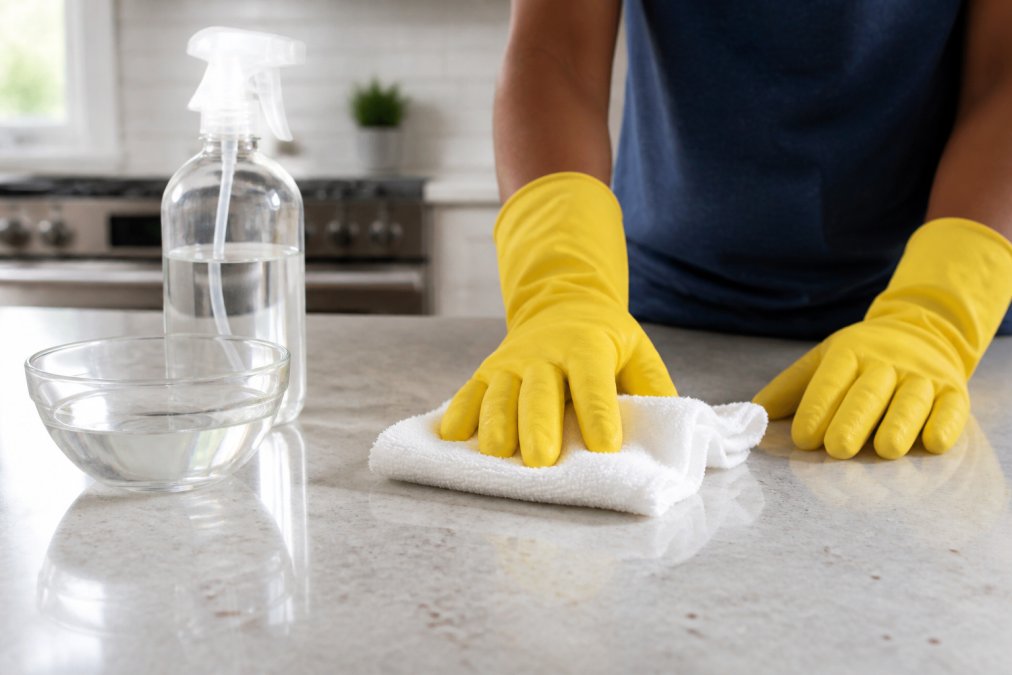
- Clear the counter and locate the trail. Watch for five minutes. Ants follow a consistent line, usually along a backsplash edge, appliance base, or caulk seam.
- Degrease first. A drop of dish soap in warm water removes food residue that shields the pheromone deposit from the vinegar.
- Mix your solution. Combine equal parts white vinegar and water in a spray bottle.
- Spray the full trail plus 15 centimeters beyond both ends. Ants mark past the visible line, so clean wider than you think you need.
- Let it sit for two minutes. Contact time is what breaks the chemical signal down.
- Wipe with a clean cloth, then repeat the spray and air dry. Do not rinse.
- Scrub grout and seams with the brush, then wipe once more.
- Dispose of the cloth in an outside bin, not the kitchen trash.
Surface Compatibility Guide: What to Use Where
Vinegar is safe on most sealed countertops but damaging on natural stone. Marble, travertine, and unsealed limestone etch permanently from acid, and no amount of rinsing reverses it (nps.gov).
For those surfaces, use a food-grade soap and water wipe followed by a 1:4 vinegar mist, or switch to the essential oil approach below. On butcher block, keep the mix weak and re-oil after cleaning so the wood does not dry and crack.
Do not spray undiluted vinegar on marble, travertine, or unsealed stone. The acid dulls the finish within seconds, and the damage is permanent. Use a soap-and-water wipe on those surfaces instead.
How to Find Ant Entry Points in Kitchen
Finding the entry point means tracing the trail backward until it disappears into a gap, crack, or seam. Ants rarely enter through an open door. They squeeze through the smallest openings.
Start where the trail is thickest, since forager traffic concentrates near the nest entrance. Then work outward:
Natural Ant Deterrents for Kitchen Counters
A few practical rules that most guides skip:
Essential oils degrade quickly in sunlight and heat. Store the spray bottle in a cabinet, not on a sunny windowsill, and mix small batches you will use within a week.
Essential Oils That Disrupt Ant Navigation
| Oil | Active Volatiles | Typical Dilution | Reapply Every | Notes |
|---|---|---|---|---|
| Peppermint | Menthol, menthone | 10-15 drops per cup water | 3 days | Strongest and longest-lasting of the common options |
| Tea tree | Terpinen-4-ol | 10-15 drops per cup water | 2-3 days | Adds mild antimicrobial action |
| Citrus (orange, lemon) | Limonene | 15-20 drops per cup water | 1-2 days | Fades fast; good for quick touch-ups |
| Cinnamon | Cinnamaldehyde | 10 drops per cup water | 1-2 days | Strong scent; can stain light grout |
| Clove | Eugenol | 8-10 drops per cup water | 1-2 days | Very strong; use sparingly near food |
How to Stop Ants From Coming Back
Post-Cleaning Maintenance Schedule
| Frequency | Task | Why It Matters |
|---|---|---|
| Daily | Wipe counters, sink rim, and appliance bases with the vinegar mix | Breaks new scent markers before they compound |
| Every 2-3 days | Reapply essential oil deterrent along entry points | Oils fade and lose potency; peppermint lasts longest |
| Weekly | Scrub grout, caulk seams, and the gap behind the stove | Removes residue buildup that shields pheromones from cleaners |
| Weekly | Check under-sink pipes and cabinet backs for moisture | Water sources rebuild trails faster than food |
| Monthly | Inspect and reseal entry points with silicone caulk | Closes new gaps before ants find them |
| Seasonally | Pull the refrigerator and dishwasher and clean behind them | Eliminates hidden trails and satellite nests |
| After any sighting | Re-clean the full trail plus 6 inches beyond both ends | Ants mark past the visible line |
Cleaning removes the trail. Maintenance prevents the next one. If you clean thoroughly, seal entry points, and still see a steady trail within 72 hours, the source is likely inside a wall or in a neighboring unit, and a licensed inspection is the faster path.
Frequently Asked Questions
What actually destroys ant pheromones on kitchen surfaces?
White vinegar and dish soap break down the pheromone trail ants leave behind. Vinegar’s acidity neutralizes the chemical signal, while soap lifts the residue so it can be wiped away. Mix equal parts white vinegar and water in a spray bottle, saturate the trail, let it sit for a minute, then wipe with a clean cloth. For greasy areas, add a few drops of dish soap to the solution. Repeat the wipe-down twice to fully remove the scent markers.
How do I know if I have successfully removed ant pheromones?
Watch the trail for 24 to 48 hours after cleaning. If ants stop following the same path and no new foragers appear at that spot, the pheromone trail is likely gone. If ants return within a day, the chemical signal survived your cleaning. Re-clean with a stronger vinegar dilution, check for nearby food residue, and inspect the area for entry points you may have missed. A second pass usually finishes the job.
Are natural ant deterrents for kitchen counters safe around food prep areas?
Yes, if you stick to food-grade ingredients and rinse thoroughly. White vinegar, lemon juice, and diluted peppermint or tea tree oil are safe on most sealed countertops. Spray the area, let it sit briefly, then wipe with a damp cloth and dry. Avoid applying essential oils directly where you chop or plate food. Always test a small hidden spot first on porous surfaces like unsealed granite or butcher block to check for staining.
How often should I clean surfaces to prevent ants from coming back?
Wipe down countertops daily and clean floors near baseboards and appliance edges every two to three days. Once you have removed an active trail, repeat the vinegar wipe-down every other day for two weeks. After that, a weekly deep clean of the kitchen, including behind appliances and under the sink, keeps pheromone trails from re-forming. Seal cracks and gaps as you find them to cut off the routes ants use most.
Ant trails will keep reappearing as long as the source colony stays active, and cleaning alone cannot reach a nest hidden inside a wall. If you have wiped the same counter five times and the ants are back by morning, the problem is bigger than the surface. Zoifia Pest Control offers licensed and insured technicians, fast response, and a 90-day guarantee with no contract necessary, so you can get the colony treated and the trail gone for good. Get a quote and put the same corner behind you.
