Table of Contents
- Start With the Big Three: Ants You’ll Actually See in a Kitchen
- The 5-Second Test: Ant or Termite?
- Use Your Nose and Your Phone: Two ID Tricks Nobody Mentions
- Signs of an Ant Infestation You Might Be Missing
- How to Get Rid of Kitchen Ants Before They Spread
- When to Call Professional Pest Control
- Frequently Asked Questions
Last Updated: September 16, 2026
Start With the Big Three: Ants You’ll Actually See in a Kitchen
Knowing how to identify common kitchen ant species starts with narrowing the field. Most kitchen infestations come down to three suspects: carpenter ants, odorous house ants, and pharaoh ants. This guide from Zoifia Pest Control covers how each one looks, where it nests, and what its presence signals.
Here’s the good news: you don’t need a microscope. You need a flashlight, five minutes, and an understanding of three body features. Learn these three terms once and you can identify almost any kitchen ant you’ll ever see:
- Petiole (the waist): the narrow segment between the thorax and abdomen. Count the bumps, called nodes. One node or two is the single most useful split in ant identification.
- Thorax profile: viewed from the side, the top of the middle body section is either evenly rounded or uneven, with a dip or notch.
- Antennae: all kitchen ants have elbowed antennae, but the number of segments and the club shape at the tip separate species.
With those three features in hand, here is how the big three compare.
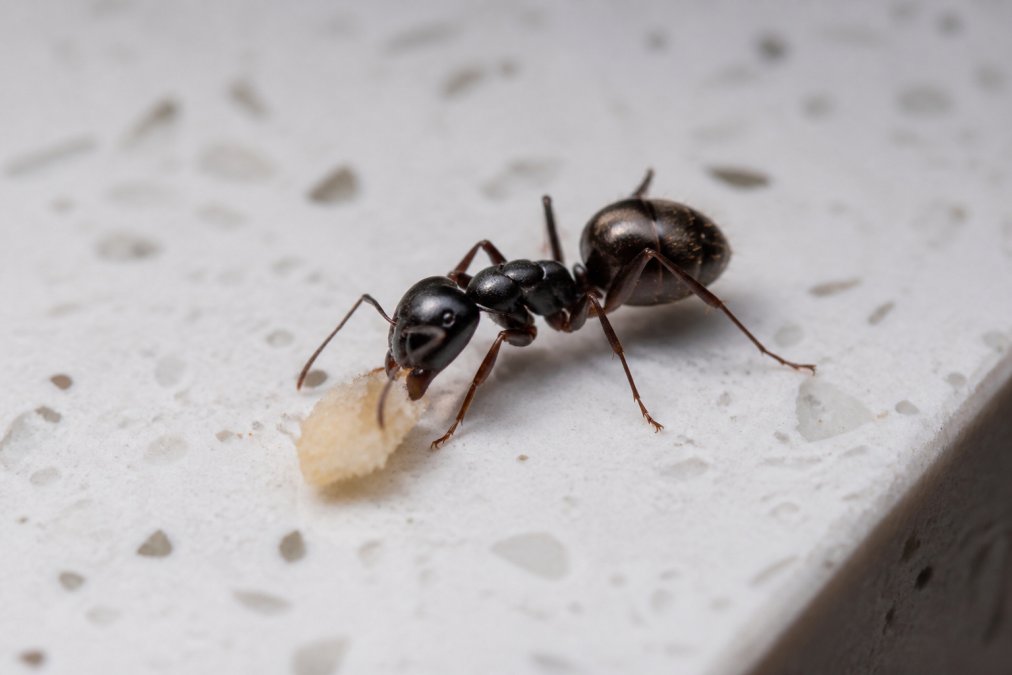
Carpenter ants are the largest of the three, typically 6 to 12 millimeters long (roughly a quarter to a half inch). Key features: a single node at the constricted waist, an evenly rounded thorax when viewed from the side, and a ring of fine hairs at the tip of the abdomen. Color varies by species, some are solid black, others are black with reddish-brown midsections. They nest in damp or damaged wood, so sightings near window frames, baseboards, or roof eaves often point to a moisture problem. A common mistake is assuming any large black ant is a carpenter ant; size alone won’t tell you, and some field ants and pavement ants reach similar lengths.
Odorous house ants run smaller, around 2.5 to 3 millimeters (about an eighth of an inch), dark brown to black, with a single flattened node that is hidden under the abdomen and hard to see without a side view. Crush one and you’ll smell rotten coconut. They build shallow nests in wall voids, under floors, and inside insulation, and they follow pheromone trails in long, busy lines. A tell that separates them from similar-looking Argentine ants: odorous house ants run with an irregular, stop-and-go gait, while Argentine ants move in fast, uniform streams.
Pharaoh ants are the trickiest. At roughly 1.5 to 2 millimeters, they’re pale yellow to reddish, with a two-segmented waist and a 12-segmented antenna that ends in a three-segmented club. Spraying them is a mistake: it scatters the colony into multiple satellite nests and makes the infestation worse. Pharaoh ants also prefer warm, humid spots near kitchens and bathrooms, so sightings near a dishwasher, coffee maker, or sink cabinet are a strong clue.
Never spray a trail of pharaoh ants with a store-bought insecticide. It triggers budding, where workers split off and form new colonies elsewhere in the building, turning one infestation into several.
If you only remember one rule: count the nodes at the waist. One node points to carpenter or odorous house ants; two nodes points to pharaoh ants and most other small kitchen species.
The 5-Second Test: Ant or Termite?
The fastest way to tell an ant from a termite is the waist and the antennae. Ants have a pinched, constricted waist and elbowed antennae; termites have a broad, straight waist and straight, bead-like antennae.
Run this quick check:
- Look at the waist. Pinched means ant. Broad and thick means termite.
- Check the antennae. Bent at an angle means ant. Straight means termite.
- Compare wing lengths. Ants have front wings longer than back wings (Are These Termites or Ants?). Termites have four wings of equal length.
- Watch the body. Ants have a hard exoskeleton and visible segmented body; termites are soft and pale.
That distinction matters because the treatment is completely different.
Use Your Nose and Your Phone: Two ID Tricks Nobody Mentions
Your nose and your camera can identify ants faster than most field guides. The crushed odor trick and macro photography are the two methods most guides skip, and both work without any equipment beyond what’s already in your pocket.
Photograph the ant from directly above and from the side. The side view shows the petiole nodes; the top view shows the head shape and mandibles. Two angles solve most identification puzzles.
Signs of an Ant Infestation You Might Be Missing
The clearest signs of an ant infestation are foraging trails, small piles of debris, and workers appearing in consistent locations. Most homeowners notice the ants before they notice the evidence around them. But two signals that almost no identification guide covers can narrow the species faster than a visual inspection: when the ants show up, and what happens if one bites or stings you.
-
Late winter to early spring: Pharaoh ants are the standout indoor species because they do not have a true outdoor season, colonies stay active year-round in heated buildings, so a January sighting in a kitchen almost always points to pharaoh ants or another indoor-nesting species.
-
Spring through early summer: Carpenter ants become visible as overwintering colonies wake up and workers forage farther from the nest. Winged swarmers emerging indoors in spring are a strong carpenter ant signal.
-
Summer: Odorous house ants peak. Their outdoor nests dry out or flood, and workers move indoors looking for consistent moisture and food. Long, busy trails along countertops in July and August are classic odorous house ant behavior.
-
Fall: Activity often shifts as colonies prepare to overwinter. Trails may move deeper into wall voids, and sightings near baseboards and outlets increase.
-
Carpenter ants can bite and will spray formic acid into the wound, producing a sharp pinch followed by a small red mark and brief stinging. They rarely sting.
-
Odorous house ants almost never bite. If you feel a pinch, you are probably not looking at an odorous house ant.
-
Pharaoh ants do not sting, but they are a known mechanical vector in healthcare settings and can bite when crushed against skin.
-
Fire ants, which occasionally trail indoors from outdoor mounds, deliver a sting that forms a white pustule within a day, a reaction pattern that no other common kitchen ant produces.
Standard visual signs to confirm:
- Foraging trails: A steady line of workers along a counter edge, baseboard, or pipe. Trails follow pheromone deposits, so they repeat.
- Nesting sites: Small openings in caulk, behind outlets, under sinks, or in wall voids. Fine sawdust near wood points to carpenter ants.
- Moisture sources: Damp wood, leaking pipes, or condensation under appliances. Ants need water, and moisture problems attract them.
- Winged swarmers: Discarded wings near windows or doors usually mean a colony is nearby.
Keep a dated note on your phone each time you see ants. Two weeks of timestamps plus the room they appeared in will often identify the species before you ever catch one under a glass.
How to Get Rid of Kitchen Ants Before They Spread
Getting rid of kitchen ants comes down to three moves: remove the food and water source, seal the entry points, and treat the colony rather than just the visible workers.
Start here:
- Clean the trail. Wipe down counters, floors, and cabinet interiors with soapy water to erase pheromone trails.
- Cut off access. Store food in sealed containers, fix dripping faucets, and empty pet bowls overnight.
- Seal entry points. Caulk cracks along baseboards, around pipes, and where walls meet counters.
- Use bait, not spray. For most species, gel or liquid bait lets workers carry the treatment back to the colony. Sprays kill the workers you see and leave the nest intact.
- Recheck in a week. If activity continues, the colony is larger than it appeared.
When to Call Professional Pest Control
Call professional pest control when baits fail after two weeks, when you find winged swarmers indoors, or when the species is pharaoh ants. Those cases need targeted treatment, not retail products.
Frequently Asked Questions
What kind of ants do I have in my kitchen?
Most kitchen ants fall into three groups: carpenter ants (large, black or reddish, 6-12 mm), odorous house ants (small, brown-black, 2-3 mm, smell like rotten coconut when crushed), and pharaoh ants (tiny, 1.5-2 mm, light yellow-brown). Look at body size, color, waist shape, and whether the antennae have a distinct bend. A single worker ant on the counter tells you little; watch the trail to find where they enter.
How do I tell what type of ants I have without a magnifying glass?
You can narrow it down with three observations. First, size: if they’re longer than a grain of rice, suspect carpenter ants. Second, waist: a pinched, narrow waist points to most household species, while a smooth, unbroken profile suggests a termite instead. Third, smell: crush one odorous house ant and sniff. A rotten coconut or blue cheese odor is a strong confirmation. Take a clear phone photo against a white background for a second opinion.
Can I identify an ant species using a picture?
A clear macro photo helps, but only if it shows the key body parts: the head, the antennae, the thorax, the petiole (waist), and the abdomen. Phone photos taken from directly above in bright light usually capture enough detail for common kitchen species. Blurry or distant shots rarely work. Place a coin next to the ant for scale, and photograph several individuals since workers within one colony can vary in size.
How do I get rid of ants in my kitchen permanently?
Permanent removal means killing the colony, not just the foragers you see. Wipe down pheromone trails with soapy water, seal cracks along baseboards and under sinks, fix moisture sources like dripping pipes, and store food in sealed containers. Baits work better than sprays because foragers carry the bait back to the nest. If ants keep returning after two weeks of baiting, or you spot winged swarmers indoors, call a licensed pest control company.
Ants in a kitchen rarely solve themselves, and the species you’re dealing with decides whether a simple bait station works or whether you need a professional. Zoifia Pest Control identifies the species first, treats the colony, and backs the work with a 90-day guarantee, licensed and insured technicians, and no contract requirement. Get a quote and stop guessing which ant you’re looking at.