Table of Contents
- When to Hire Professional Pest Control for Ants: The Tipping Point
- Signs of an Ant Infestation in House You Should Not Ignore
- DIY Methods vs. Hiring a Pest Management Professional
- How Much Does Ant Extermination Cost in 2026?
- How Long Does Professional Ant Treatment Last?
- Seasonal Ant Activity and Why Timing Matters
- Preventing Re-Infestation: Post-Treatment Maintenance
- Conclusion
- Frequently Asked Questions
Last Updated: September 16, 2026
When to Hire Professional Pest Control for Ants: The Tipping Point
Most homeowners tolerate a few ants on the counter for weeks before acting, and that delay usually costs more than the treatment would have. Knowing when to hire professional pest control for ants comes down to three signals: you can’t find the nest, the colony keeps rebuilding after store-bought bait, or you’ve spotted damage near your foundation. This guide from Zoifia Pest Control walks through each signal so you can judge severity before you spend a dollar.
Ants are persistent by design. A single colony can send foragers along the same pheromone trails for months, and worker ants from one nest can number in the thousands. Killing the ants you see rarely touches the queen producing them.
Below, we break down identification signs, the limits of DIY baiting, cost factors, and the maintenance that keeps a treated home treated, so you can decide whether you actually need a service call.
[EPA guidance on ant control(/carpenter-ant-control/) and pesticide safety | epa.gov]
Signs of an Ant Infestation in House You Should Not Ignore
A visible trail of ants is the last sign of an infestation, not the first. Earlier signals are quieter: a faint rustling inside a wall, tiny piles of sawdust-like frass near baseboards, or a sweet, musty odor in a rarely opened cabinet. Homeowners who catch these early tend to need less invasive treatment.
Identify the Species Before You Decide How Urgent It Is
Before calling anyone, figure out which ant you’re looking at. The species determines whether you have a nuisance problem or a structural one, and the two carry very different timelines.
Carpenter ants are the ones that matter structurally. Workers commonly run a quarter-inch to a half-inch long and are usually black, though some are red and black. They don’t eat wood like termites; they excavate it to build galleries, preferring wood that’s already damp or softened. The tell is what they leave behind: coarse sawdust-like frass mixed with insect body parts, pushed out of a small slit in the wall or floor. You may also hear a dry rustling inside a wall at night. Winged ants emerging indoors in spring signal a swarm, usually an established colony already inside the structure.
Sugar ants, the small, fast, dark or reddish-brown ants on a kitchen counter, are a nuisance, not a structural threat. They don’t damage wood, but they contaminate food, trail through cabinets, and multiply if left alone. Urgency is lower and treatment simpler.
Odorous house ants are small and dark, and they earn the name: crush one and you’ll smell a faint rotten-coconut odor. They nest in wall voids, under floors, and inside insulation, and they’re notorious for splitting into satellite colonies when disturbed, which is why spraying a trail often makes the problem worse.
Pavement ants are small, dark brown to black, nesting under slabs, sidewalks, and driveways and pushing small mounds of excavated soil up through cracks. They rarely cause structural damage, but they’re persistent and hard to reach because the nest sits under concrete.
Pharaoh ants are tiny, roughly one-sixteenth of an inch, and pale yellow to reddish. They most often require professional intervention: they nest in warm, hidden spots deep inside wall voids and cabinets, and any repellent spray scatters the colony into new nests throughout the building. In multi-family housing, this is the species that spreads between units.
A quick field test: if the ant is large, black, and you’re finding frass, treat it as urgent and get an inspection. If it’s small and you’re finding it on food, you have more time, but you still need to find the nest.
Foraging Trails and Entry Points to Check
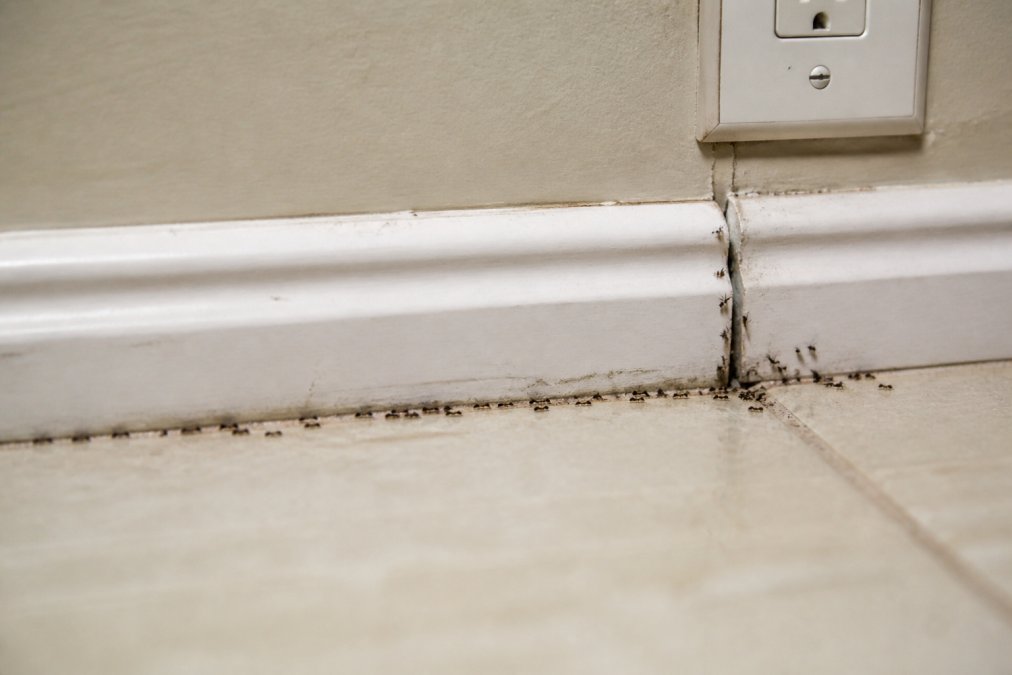
Foraging trails are the pheromone-marked routes worker ants follow between food and nest. Follow one backward instead of spraying it. The trail usually leads to a crack along a foundation sill, a gap under a door sweep, a utility penetration, or a seam in kitchen cabinetry. Those are your entry points, and sealing them matters more than killing the ants walking through them.
Check these spots first:
- Foundation sill plates and the joint where siding meets concrete
- Gaps around plumbing and electrical penetrations
- Window frames on ground-floor rooms
- Mulch beds sitting directly against the foundation
Nesting Sites in Wall Voids and Foundations
Nesting sites are where the colony actually lives, rarely where you see the ants. Wall voids, insulation cavities, and the soil along a foundation slab are common. Subterranean species nest in soil and enter through the slab edge; others nest inside wall voids and drop debris through outlet covers.
Carpenter ants complicate this: their main nest is often outdoors in a tree, stump, or woodpile, and the ants you see indoors are a satellite colony working from a damp spot inside the structure.
Species changes the decision. Large black ants with frass or spring swarming indoors = structural risk, get an inspection now. Small ants on food with no wood debris = nuisance, but still worth finding the nest before it splits.
EPA guidance on ant control and pesticide safety
DIY Methods vs. Hiring a Pest Management Professional
| Situation | DIY Approach | Professional Approach |
|---|---|---|
| Single visible trail, nest located | Sealing entry points, targeted bait | Usually unnecessary |
| Nest inside wall void | Limited; sprays miss the colony | Inspection, void treatment, baiting |
| Ants return within 2 weeks | Repeat baiting rarely resolves it | Colony-level treatment |
| Multiple rooms affected | Not practical | Full perimeter and interior plan |
| Structural moisture present | No fix | Moisture and sanitation correction |
Never spray a bait station’s surroundings. Repellent sprays kill the foragers that would carry bait back to the queen, and the colony survives. You’ll see fewer ants for a week, then the same problem returns.
How Much Does Ant Extermination Cost in 2026?
Ant extermination cost depends on the species, the size of the treated area, whether the nest is inside a wall void, and whether the visit is one-time or recurring.
What Actually Moves the Price
- Species. Carpenter and Pharaoh ants take longer to locate and treat than pavement or odorous house ants, and Pharaoh ants often need a follow-up because of colony splitting.
- Number and location of nesting sites. One accessible exterior nest is cheapest.
How to Read a Quote
- What’s the treatment method? Baiting, residual barrier, void treatment, or a combination.
- Is the inspection included, or billed separately?
- Does the price cover follow-up visits? If ants return in two weeks, is that a free callback or a new charge?
- What’s the guarantee window, and what voids it? Many plans are voided if you spray store-bought product on top of the treatment.
- Is there a contract term? Some companies require an annual agreement; others bill month to month.
One-Time vs. Recurring: Which Is Cheaper Over a Year
A one-time treatment looks cheaper on the invoice but often isn’t over twelve months, because ant pressure is seasonal, a colony knocked down in June can be replaced by August if entry points and moisture issues weren’t addressed.
Red Flags in Ant Pricing
- A flat price quoted over the phone before anyone has seen the property
- A quote that doesn’t specify whether follow-ups are included
- Pressure to sign a long-term contract on the first visit
- A price that’s dramatically below the local market, it usually means a spray-only visit that won’t reach the colony
How Long Does Professional Ant Treatment Last?
Professional ant treatment typically holds for several months when the colony is eliminated and entry points are sealed, but only weeks when just the visible foragers are treated.
Seasonal Ant Activity and Why Timing Matters
Treat the perimeter in early spring, before trails appear indoors. Barrier application on a dry foundation edge lasts longer than a mid-summer application on wet ground, and you interrupt the colony before it establishes a satellite nest inside.
Preventing Re-Infestation: Post-Treatment Maintenance
CDC guidance on household pests and health risks
Conclusion
Ant problems are self-correcting only in the sense that they get worse on their own.
Frequently Asked Questions
Is it worth getting an exterminator for ants?
It is worth calling a professional when you see multiple foraging trails, ants returning after DIY baiting, or nesting in wall voids. Store-bought baits often fail because they do not reach the colony or use the wrong bait type for the species. A pest management professional can identify the ant species, locate nesting sites, and apply targeted treatments that eliminate the queen and workers. For small, isolated sightings, DIY may suffice, but persistent or widespread activity usually justifies professional help.
How do I know if I have a severe ant infestation?
Severe infestations show constant foraging trails, ants appearing in multiple rooms, visible nesting sites in walls or foundations, and ants swarming around food sources within minutes of it being left out. You may also hear faint rustling in wall voids. If you see winged ants indoors, that indicates a mature colony ready to reproduce. These signs of ant infestation in house mean the colony is established and likely requires professional-grade pesticides and baiting to fully eliminate.
How much does ant extermination cost?
The cost of ant extermination depends on the severity of the infestation, the species, the size of the property, and the treatment method. Factors include whether the colony is inside wall voids or underground, the number of rooms affected, and whether follow-up visits are needed. Because every situation differs, most companies provide a custom quote after an inspection. Zoifia Pest Control offers transparent pricing with no hidden fees. Contact us for a quote tailored to your home.
How long does professional ant treatment last?
Professional ant treatment typically remains effective for several months, but the exact duration depends on the product used, the species, and environmental conditions. Residual treatments and barrier applications can keep ants away for 60 to 90 days or longer. However, heavy rain or disruption of the treated barrier may shorten effectiveness. Many pest control plans include follow-up visits to maintain protection. Zoifia Pest Control backs its service with a 90-day guarantee, so if ants return within that window, we re-treat at no extra cost.
