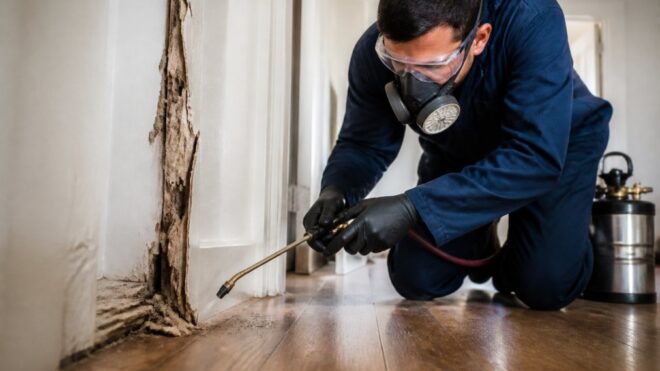
Table of Contents
- Why Termites Are So Hard to Eliminate on Your Own
- Early Signs of Termite Infestation You Should Never Ignore
- Professional Equipment vs. Store-Bought Sprays
- The Real Cost of Professional Termite Treatment Versus DIY Damage
- How Long Does Termite Treatment Last? Comparing Methods
- How to Choose a Pest Management Company You Can Trust
- Insurance, Liability, and Environmental Safety
- Conclusion: Protect Your Property with a Licensed Exterminator
- Frequently Asked Questions
Last Updated: September 7, 2026
Termites cause billions of dollars in property damage across the United States each year, yet most homeowners only notice them after the damage is done (usda.gov). When you spot the warning signs, the question of why you should hire a professional for termite control becomes urgent. The answer comes down to one simple fact: termite colonies are hidden, resilient, and nearly impossible to eliminate with retail products alone.
Why Termites Are So Hard to Eliminate on Your Own
Termite control is not a surface problem. The workers you see in mud tubes or swarming near windows represent only a tiny fraction of the colony, which can number in the millions and extend deep beneath your foundation.
The Hidden Colony Problem
Store-bought sprays kill the termites they touch, but they never reach the colony’s heart. A mature subterranean termite colony operates like a distributed network, with the queen and reproductive members protected deep in the soil. Spraying visible activity is like trimming leaves while the roots thrive underground. Professional treatments are designed around colony elimination, using targeted methods that spread through the entire colony.
Early Signs of Termite Infestation You Should Never Ignore
The warning signs of termite activity are subtle, but early detection is the single most important factor in limiting structural damage. Look for mud tubes along foundation walls, hollow-sounding wood when tapped, discarded wings near windowsills, and frass resembling sawdust or coffee grounds.
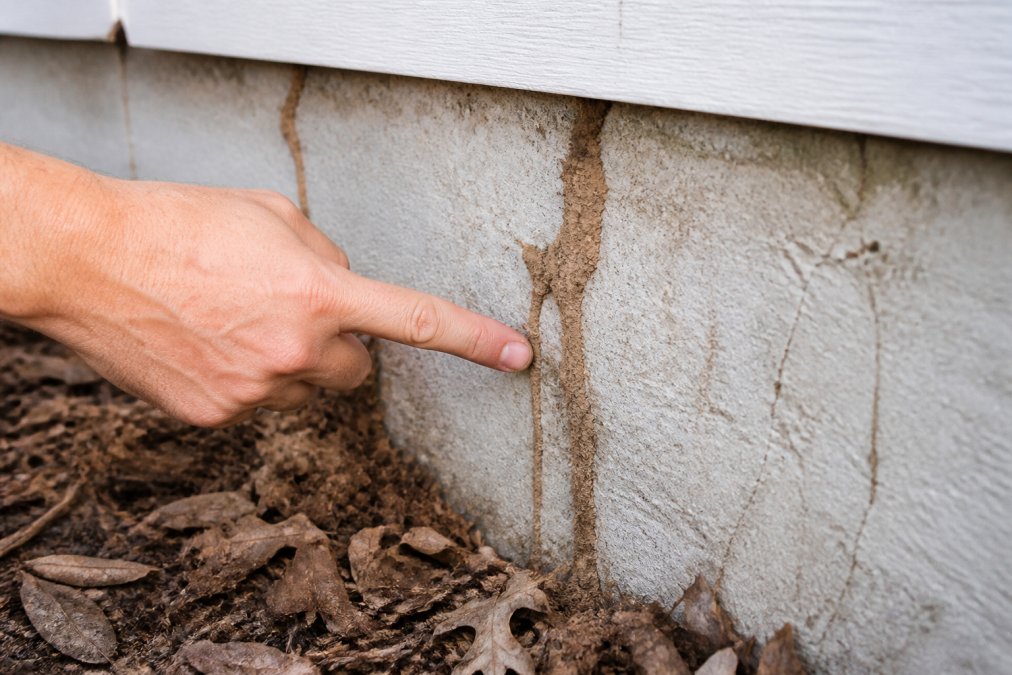
These wood-destroying insects work silently for years before visible damage appears. A common mistake is mistaking termite activity for regular carpenter ant problems or ignoring it entirely because the signs are not dramatic. If you notice buckling wood, sticking doors, or windows that suddenly resist opening, schedule a foundation inspection immediately. According to guidance from the United States Department of Agriculture on wood-destroying pests, structural damage from termites often goes undetected until it compromises load-bearing elements of a home.
Professional Equipment vs. Store-Bought Sprays
The gap between consumer products and professional tools is wider in pest control than in almost any other home maintenance category. Retail termiticide sprays contain lower concentrations of active ingredients and lack the specialized equipment needed to reach hidden nesting sites.
Professional applicators use liquid soil treatment barriers, baiting systems, and foam applications that require calibrated equipment and training. Termiticides must be placed at exact depths and volumes to create an effective barrier. A professional also knows which strategy works for your situation, whether targeting subterranean termites with soil barriers or addressing drywood species with localized treatments.
Using consumer sprays without understanding termite biology often scatters the colony. When disturbed, termites will simply relocate and establish satellite nests, making the infestation harder and costlier to treat later.
The Real Cost of Professional Termite Treatment Versus DIY Damage
Most homeowners compare the upfront price of a professional treatment against a $30 can of foam spray and conclude they are saving money. That comparison ignores the most expensive variable: the cost of structural damage that DIY methods fail to prevent.
The True Cost of a Failed DIY Attempt
A typical DIY approach involves sprays, foams, and dusts costing $25 to $80 per application, repeated two or three times a year as new activity appears, $150 to $500 annually on products that only kill surface workers. After two years, you have spent $300 to $1,000, and the colony remains active underground.
The real financial hit comes when damage reaches structural elements. Replacing a single floor joist costs $200 to $500 for materials alone. Repairing a load-bearing beam or foundation sill plate can run $1,500 to $5,000. In advanced cases, engineering assessments and structural repairs can exceed $10,000. Because standard homeowners insurance policies explicitly exclude termite damage, every dollar comes out of your pocket.
What Professional Treatment Actually Costs
Professional termite treatment typically ranges from $1,200 to $3,500 for a liquid soil barrier on an average single-family home, depending on square footage, foundation type, and infestation severity. Baiting system installations run $1,500 to $2,500 initially, with annual monitoring fees of $200 to $400. These figures come with a critical difference: a warranty.
A professional contract includes a renewable warranty covering re-treatment if termites return within the warranty period, usually one to five years depending on the company and state regulations. Some warranties also include limited damage repair coverage, meaning the company assumes financial responsibility if their treatment fails and termites cause new structural damage.
The 10-Year Cost Comparison
| Approach | Year 1 Cost | Years 2-5 (Recurring) | Years 6-10 | Total 10-Year Cost | What You Get |
|---|---|---|---|---|---|
| DIY Sprays & Foams | $150-$300 | $300-$500/year | $300-$500/year | $2,850-$5,300 | Surface kills only; colony survives; potential $1,500-$10,000+ in repairs |
| DIY Bait Stations | $200-$400 | $150-$300/year for replacement baits | $150-$300/year | $1,700-$3,400 | Limited placement; misses satellite colonies; no warranty |
| Professional Liquid Barrier | $1,200-$3,500 | $0 (warranty covers re-treatment) | $0-$300 (optional annual inspection) | $1,200-$4,400 | Colony elimination; 5-10 year barrier; warranty with re-treatment coverage |
| Professional Baiting System | $1,500-$2,500 | $200-$400/year monitoring | $200-$400/year monitoring | $3,300-$6,500 | Colony elimination; continuous monitoring; warranty with re-treatment coverage |
The Hidden Cost of Delay
Every month you delay professional treatment while attempting DIY methods gives the colony time to expand. A mature subterranean colony can contain 1 to 5 million termites and consume about one linear foot of wood every six months (extension.org). Catching an infestation early versus discovering it after three years of DIY attempts is often the difference between a $500 repair and a $10,000 structural project.
When you compare the total 10-year cost of DIY attempts against a professional treatment with a warranty, professional service is often the cheaper option, even before factoring in the avoided risk of uncovered structural damage.
How Long Does Termite Treatment Last? Comparing Methods
The durability of a termite treatment depends entirely on the method used, which is why how long does termite treatment last is a question professionals answer differently for every home. Liquid soil treatments create a chemical barrier that typically remains effective for five to ten years when applied correctly. Baiting systems require ongoing monitoring but offer continuous protection as long as stations are maintained.
Professional treatments are designed as long-term solutions, not one-time fixes. The most effective programs combine initial colony elimination with preventative maintenance, including annual inspections to catch new activity before it becomes structural damage. When you hire a professional, you are paying for a system that includes monitoring and re-treatment if activity returns, which is why you should hire a professional for termite control rather than relying on a single hardware store application.
How to Choose a Pest Management Company You Can Trust
Selecting the right exterminator matters as much as deciding to hire one. The termite control industry includes both highly qualified firms and operators who lack proper training, so knowing how to choose a pest management company protects you from wasting money on ineffective treatments, or worse, on treatments that scatter the colony.
Start with Species Identification
Before you call any company, understand that termite treatment is not one-size-fits-all. The species active on your property determines the treatment strategy, and a company lacking regional species experience may recommend the wrong approach.
- Subterranean termites (including the Eastern subterranean species common across most of the continental United States) build mud tubes and nest in soil. They require soil barriers or baiting systems placed at specific depths around the foundation perimeter. Treatment failures often occur when applicators place liquid termiticide at the wrong depth or miss the critical soil-to-foundation interface.
- Formosan termites are an aggressive subterranean species concentrated in the Southeast, Gulf Coast, and Hawaii. They build larger colonies, up to several million individuals, and can infest structures above ground without soil contact. They require more aggressive treatment protocols and ongoing monitoring. A company that only handles native subterranean species may underestimate a Formosan infestation.
- Drywood termites nest inside the wood itself and do not require soil contact. They are common in coastal states from the Carolinas through California. Treatment typically involves localized wood injection, fumigation, or heat treatment, entirely different methods than soil barriers. A company that recommends a soil barrier for a drywood infestation is showing a lack of basic species knowledge.
Verify State Certification and Insurance
Every state regulates pesticide application, and termiticide application requires a certified applicator license. Ask for the company’s state-issued license number and verify it through your state’s department of agriculture or structural pest control board, most of which maintain online lookup tools to confirm the license is active and check for disciplinary actions.
Insurance verification is equally critical. Ask for a certificate of insurance naming the company and showing both general liability and workers’ compensation coverage. General liability protects you if the treatment damages your property; workers’ compensation protects you if a technician is injured on your property. A company that hesitates to provide proof is a red flag.
The Inspection Should Come Before the Quote
A reputable company will never give a firm price over the phone without inspecting your property. Pricing depends on square footage, foundation type, construction style, and infestation extent. A proper inspection takes 45 to 90 minutes and includes:
- Crawling the crawlspace or accessing the basement to inspect joists, sill plates, and foundation walls
- Walking the exterior perimeter to check for mud tubes and soil-to-wood contact points
- Probing wood with a screwdriver or moisture meter to detect hidden damage
- Checking attics and rooflines for drywood termite activity
- Documenting findings with photographs and a written report
Questions That Separate Professionals from Amateurs
Beyond the basics of licensing and insurance, ask these specific questions during your consultation:
- What species of termite is active on my property, and how did you confirm that identification? A professional should point to specific evidence, mud tube structure, swarmer characteristics, or frass appearance, rather than giving a generic answer.
- What treatment method are you recommending, and why is it appropriate for this species and my home’s construction? The answer should reference your foundation type, the species, and the extent of activity.
- Do you use liquid soil treatments, baiting systems, or a combination? Each has trade-offs. Liquid barriers offer immediate protection but require precise application. Baiting systems take longer to eliminate the colony but offer ongoing monitoring. A company that only offers one method may be pushing a product rather than solving your problem.
- What is your warranty, in writing, and what does it cover? Ask whether re-treatment is covered, whether the warranty is renewable annually, and whether it includes any damage repair coverage. Get the warranty terms in writing before you sign.
- Will you provide a written inspection report with photographs? A company that documents their findings in writing is more likely to stand behind their work than one who only gives verbal assurances.
Red Flags to Walk Away From
- A company that pressures you to sign immediately with a “today-only” discount
- A quote based solely on square footage without an inspection
- A technician who cannot explain the difference between subterranean and drywood termites
- A company that recommends fumigation without first confirming drywood termite activity
- A refusal to provide proof of state licensing or insurance
Your state’s pesticide regulatory agency maintains disciplinary records for licensed applicators. A quick online lookup can reveal whether a company has a history of violations, failed inspections, or consumer complaints before you commit to a treatment contract.
The right professional treats the species on your property, documents their findings, holds current state certification and insurance, and puts their warranty in writing. Anything less is a gamble with your home’s structural integrity.
Insurance, Liability, and Environmental Safety
Professional termite control involves regulatory compliance that DIY homeowners rarely consider. Termiticides are regulated substances requiring certification because improper handling poses risks to humans, pets, and groundwater. Licensed professionals follow strict protocols for chemical safety, including proper dilution, application rates, and notification requirements.
There is also a liability dimension favoring professional service. If a DIY treatment contaminates soil or groundwater, the homeowner bears responsibility for remediation. Professional companies carry insurance protecting both their technicians and your property. Many professionals also emphasize integrated pest management, combining targeted chemical application with moisture control and habitat modification to reduce environmental impact compared to broadcast spraying.
Conclusion: Protect Your Property with a Licensed Exterminator
Termites are the rare pest where the cost of failure is measured in structural damage, not just annoyance. The evidence is clear: professional treatment delivers colony elimination, long-term prevention, and warranty protection that DIY methods cannot match. When you need a termite control partner you can trust, Zoifia Pest Control provides licensed and insured service with a 90-day guarantee, ensuring your property remains pest-free without the need for long-term contracts. Get a quote today and protect the value of your home.
Frequently Asked Questions
Can you ever fully get rid of termites?
Yes, a licensed exterminator can eliminate the active colony, but complete termite control requires ongoing monitoring. Termites are always present in the soil around most homes. Professional treatments create a protective barrier, and annual inspections catch new activity before it becomes structural damage. Without a maintenance plan, a new colony can move in within a few years.
Why are termites so difficult to eliminate without professional equipment?
Store-bought sprays only kill the termites they touch, which might be less than 1% of the colony. The rest stay hidden deep in the soil or inside wood. Professionals use specialized tools to inject termiticide into the soil around your foundation and install baiting systems that the entire colony carries back to the nest, including the queen.
How much is a professional termite inspection?
Inspection fees vary by company, property size, and region. Many pest management companies offer free or reduced-cost inspections as part of a treatment quote. The cost of professional termite treatment itself depends on the size of your home, the severity of the infestation, and the method used. Contact a licensed local exterminator for a specific quote.
How do I know if I need professional treatment or just a DIY spray?
If you see mud tubes on your foundation, wings near windowsills, or hollow-sounding wood, you have an active infestation that requires professional treatment. DIY sprays cannot reach the colony. Termites cause billions in structural damage each year, and most homeowner insurance policies do not cover termite damage, making professional intervention the safer financial choice.
