Table of Contents
- Why Ants Target Your Kitchen and Pantry
- Best Airtight Containers for Pantry Storage
- How to Keep Ants Out of Pet Food
- Step-by-Step: Cleaning Food Residue and Spills
- Waste Disposal and Trash Bin Maintenance
- Post-Infestation Storage Protocols and Prevention
- When to Call Zoifia Pest Control
- Frequently Asked Questions
Last Updated: September 12, 2026
Why Ants Target Your Kitchen and Pantry
Ants invade kitchens because food, moisture, and warmth sit in one convenient place, which is why good storage habits are the first step to prevent ant infestations. A single unsealed cereal box or sticky honey jar gives a colony everything it needs to establish a route inside and keep coming back.
Most homeowners treat the symptom, the visible trail, instead of the cause: accessible food and a scent trail that keeps recruiting workers. Learning how to store food to prevent ant infestations starts with understanding what draws them in. Most pest control professionals see the same pattern in homes again and again, and it traces back to storage habits rather than the ants themselves.
Scent Trails and Foraging Behavior
Ants navigate by laying pheromone trails that other workers follow to the same food (peer-reviewed research). One scout finds a crumb trail along your baseboards, and within hours the colony knows the route. That’s why killing the ants you see rarely solves the problem: the trail stays active until you remove the food and clean the chemical markers.
Break the trail and remove the source at the same time, or the colony simply reroutes and returns.
Common Entry Points in Metro Boston Homes
Older housing stock in Somerville and the surrounding area gives ants plenty of ways in. Common entry points include:
- Gaps around window frames and door thresholds
- Cracks in foundation walls and mortar joints
- Utility penetrations for plumbing and wiring
- Vents, weep holes, and gaps under siding
Sealing these entry points matters, but it works best alongside proper food storage, exclusion without storage discipline just pushes ants toward the next crumb.
Best Airtight Containers for Pantry Storage
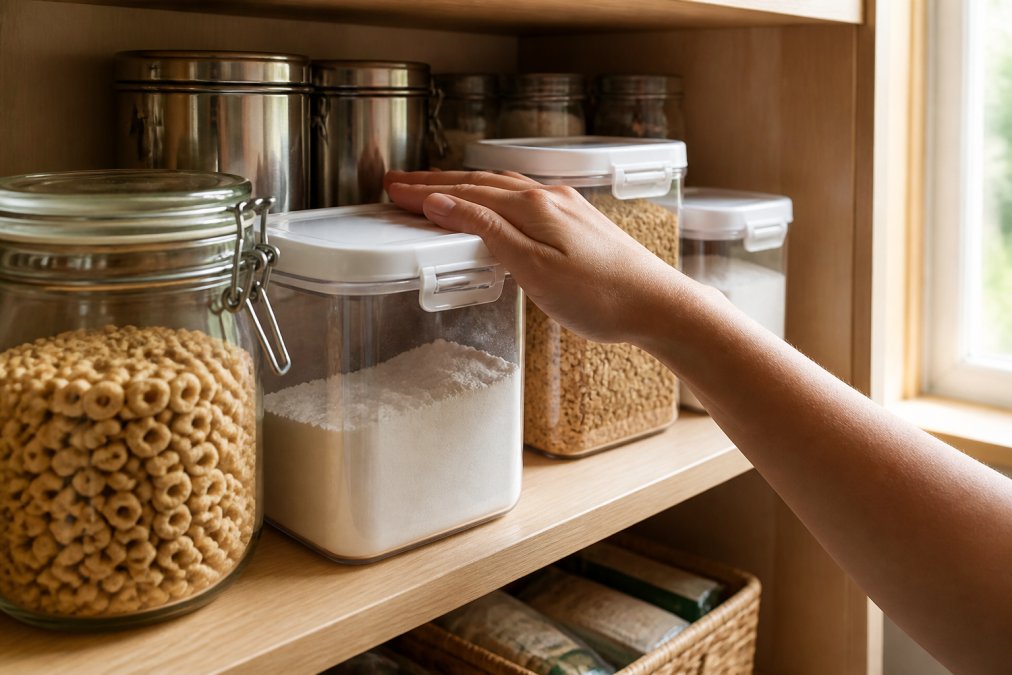
The best airtight containers for pantry storage are glass canisters with gasketed lids, food-grade plastic containers with locking seals, or metal tins with tight friction lids. All three block the scent plume ants follow and keep moisture out. What matters is the seal, not the brand: a container that snaps shut but lets scent escape does nothing.
Glass vs. Plastic vs. Metal: Material Effectiveness Against Ants
Most guides stop at ‘use airtight containers,’ but the material matters: ants don’t just smell food, they chew. A worker’s mandibles can work at thin plastic film, cardboard, and paper bags, but fail against hard, smooth surfaces with no seam to grip (extension.psu.edu).
- Glass is the strongest choice: non-porous, doesn’t hold odors, resists scratching, and gives mandibles nothing to bite. It’s also easiest to inspect. The trade-off is weight and breakage risk on high shelves.
- Food-grade plastic costs less and won’t shatter, making it practical for bulk items and households with kids. The weakness is scratchability: a scuffed interior holds odor, and a warped lid loses its seal. Look for thick-walled containers with a rubber or silicone gasket and a four-sided locking lid, not thin deli-style tubs.
- Metal (stainless steel or tin) is underrated: ants can’t chew through it, it’s opaque so light-sensitive goods keep longer, and it doesn’t retain odors. The catch is that metal dents and lids bend out of true, so check the seal periodically. Avoid painted or coated tins that chip.
A common pattern in kitchens that keep getting ants: the food is in ‘airtight’ containers, but they’re thin plastic with a single snap tab and a visible gap at the corner. That gap is a scent leak, and a scent leak is an invitation.
Matching the Container to the Food
Different foods attract different foragers, so match storage to the food’s scent profile:
- Sugars, honey, syrups, jams, glass with a gasketed lid. These are the highest-value targets for sugar-loving species, and sticky residue on the outside of a jar is enough to start a trail.
- Flour, cereal, grains, pasta, glass or thick plastic, ideally with a desiccant packet inside. These are starch sources and also the most moisture-sensitive.
- Pet kibble and treats, metal or thick plastic, stored away from the feeding area. Protein-rich foods draw a different set of foragers than sugar does.
- Oils, nut butters, grease-heavy items, glass, wiped clean on the outside. Grease residue on the exterior is a scent beacon even when the lid is tight.
Moisture Control and Vacuum Sealing
Moisture control is the angle most guides skip. Damp flour and clumped sugar attract ants faster than dry goods, and moisture degrades the seal on cardboard packaging (extension.umn.edu). Vacuum sealing is strongest for long-term storage since it removes the air and scent ants detect. For everyday items, a desiccant packet and a quick check for condensation go a long way. In a humid climate, or if your pantry shares a wall with a bathroom or laundry, a small rechargeable dehumidifier is a cheap upgrade most guides never mention.
Ants can follow a scent trail through a pinhole gap in a lid. Before you trust a container, fill it with water, seal it, and turn it upside down. If it leaks, it will also leak scent.
How to Keep Ants Out of Pet Food
Keeping ants out of pet food comes down to two habits: never leave bowls out between meals, and store food in a sealed container, not the bag it came in. Pet food is a concentrated protein source, one of the strongest ant magnets in any home.
Pet Bowl Placement and Cleaning Routines
Where you place bowls matters as much as how you store the food. Ants reach bowls left on the floor near baseboards, doors, or pet doors first. A few changes help:
- Feed on a raised mat away from walls and entry points
- Lift bowls after each meal instead of free-feeding
- Wipe the mat and floor daily to remove grease buildup and crumbs
- Wash bowls with hot water every day, not every few days
- Store the main food supply in a sealed container in a cabinet
A common mistake is storing a large bag of kibble in the garage or closet in its original packaging, the bag isn’t airtight and the scent travels. Move it into a sealed container the day you bring it home.
Step-by-Step: Cleaning Food Residue and Spills
Cleaning food residue and spills removes both the food and the scent trail ants rely on. Follow these steps after any spill or weekly:
- Clear the surface. Remove dishes, appliances, and anything sitting on the counter.
- Wipe up solids first. Use a damp paper towel to lift crumbs and sticky residue.
- Degrease. Wash with warm soapy water to cut through grease buildup on stovetops and counters.
- Rinse the trail area. Wipe baseboards, floor edges, and the path ants used with a vinegar-and-water solution to break the pheromone trail.
- Dry completely. Moisture left behind invites ants back, so dry every surface.
- Check hidden spots. Pull out the toaster, microwave, and canisters to clean underneath.
- Dispose of the waste. Take the bag straight to an outdoor bin, not the kitchen trash.
Consistency beats intensity here. A quick daily wipe does more than a deep clean once a month.
Waste Disposal and Trash Bin Maintenance
Waste management is where many ant problems quietly restart. A trash bin with a loose lid or a recycling bin rinsed occasionally gives ants a steady food supply inside the house. But the bigger gap most guides skip is what to do with food after an infestation is detected, the salvage-or-toss decision that determines whether you re-seed the problem.
Day-to-Day Bin Habits
Keep the bin lined and take bags out nightly. Rinse recyclables before they go in, since residue on cans and jars feeds ants. Wash the bin with soapy water every couple of weeks and check the lid seal for gaps. Outdoor bins should sit away from the house with tight-fitting lids, a bin against the foundation is an open invitation. If you compost, use a sealed countertop bin and empty it every one to two days; an open pail is a protein-and-sugar buffet.
Post-Infestation Storage Protocols: Salvage or Toss
Once you find ants in a pantry or cabinet, every item in that space needs a decision, the step most articles skip, and the one that prevents a second wave.
Toss without question:
- Any food with visible ants, live or dead, or with frass (fine debris) in the package
- Anything in a chewed-through bag, box, or wrapper, even if the food inside looks untouched
- Open packages of flour, sugar, cereal, crackers, and pet food that were stored in the infested cabinet
- Anything with a greasy or sticky exterior that ants could have walked across
Salvage with caution:
- Factory-sealed cans and jars with intact lids, wipe the exterior with warm soapy water, then dry completely before moving them to a clean area
- Unopened, undamaged sealed containers (glass, metal, or thick plastic), inspect the seal, wash the outside, and re-home them away from the infested zone
- Items stored in a different cabinet that showed no trail activity, inspect, then transfer to fresh sealed containers as a precaution
The rule of thumb: if you can’t verify the seal was never breached, treat it as contaminated. The cost of replacing a bag of flour is far lower than the cost of a recurring infestation.
Cleaning the Bin and the Zone After an Infestation
After sorting and removing food, clean the entire zone, not just the shelf where you saw ants:
- Empty the cabinet completely, including items you’re keeping.
- Vacuum cracks, corners, and shelf seams with a crevice tool to pull out crumbs and frass.
- Wipe every surface with warm soapy water, then follow with a vinegar-and-water solution to break the pheromone trail.
- Let the cabinet dry fully before reloading, moisture invites foragers back.
- Reload only sealed containers, and leave the cabinet slightly under-filled for a week or two so you can spot any returning trail.
Don’t rely on chemical-free storage alone if you’ve had a nest inside a wall or cabinet void. Sealed containers stop new foragers, but a colony already indoors keeps sending workers until the nest itself is treated. If you see ants returning to a cleaned, sealed cabinet within a few days, the nest is likely inside the structure, not in your food.
Outdoor Bins and the Perimeter
Outdoor bins should sit a few feet from the foundation, on a hard surface if possible, with tight-fitting lids. A bin against siding or on soil gives foragers a shaded highway to your wall. Rinse outdoor bins monthly and check the lid gasket for cracks, a warped lid is one of the most common re-entry points for a colony that was almost gone.
Post-Infestation Storage Protocols and Prevention
Once you’ve cleared an infestation, storage protocol keeps ants from returning. Ants leave scent trails behind, so even after the visible ants are gone, the route stays marked until you clean it.
After treatment, move every pantry item into sealed storage, even ones you think are safe. Discard any food ants reached. Wipe shelves, then check the pantry monthly for moisture and early signs of activity. Seasonal activity peaks in warmer months, so tighten your routine in spring before foragers start scouting.
Don’t rely on chemical-free storage alone if you’ve had a nest inside a wall or cabinet void. Sealed containers stop new foragers, but a colony already indoors keeps sending workers until the nest itself is treated.
When to Call Zoifia Pest Control
Some infestations need professional treatment, not just better storage. If you’ve sealed your food, cleaned thoroughly, and still see ants, the colony is likely nesting inside a wall, under flooring, or behind cabinetry where storage changes can’t reach.
That’s where Zoifia Pest Control comes in. We’re licensed and insured, we respond fast across the Metro Boston area, and we back our work with a 90-day guarantee. No long-term contract is required, so renters and landlords can get a one-time treatment without signing up for monthly service. If pests return within the guarantee window, we come back at no extra cost.
Storage changes stop ants from finding food. Professional treatment removes the colony that’s already inside. You usually need both to end an infestation for good.
Ant infestations rarely start from bad luck. They start because food, moisture, and an entry point lined up at once. Fix the storage, seal the gaps, and clean the trails, and you remove the reasons ants keep coming back. When the colony is already inside your walls, storage alone won’t finish the job.
Zoifia Pest Control handles that part. Our licensed and insured technicians target the nest directly, our 90-day guarantee covers a return visit if pests come back, and we work without long-term contracts so you stay in control. Get a quote from Zoifia Pest Control and put an end to the cycle.
Frequently Asked Questions
Are Ziploc bags ant-proof?
Standard Ziploc bags are not ant-proof. Ants can chew through thin plastic and squeeze through the small gaps where the seal folds. For true protection, transfer dry goods into hard-sided airtight containers with rubber gaskets or locking lids. If you must use bags temporarily, double-bag and store them inside a sealed container or the refrigerator. For pantry staples like sugar, flour, and cereal, hard containers are the only reliable option to prevent ant infestations.
What natural barriers won’t ants cross?
Ants avoid certain textures and scents. Diatomaceous earth creates an abrasive barrier that damages their exoskeleton. Cinnamon, peppermint oil, and vinegar disrupt scent trails. Coffee grounds and citrus peels also act as natural deterrents. However, these only work as temporary barriers. If you have a persistent infestation, sealing entry points and using airtight storage is more effective. Zoifia Pest Control can identify structural gaps and apply professional treatments for lasting results.
How do I keep ants out of pet food bowls?
Start by placing pet bowls inside a shallow moat of water or on a tray with a raised lip. Ants struggle to cross water. Clean bowls after every meal and avoid leaving food out for more than 20 minutes. Store dry pet food in a sealed, food-grade plastic or glass container, not the original bag. Wipe down the feeding area daily to remove crumbs and grease. If ants still appear, check for cracks near baseboards and call a licensed pest professional.
Does cleaning crumbs really stop ants from entering the kitchen?
Yes, crumb management is one of the most effective prevention steps. Ants send foragers to scout for food, and even a few crumbs can sustain a colony. Wipe counters after every meal, sweep floors daily, and vacuum under appliances monthly. Pay attention to grease buildup on stovetops and behind the refrigerator. Without a food source, ants lose the scent trail and move on. Combine cleaning with sealed storage and waste management for the best results.
