Table of Contents
- Why a Borax Ant Bait Recipe Works in Kitchens
- Ingredients and Supplies for Your DIY Ant Trap
- Step-by-Step Mixing Instructions
- Placement Tips for Kitchen Counters and Ant Trails
- Is Borax Toxic to Pets and Children?
- Signs of a Severe Ant Infestation
- When to Call Professional Ant Extermination Services
- Troubleshooting Common Issues with Homemade Ant Bait
- Frequently Asked Questions
Last Updated: September 13, 2026
Why a Borax Ant Bait Recipe Works in Kitchens
A borax ant bait recipe works because it exploits how ants feed each other. Workers carry the sweetened mixture back to the nest and pass it along through trophallaxis, so the colony collapses over several days rather than just the ants on your counter.
Sprays kill the ants you see; baits kill the colony you cannot.
Most kitchen infestations start with a scout: one worker finds a crumb, lays a pheromone trail, and within days ants march across your backsplash. A borax bait turns that trail against them, because ants take it willingly and share it before the poison takes effect.
The 1:3 ratio below consistently attracts worker ants without repelling them. Get it wrong and ants walk right past your bait.
Ingredients and Supplies for Your DIY Ant Trap
You need three core ingredients and a few household items, all reusable except the bait itself.
Core ingredients:
- 1 part borax (about 1 teaspoon)
- 3 parts granulated sugar (about 3 teaspoons)
- 3 to 4 tablespoons warm water
Supplies:
- Small bowl or mason jar lid for mixing
- Cotton balls or plastic bottle caps
- Spoon for stirring
- Index cards or small squares of cardboard (optional, for easy cleanup)
- A shallow dish or mason jar ring (for a pet-resistant station)
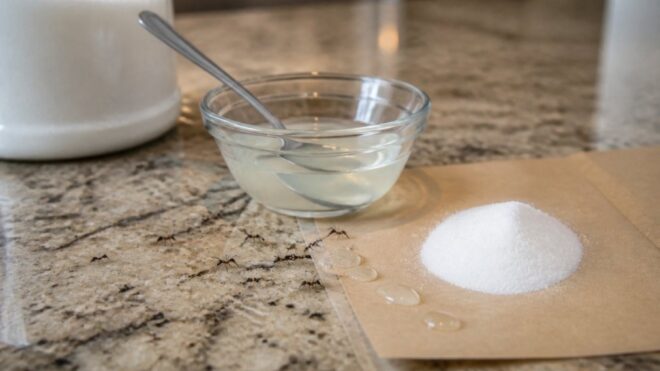
Borax (sodium tetraborate) is the active ingredient, sugar is the attractant, and warm water dissolves both into the syrupy sludge ants find irresistible.
A common mistake is buying the wrong product. Use plain borax powder, not borax-based laundry detergent with fragrances and surfactants that repel ants. Check the label for “sodium tetraborate” or “borax” as the sole active ingredient.
The 1:3 Ratio That Actually Attracts Worker Ants
The 1:3 borax-to-sugar ratio is the sweet spot for most kitchen ants. Too much borax turns the bait bitter and ants avoid it; too little kills a few workers but leaves the colony intact.
Borax is the poison; sugar is the sales pitch. If the sales pitch fails, the poison never gets delivered.
Some guides suggest stronger concentrations for faster results. Don’t. A bait that kills workers too quickly never reaches the nest, and you’ll be back to square one in a week. The delayed action is a feature, not a bug.
Choosing the Right Attractant: Sugar vs. Syrup vs. Cornmeal
Not every kitchen ant wants the same food. Match the attractant to what you actually see ants feeding on, or the colony may ignore the bait entirely.
| Attractant | Best For | Trade-offs |
|---|---|---|
| Granulated white sugar | Sweet-feeding ants (odorous house ants, Argentine ants, ghost ants) | Dissolves cleanly, easy to measure, but dries out faster in warm kitchens |
| Corn syrup or maple syrup | Sweet-feeding ants in dry climates | Stays moist longer, but can ferment within a few days and attract fruit flies |
| Cornmeal (dry, no liquid) | Protein- and grease-feeding ants (fire ants, carpenter ants, some pavement ants) | Requires a separate dry-bait approach; borax must be dusted lightly, not dissolved |
| Peanut butter + sugar | Protein-preferring ants | Harder to dose accurately; borax must be mixed very evenly to avoid hot spots |
A practical test: place a dab of sugar water and a dab of peanut butter on two index cards near the trail. Check back in 30 minutes; whichever draws more ants tells you which bait base to use.
If ants ignore a sugar bait, don’t assume the recipe failed. You may have a grease- or protein-feeding species; switching the attractant is often the fix, not adding more borax.
Why Plain Borax Beats “Improved” Formulas
Some commercial products add fragrances, dyes, or extra insecticides. For a DIY kitchen bait, plain borax is better for three reasons:
- Dosing control. You know exactly how much active ingredient is in the mix.
- No repellents. Fragrances and surfactants can mask the sugar scent ants follow.
- Predictable behavior. The 1:3 ratio has worked in household ant control for decades.
Store borax powder sealed in its original container, away from food and out of reach of children and pets. A one-pound box lasts several baiting cycles.
Step-by-Step Mixing Instructions
Total time: 5 minutes
Difficulty: Beginner
Follow these steps in order; consistency matters as much as the ratio.
-
Dissolve the borax first. Add 1 teaspoon of borax to 3 to 4 tablespoons of warm water and stir until fully dissolved, with no grit at the bottom.
-
Add the sugar. Pour in 3 teaspoons of granulated sugar and stir until dissolved. The mixture should look slightly cloudy.
-
Check the consistency. You want a syrupy sludge, not watery or pasty. Too thin, add a pinch more sugar; too thick, add a few drops of warm water.
-
Soak your delivery method. Drop cotton balls into the mixture and let them absorb for a minute. Alternatively, fill bottle caps or a mason jar lid about halfway.
-
Place the bait. Set soaked cotton balls or filled caps directly on ant trails or near entry points. Don’t block the trail; ants must find the bait on their own.
-
Leave it alone. Do not disturb the bait for at least 48 hours. You will see ants swarming it, which is exactly what you want.
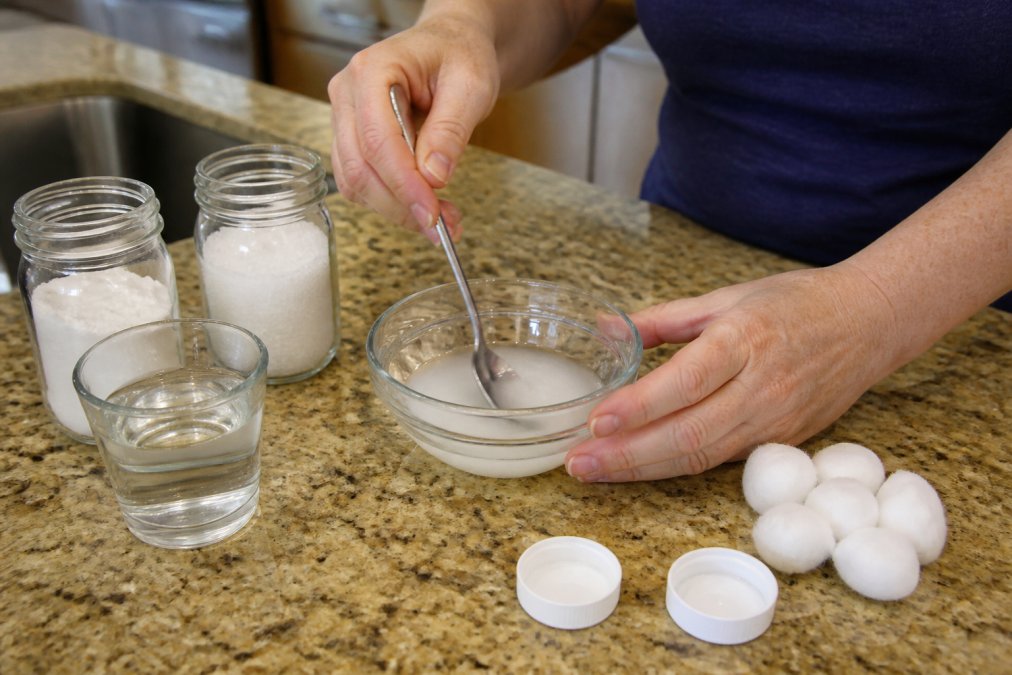
Expected result: Within 24 hours, you should see a steady stream of worker ants feeding on the bait. Activity typically peaks around day two, then drops off sharply as the colony dies.
How to Use Cotton Balls and Bottle Caps
Cotton balls and bottle caps both work but suit different situations. Cotton balls hold more liquid and stay moist longer, better for heavy trails; bottle caps are easier to clean up and work well for small, targeted placements.
With pets or small children, bottle caps inside a mason jar lid or shallow dish are safer than loose cotton balls. You can also cut a slit in a plastic container lid and place the bait inside, keeping pets out while letting ants in.
Placement Tips for Kitchen Counters and Ant Trails
Placement determines whether your bait works or sits untouched. Ants follow pheromone trails, so put bait on or within an inch of an active trail.
Good placement spots:
- Along the base of the backsplash where trails form
- Near the corner where counter meets wall
- Behind the coffee maker, toaster, or microwave
- Under the sink, near pipe entry points
- Along window sills where ants enter
Avoid placing bait on food debris or near strong-smelling cleaners; both mask the sugar scent and reduce effectiveness.
Do not spray insecticide near the bait, the most common mistake we see. Sprays kill ants before they carry the bait back and contaminate the trail with colony-repelling chemicals.
Never place bait directly on top of an ant trail you plan to spray later. If you spray first, the surviving ants avoid the area entirely and your bait sits untouched. Choose one method and commit to it.
Is Borax Toxic to Pets and Children?
Borax is toxic to pets and children if ingested in sufficient amounts (atsdr.cdc.gov). A properly contained bait station is low-risk because the borax is diluted and enclosed; an open bowl of powder on the floor is not.
According to the Agency for Toxic Substances and Disease Registry, borax can cause irritation to the skin, eyes, and respiratory tract, and ingestion of larger amounts can lead to nausea, vomiting, and more serious symptoms. The National Pesticide Information Center notes that pets are particularly susceptible because they may lick bait stations or walk through powder and groom themselves afterward.
Tamper-Proof DIY Bait Stations You Can Build Today
Most guides say “keep bait out of reach” and stop there, advice that fails the moment a cat jumps on the counter or a toddler pushes a chair to the sink. Build a station ants can enter but pets and children cannot.
The mason jar ring method:
- Place a soaked cotton ball or filled bottle cap in the center of a mason jar lid.
- Set a mason jar ring around it, open side down, so the bait sits inside a shallow well.
- Tape the ring to the counter with painter’s tape. Ants walk under the rim; paws and fingers cannot reach the bait.
The plastic container method:
- Take a small lidded plastic container (a deli cup or a cleaned yogurt cup works).
- Poke 4 to 6 holes around the sides, each about 1/8 inch wide. That is wide enough for most kitchen ants and too narrow for a cat’s paw or a child’s finger.
- Place the bait inside, snap the lid on, and set it on the trail.
The index card sandwich method:
- Put a soaked cotton ball on one index card.
- Invert a second card over it, leaving a small gap on two sides.
- Tape the edges down. Ants enter through the gaps; larger animals cannot.
Rotating placement every 48 hours reduces that risk.
Pet-Safe Placement Rules
- Never place bait on the floor where a dog or cat eats, sleeps, or plays.
- Keep bait behind appliances, inside lower cabinets with child locks, or on counters a pet cannot reach.
- Do not use loose cotton balls in homes with cats. Cats bat at them, and the cotton holds the most concentrated dose of the mixture.
- If a pet does contact the bait, wipe the area with a damp paper towel and call your veterinarian or a pet poison control line. Do not induce vomiting unless a professional tells you to.
- Store borax powder in a locked cabinet, not under the sink where a child might reach during a plumbing repair.
What to Do If Exposure Happens
If a child or pet ingests bait, remove them from the area and call Poison Control (1-800-222-1222) or your veterinarian immediately. Have the borax container on hand so you can read the label. Do not wait for symptoms to appear.
For skin contact, wash the area with soap and water for several minutes. For eye contact, rinse with lukewarm water for 15 minutes and seek medical attention if irritation persists.
Borax ant bait is effective but not risk-free. Contain it in a tamper-proof station, place it where pets and children cannot reach, and store the powder securely. If you cannot do all three, professional treatment is the better choice.
Signs of a Severe Ant Infestation
A few ants on your counter is normal in warmer months. A severe infestation looks different, and it usually means the colony is larger than bait alone can handle quickly.
Watch for these signs:
- Multiple trails in different rooms, not just the kitchen
- Ants appearing within hours of cleaning
- Visible nest sites near foundations, under siding, or in wall voids
- Winged ants (swarmers) indoors, which often indicates a mature colony
- Persistent activity that continues past two weeks of baiting
The last sign matters most. If you have been baiting consistently for two weeks and still see heavy activity, you are likely dealing with multiple colonies or a species that does not respond well to sugar-based baits.
When to Call Professional Ant Extermination Services
Professional ant extermination services make sense when DIY baiting has failed, when the infestation spans multiple units, or when you cannot safely place bait because of pets and children.
Zoifia Pest Control handles cases where homeowners have tried everything and are ready for a permanent fix. Our licensed and insured technicians identify the species, locate the nest, and treat the source rather than just the visible trail. We back our work with a 90-day guarantee, and we do not require long-term contracts. If you are a renter or a landlord who needs a one-time treatment, we can work with that.
For multi-family buildings, the calculus changes. Treating one unit while the colony lives in the walls of another rarely solves the problem. A coordinated treatment across affected units is usually the only way to eliminate the source.
If you are seeing swarmers indoors or trails in multiple rooms, calling a professional early usually costs less than months of failed DIY attempts.
Troubleshooting Common Issues with Homemade Ant Bait
Ants ignoring your bait is the most common complaint. The fix is usually the ratio or the placement.
| Problem | Likely Cause | Fix |
|---|---|---|
| Ants ignore the bait | Too much borax or wrong product | Recheck the 1:3 ratio; use plain borax |
| Bait dries out | Warm kitchen air | Add a few drops of water or replace cotton balls |
| Ants disappear then return | Colony not fully eliminated | Re-bait for 7-10 days; check for new trails |
| Bait attracts more ants | Working as intended | Leave it; activity peaks before it drops |
| Pets or kids at risk | Open placement | Switch to sealed bait stations |
A second common issue is using the wrong sugar. Granulated white sugar works best. Honey, maple syrup, and artificial sweeteners either ferment, attract the wrong insects, or fail to interest ants.
If you have tried the correct ratio, the correct placement, and two weeks of consistent baiting with no improvement, you are likely dealing with a species that prefers protein or grease over sugar. In that case, a professional inspection is the fastest way to identify what you are actually dealing with.
Frequently Asked Questions
Is borax safe to use in the kitchen around food?
Borax is not safe to ingest, so keep the bait away from food, utensils, and prep areas. Place traps in cracks, behind appliances, or along baseboards where children and pets cannot reach. Wash your hands after handling, and store the mixture in a labeled container. If you have toddlers or pets, use enclosed stations instead of open cotton balls. When in doubt, call a licensed pest control professional for a safer, targeted treatment.
How long does it take for borax ant bait to work?
Most worker ants die within 24 to 48 hours after feeding, but the colony can take 1 to 2 weeks to collapse because the poison is slow-acting. This delayed action allows ants to share the bait through trophallaxis, reaching the queen and larvae. You may see more ants at first, which is a good sign. Keep bait stations filled and undisturbed for at least two weeks. If activity continues after that, you likely have a severe infestation that needs professional help.
What is the best ratio for borax and sugar ant bait?
A ratio of 1 part borax to 3 parts granulated sugar dissolved in warm water works for most sweet-eating ants. Too much borax makes the bait bitter and ants avoid it; too little and it won’t kill the colony. Start with 1 teaspoon borax and 3 teaspoons sugar in 1 cup of warm water. Stir until dissolved. If ants ignore it, reduce borax to 1/4 teaspoon. Always test a small batch before making a large amount.
When should you call a professional for an ant infestation?
Call professional ant extermination services if you see ants after two weeks of baiting, find multiple nests, or notice structural damage. Signs of a severe ant infestation include constant trails, winged swarmers, and ants in food packaging. DIY baits often fail with certain species like carpenter ants or pharaoh ants. A licensed technician can identify the species, apply targeted treatments, and offer a 90-day guarantee. Get a quote from Zoifia Pest Control for fast, reliable service.
Ant infestations in kitchens rarely resolve on their own, and the longer a colony establishes itself, the harder it becomes to eliminate. If DIY baiting has not delivered results, Zoifia Pest Control offers licensed and insured technicians, fast response times, and a 90-day guarantee with no long-term contract required. Get a quote today and let our team handle the infestation at the source.
