Table of Contents
- Why Do I Keep Seeing Roaches Even in a Clean Home?
- Common Entry Points Cockroaches Use to Get Inside
- Signs of a Roach Infestation You Should Never Ignore
- Species Identification: Which Roach Are You Dealing With?
- Roach Prevention Tips That Actually Work
- How to Get Rid of Roaches: DIY Steps and What Works
- Why Do I Keep Seeing Roaches After Treatment? Managing the Anxiety
- When to Call a Professional Exterminator
- Conclusion
Last Updated: May 21, 2026
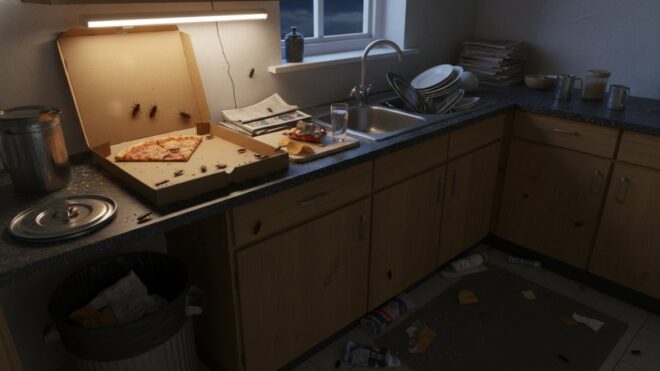
If you keep spotting cockroaches in your home despite regular cleaning, you are not alone and you are not imagining things. The question of why do I keep seeing roaches is one of the most common concerns the team at Zoifia Pest Control hears from homeowners and renters across the Metro Boston area. Here is the hard truth most guides skip: cleanliness is only one piece of the puzzle. Roaches are driven by moisture, warmth, and access, and a spotless kitchen will not stop them if your building has plumbing voids, exterior gaps, or a neighbor with an untreated infestation. Below, we cover exactly why roaches keep appearing, how to identify entry points, and what actually works to stop them for good.
A cockroach infestation is a persistent presence of one or more cockroach species in a structure, typically sustained by available food sources, moisture, and undisturbed nesting sites. Understanding this definition matters because it shifts the focus from "I saw a roach" to "I have conditions that support roaches," which is a fundamentally different problem requiring a different solution.
The most important thing to understand upfront: seeing roaches during daylight hours is a warning sign that the population has grown large enough to force foraging at unusual times. That single sighting likely means dozens more are hiding in cracks and crevices nearby.
Why Do I Keep Seeing Roaches Even in a Clean Home?
Roaches are resilient pests with survival instincts that have nothing to do with how often you mop the floor. The real drivers are moisture, warmth, and structural access, not sanitation alone. A clean home can still harbor a cockroach infestation if the underlying conditions are right.
Moisture and Water Sources Are the Real Culprit
Most people assume roaches are drawn to food scraps and dirty dishes. Moisture is actually the primary magnet. Cockroaches can survive weeks without food but only days without water. Leaking pipes under sinks, condensation around drain lines, and damp areas beneath appliances create exactly the environment these nocturnal insects need to thrive.
Common moisture sources that attract roaches include:
- Slow drips under kitchen and bathroom sinks
- Condensation on cold water pipes in basements
- Standing water in HVAC drip pans
- Wet cardboard boxes stored in basements or garages
- Clogged or slow-draining drain lines
The German cockroach, the most common species found in residential buildings, is especially dependent on moisture and tends to nest close to plumbing voids. Eliminating water sources is the single most effective sanitation step you can take before any treatment.
Fix even minor plumbing drips before applying any DIY pest control products. A roach population will rebuild around a persistent water source no matter what pesticide you use.
How Roaches Hitchhike Into Your Home
Roaches do not always walk through your front door. Hitchhiking is one of the most underappreciated entry mechanisms, and it explains why people in otherwise well-sealed apartments suddenly discover a cockroach infestation.
The most common hitchhiking routes include:
- Cardboard boxes: Egg cases (oothecae) are frequently laid in the corrugated folds of cardboard boxes, especially those from grocery stores, warehouses, or online deliveries
- Used furniture and appliances: Second-hand refrigerators, microwaves, and upholstered furniture are notorious hiding spots
- Grocery bags: Paper bags in particular can carry egg cases from infested storage facilities
- Luggage: Hotel rooms with infestations can transfer roaches to your suitcase
The fix here is behavioral, not chemical. Inspect all secondhand items before bringing them inside. Unpack grocery deliveries outside when possible and dispose of cardboard immediately. This is especially critical in apartment buildings where shared hallways and delivery areas create constant hitchhiking opportunities.
Common Entry Points Cockroaches Use to Get Inside
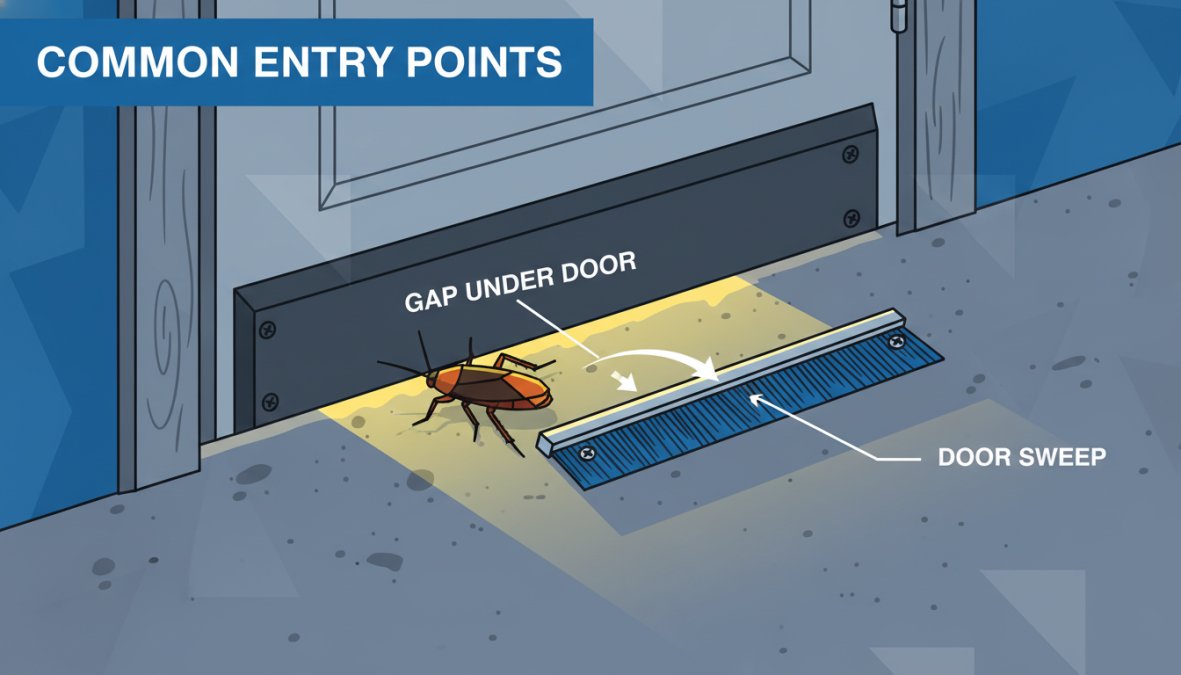
The structural gaps in most homes are far larger than people realize. A cockroach only needs a crack about 1.5mm wide to squeeze through, which means almost any gap around a pipe, door, or window frame is a viable entry point.
Cracks, Crevices, and Plumbing Voids
Plumbing voids are the highway system of cockroach movement inside buildings. The spaces where pipes enter walls are rarely sealed tightly, and in multi-unit buildings, these voids connect apartments vertically and horizontally. A roach in a ground-floor unit can travel to the third floor through these channels without ever entering a common hallway.
Key structural entry points to inspect:
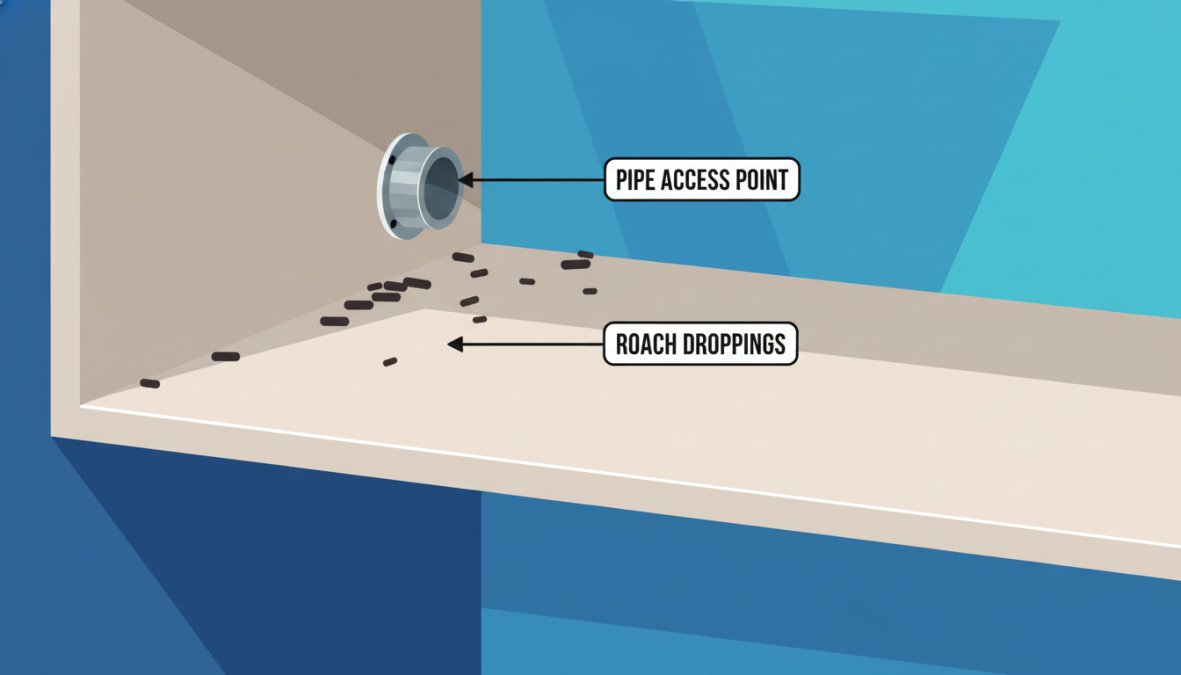
- Gaps around pipe penetrations under sinks and behind toilets
- Cracks in foundation walls and basement floors
- Spaces between countertops and walls
- Gaps around electrical outlets on exterior walls
- Unsealed areas where utility lines enter the building
Sealing these areas with caulk or expanding foam is one of the most cost-effective roach prevention tips available. It is also permanent, unlike most pesticide treatments that degrade over time.
Window AC Units, Door Sweeps, and Exterior Gaps
Window AC units are a frequently overlooked entry point. The foam insulation panels that come with most units compress and degrade over time, leaving gaps large enough for roaches and other pests to pass through freely. Exterior gaps around the unit also provide direct access from outside.
Door sweeps deserve equal attention. A door sweep that does not fully contact the floor leaves a gap that cockroaches exploit routinely. This is especially common in older buildings where door frames have settled or warped. Check all exterior doors, including basement and garage entries, and replace worn sweeps immediately.
According to the EPA’s guidance on integrated pest management for buildings, physical exclusion methods like sealing entry points are a foundational component of any effective pest management strategy and should be addressed before chemical treatments.
Signs of a Roach Infestation You Should Never Ignore
Recognizing the signs of a roach infestation early can mean the difference between a manageable situation and a full-scale problem requiring professional treatment. Roaches are nocturnal, so what you see during the day is only a fraction of the actual population.
The most reliable signs include:
- Roach droppings: Small, dark, cylindrical pellets resembling black pepper or coffee grounds, found along baseboards, inside cabinets, and behind appliances
- Egg cases (oothecae): Brown, capsule-shaped cases approximately 8-10mm long, often found in dark, hidden areas
- Musty odor: A persistent, oily, musty smell in enclosed spaces like cabinets or under sinks indicates a significant population
- Shed skins: Roaches molt multiple times as they mature; finding translucent shed casings signals active nesting
- Smear marks: Dark, irregular streaks along walls and surfaces where roaches travel repeatedly
What It Means If You See Roaches During the Day
Seeing roaches during daylight hours is not a minor concern. Cockroaches are nocturnal by nature and avoid light instinctively. When they appear during the day, it typically means the population has grown large enough that competition for hiding spots is forcing individuals out into the open.
This is a clear signal that a DIY pest control approach may no longer be sufficient. A daytime sighting warrants a thorough inspection of all nesting sites and, in most cases, professional treatment. Do not wait for a second sighting.
Species Identification: Which Roach Are You Dealing With?
Not all roaches respond to the same treatments, and misidentifying the species is one of the most common mistakes in DIY pest control. Knowing what you are dealing with shapes every decision that follows.
| Species | Size | Color | Key Identifier | Preferred Habitat |
|---|---|---|---|---|
| German Cockroach | 13-16mm | Light brown | Two dark stripes behind head | Kitchens, bathrooms, near moisture |
| American Cockroach | 35-40mm | Reddish-brown | Large size, oval shape | Basements, drains, sewers |
| Oriental Cockroach | 20-25mm | Dark brown/black | Slow-moving, shiny | Basements, drains, cool/damp areas |
| Brown-Banded Cockroach | 11-14mm | Light brown | Pale bands across wings | Higher locations, warm/dry areas |
The German cockroach is the most problematic species in residential settings. Its short breeding cycle, roughly 60 days from egg to reproductive adult, means populations grow faster than almost any other household pest. German cockroaches rarely venture outside and are almost always introduced through hitchhiking.
The American cockroach, by contrast, often enters from outdoors through drain lines and exterior gaps. Seeing one does not necessarily mean you have an established infestation indoors, though it warrants a perimeter check.
Misidentifying a German cockroach infestation as an American cockroach problem leads to the wrong treatment approach. German cockroaches require targeted baiting in nesting sites, not perimeter sprays. Using the wrong method delays control and allows the breeding cycle to continue.
Roach Prevention Tips That Actually Work
Prevention is more effective than treatment, and most roach prevention tips focus on eliminating the three things cockroaches need: food, water, and access. Address all three simultaneously for lasting results.
A practical prevention checklist:
- Fix all plumbing leaks and eliminate standing water sources
- Seal gaps around pipes, outlets, and door frames with caulk or expanding foam
- Replace worn door sweeps on all exterior doors
- Store food in airtight containers, including pet food
- Remove cardboard boxes from storage areas and replace with plastic bins
- Clean behind and under appliances regularly, especially the refrigerator and stove
- Run a perimeter check monthly, inspecting the exterior foundation for new cracks
- Keep drain lines clear and use drain covers in bathrooms and kitchens
According to the CDC’s guidance on pest control and public health, cockroach allergens are a significant trigger for asthma symptoms and allergy symptoms, particularly in children. This makes prevention a health priority, not just a comfort one.
Pet-Safe Prevention Methods for Households with Animals
Standard pest control products often contain chemicals that are unsafe for dogs, cats, and small animals. The good news is that the most effective roach prevention methods are also the safest for pets.
Pet-safe approaches include:
- Diatomaceous earth (food grade): Applied in thin layers behind appliances and along baseboards, this powder damages the roach’s exoskeleton without posing significant risk to pets. Keep animals away from treated areas until dust settles.
- Boric acid baits: When placed inside bait stations out of reach of pets, boric acid is highly effective against German cockroaches with minimal exposure risk
- Essential oil deterrents: Peppermint and eucalyptus oils act as mild deterrents along entry points, though they are not a substitute for sealing cracks
- Physical exclusion: Sealing entry points with caulk is entirely pet-safe and permanently reduces access
Avoid aerosol sprays in areas where pets spend time, especially floor level. If a professional exterminator applies a treatment, ask specifically about the re-entry interval and whether products used are safe around animals.
Apartment-Specific Tips and Landlord Communication
Renters face a challenge that homeowners do not: the infestation may originate in a neighboring unit, and the structural fixes required are the landlord’s legal responsibility, not yours.
Here is how to handle it effectively:
- Document everything. Photograph roach sightings, droppings, and egg cases with timestamps before contacting your landlord
- Submit written notice. Send a formal written request for pest control via email so you have a paper trail. In Massachusetts, landlords are legally required to maintain rental units free of insect infestations under the State Sanitary Code
- Reference the Sanitary Code. Citing Massachusetts State Sanitary Code requirements for pest-free rental housing in your communication signals that you know your rights and typically accelerates landlord response
- Request professional treatment for the entire building. Unit-by-unit treatment without addressing shared plumbing voids and common areas rarely resolves a building-wide problem
- Follow up in writing. If your landlord does not respond within a reasonable timeframe, contact your local board of health
The psychological toll of a cockroach infestation is real and worth acknowledging. Many people experience anxiety, disrupted sleep, and reluctance to use their kitchen after discovering roaches. Knowing your legal rights and taking concrete action addresses both the practical problem and the sense of helplessness that often accompanies it.
How to Get Rid of Roaches: DIY Steps and What Works
A structured approach matters more than any single product. The most common reason DIY attempts fail is applying the right product in the wrong place, or using a repellent spray that scatters roaches into new harborage sites instead of eliminating them. The steps below are sequenced deliberately, skipping ahead to treatment before completing inspection and moisture control is the single biggest mistake homeowners and renters make.
Step 1: Map the Infestation Before You Buy Anything
Before purchasing any product, spend 20 minutes with a flashlight doing a systematic inspection. Check every location where two surfaces meet at a 90-degree angle: cabinet hinges, the junction between the countertop and the wall, the underside of drawer tracks, the gap behind the refrigerator’s motor housing, and around every pipe penetration under sinks and behind toilets.
Place sticky monitoring traps (also called glue boards) in at least six locations: under the sink, behind the refrigerator, behind the stove, inside a lower cabinet, near the water heater, and in the bathroom near the drain. Leave them for 48 hours. The trap with the highest catch count identifies your primary nesting zone. This is where treatment needs to be concentrated, not spread evenly across the whole kitchen.
Why this matters by species:
- German cockroaches cluster tightly near moisture and heat. Expect the highest trap counts within 12 inches of plumbing and appliance motors.
- American cockroaches travel farther and may show up in multiple rooms. High counts near floor drains or basement entries point to an outdoor entry problem, not an established indoor nest.
- Oriental cockroaches favor cool, damp areas. Basement floor drains and crawl spaces are the primary inspection targets.
Misreading the trap data and treating the wrong zone wastes time and allows the breeding cycle to continue.
Step 2: Eliminate Moisture First, Not Concurrently
Fix every plumbing drip before applying any product. Gel bait loses effectiveness in high-humidity environments because roaches can meet their water needs from condensation rather than being drawn to bait. A slow drip under a sink creates a competing water source that reduces bait uptake significantly.
Practical moisture elimination steps:
- Wrap cold water pipes in foam pipe insulation to reduce condensation
- Empty and dry HVAC drip pans monthly
- Replace the cardboard lining inside lower cabinets with plastic shelf liner, which does not absorb moisture
- Run the bathroom exhaust fan for 15 minutes after every shower
Step 3: Apply Gel Bait Directly to Nesting Sites
Gel bait is the most effective consumer-available treatment for German cockroaches and works through a secondary kill mechanism: roaches that consume the bait return to the harborage site and die there, where other roaches consume them and are also killed. This cascade effect reaches roaches that never directly contacted the bait.
Application rules that most guides skip:
- Apply in dots the size of a pea, not smears. Smaller dots dry out more slowly and remain attractive longer.
- Place dots inside cabinet hinges, along the back edge of drawer tracks, inside the void behind the kick plate under the stove, and directly at pipe penetrations, not on open shelf surfaces where they are easy to see.
- Do not spray any aerosol product near bait placements. Repellent sprays contain compounds that make roaches avoid treated areas, which means they will avoid the bait. This is the most common DIY failure mode.
- Replace bait every 3 months or when it dries out and hardens, whichever comes first.
For American cockroaches entering from drains: Gel bait is less effective as a primary treatment. Use boric acid powder dusted lightly inside the drain void, and address the exterior entry point directly.
Step 4: Use Insect Growth Regulator (IGR) as a Second Layer
This step is almost never mentioned in generic guides and represents a meaningful advantage over single-product approaches. Insect growth regulators are compounds that mimic juvenile hormones in cockroaches, preventing nymphs from maturing into reproductive adults. They do not kill roaches directly but interrupt the breeding cycle.
Consumer-available IGR products come in aerosol or concentrate form and can be applied to the same harborage areas as bait without interfering with it. Using gel bait and an IGR together addresses both the existing adult population and the next generation simultaneously. Without an IGR, egg cases that were present before treatment will continue hatching for up to 30 days, which is why many people believe their treatment failed when it is actually working.
Step 5: Apply Diatomaceous Earth or Boric Acid in Voids, Pet-Safe Application
Dust products work by physically damaging the waxy outer layer of the cockroach’s exoskeleton, causing dehydration. They have no expiration date as long as they stay dry, making them a permanent background treatment in wall voids and under appliances.
Food-grade diatomaceous earth (DE) is the safest option for households with pets and children. Key application rules:
- Apply in a thin, barely visible layer. A thick pile of DE is less effective than a fine dusting because roaches walk around visible piles rather than through them.
- Use a bulb duster or squeeze bottle to direct powder into voids, behind the refrigerator motor, inside the wall void at pipe penetrations, and along the interior of the kick plate under cabinets.
- Keep pets out of treated areas until the dust has settled, typically 30 minutes. Once settled, food-grade DE poses minimal risk to dogs and cats at the application volumes used for pest control.
- DE loses effectiveness when wet. Do not apply in areas with active moisture until the leak is fixed.
Boric acid is more effective than DE against German cockroaches but requires more caution around pets. Use pre-filled boric acid bait stations rather than loose powder in any household with dogs or cats that access floor level. Bait stations contain the product inside a tamper-resistant housing that roaches enter but pets cannot.
For renters who cannot make permanent modifications, boric acid bait stations placed inside cabinet voids and under the stove are a fully removable, pet-safer alternative to powder applications. They can be removed when you move out without leaving residue.
Step 6: Seal Entry Points After Treatment, Not Before
Counter-intuitively, sealing entry points before treatment can trap roaches inside wall voids where they are harder to reach with bait. The correct sequence is: treat first, then seal once the population is declining.
Use paintable latex caulk for gaps along countertops and baseboards. Use expanding foam for larger voids around pipe penetrations, but trim it flush and paint over it, exposed foam degrades and crumbles over time, reopening the gap.
For renters: document all gaps with photographs before and after sealing. In most jurisdictions, sealing small cracks with caulk is considered routine maintenance that does not require landlord permission, but photograph the condition before you start in case the issue is later disputed.
Step 7: Monitor with Sticky Traps for 8 Weeks
Replace the sticky traps from Step 1 with fresh ones after treatment and check them weekly. A declining catch count week over week confirms the treatment is working. A flat or rising count after week three indicates either a missed nesting site, reinfestation from an adjacent unit, or a product-resistant population, all of which require a different response.
Keep a simple log: date, trap location, approximate roach count. This documentation is also useful if you need to escalate to a landlord or professional exterminator, as it demonstrates the timeline and scope of the problem.
Gel bait applied in small dots directly at nesting sites, combined with an IGR to interrupt the breeding cycle, outperforms aerosol sprays in almost every residential scenario. Sprays repel roaches rather than eliminate them, which disperses the population without reducing it and often makes the infestation harder to treat afterward.
Why Do I Keep Seeing Roaches After Treatment? Managing the Anxiety
This is the question that causes the most frustration, and it deserves a more honest answer than most pest control guides provide. Seeing roaches after treatment is normal and expected for several weeks, but the emotional experience of watching a roach cross your kitchen floor after you have already cleaned, treated, and sealed everything is genuinely distressing in a way that a simple timeline does not address.
This section covers both what is actually happening biologically and how to manage the psychological toll of a problem that feels like it is never going to end.
What Is Actually Happening After Treatment
Understanding the mechanism makes the waiting period less alarming.
Egg cases do not die when adults do. Cockroach egg cases (oothecae) are physically sealed and resistant to most surface-applied pesticides. A German cockroach egg case contains 30 to 40 eggs and takes roughly 28 days to hatch at room temperature. This means that even a completely successful treatment will produce a new wave of nymphs for up to a month after application. These nymphs will contact residual bait and die, but they will be visible in the meantime.
Dead and dying roaches become more visible, not less. As the product works through the population, roaches that have consumed bait often move erratically and appear in open areas they would normally avoid. Seeing more roaches in the first week after treatment is frequently a sign the product is working, not failing.
A realistic post-treatment timeline:
| Week | What to Expect |
|---|---|
| 1-2 | Roach activity may appear to increase as the product disrupts harborage behavior; dead roaches visible |
| 3-4 | Sightings should begin declining noticeably; nymphs from pre-treatment egg cases may appear |
| 5-6 | Sightings should be rare; any activity concentrated near a single location suggests a missed nesting site |
| 7-8 | Persistent sightings at this stage indicate reinfestation, a missed void, or a population that has exceeded consumer product capacity |
If you used an insect growth regulator (IGR) alongside gel bait, this timeline compresses because the IGR prevents the egg-case hatch from producing new reproductive adults.
The Specific Frustration of Apartment Living
For renters, the post-treatment anxiety has an additional layer that homeowners do not face: you may have done everything correctly and still keep seeing roaches because the source is in a neighboring unit, a shared wall void, or a common area that your landlord has not treated.
This is not a failure of your treatment. It is a structural problem that individual unit-level treatment cannot solve.
Signs that reinfestation is coming from outside your unit:
- Sightings resume consistently near the same wall shared with a neighboring unit
- Trap counts drop after treatment but spike again every few weeks in a repeating pattern
- You have sealed all visible entry points and the roaches still appear near plumbing walls
If this pattern describes your situation, the next step is not more product, it is a written request to your landlord for building-wide treatment. In Massachusetts and most other states, landlords are legally required to maintain rental units free of pest infestations. A roach problem that originates in shared building infrastructure is the landlord’s responsibility to remediate, not yours.
Template for written landlord notification:
Subject: Formal Notice, Cockroach Infestation Requiring Remediation at [Unit Address]
Dear [Landlord/Property Manager Name],
I am writing to formally notify you of an ongoing cockroach infestation in my unit at [address], which I first observed on [date]. I have taken the following steps at my own expense: [list steps, sealed gaps, applied bait, etc.]. Despite these efforts, I continue to observe roach activity, which I believe originates from shared building infrastructure or an adjacent unit.
Under [your state] housing code, landlords are required to maintain rental units free of insect infestations. I am requesting that you arrange for a licensed pest control professional to inspect and treat the affected unit and any adjacent units or common areas within [14] days of this notice.
I have documented the infestation with photographs and trap counts, which I am happy to share. Please confirm receipt of this notice and your planned course of action in writing.
Sincerely,
[Your Name]
[Unit Number]
[Date]
Sending this via email creates a timestamped paper trail. If your landlord does not respond within a reasonable period, contact your local board of health or housing authority, who have enforcement authority over sanitary code violations.
The Psychological Reality, and Why It Is Valid
Public health research consistently links cockroach infestations to elevated stress, disrupted sleep, and reduced quality of life in affected households. This is not an overreaction. The disgust response to insects is a deeply wired survival mechanism, and the sense of loss of control that comes from seeing roaches in your own home, a space that is supposed to be safe, is a legitimate psychological stressor.
Common experiences people report but rarely talk about:
- Reluctance to use the kitchen, leading to changes in eating habits
- Hypervigilance, scanning surfaces before touching them, checking shoes before putting them on
- Embarrassment about having guests over, even after treatment has begun
- Disrupted sleep from sounds or the fear of nighttime roach activity
- A persistent feeling that the home is unclean regardless of cleaning effort
All of these responses are normal. They are also temporary, and they tend to resolve faster when you have a concrete, documented action plan rather than reacting to each sighting individually.
A framework for managing the waiting period:
- Shift from reactive to scheduled. Instead of inspecting every time you see a roach, check your sticky traps on a fixed schedule, every Sunday, for example. This replaces constant vigilance with a structured monitoring routine.
- Track the trend, not individual sightings. A single roach sighting on day 10 post-treatment means less than the overall direction of your weekly trap counts. Declining numbers are success, even if individual sightings still occur.
- Separate what you can control from what you cannot. If you have sealed entry points, applied bait correctly, and notified your landlord in writing, you have done what is within your control. Reinfestation from a neighboring unit is not a reflection of your effort.
- Set a decision point. Decide in advance that if sightings persist beyond week six, you will call a professional exterminator. Having a predetermined escalation point reduces the open-ended anxiety of wondering how long to keep trying.
If the infestation is affecting your sleep or daily routine significantly, that is a legitimate reason to escalate to professional treatment sooner rather than later. The cost of professional treatment is often lower than the ongoing stress of managing a persistent infestation with consumer products.
If sightings persist beyond six to eight weeks after a thorough DIY treatment, the infestation has likely exceeded what consumer products can address, and professional intervention is the logical next step, not a last resort.
When to Call a Professional Exterminator
Knowing when to call a professional exterminator is as important as knowing how to handle things yourself. Some infestations are simply beyond the scope of DIY pest control, and delaying professional intervention extends both the problem and the anxiety.
Call a professional when:
- You see roaches during the day on multiple occasions
- DIY treatment has not reduced sightings after 4-6 weeks
- You find egg cases in multiple rooms, indicating a widespread infestation
- You live in a multi-unit building where neighbors also have sightings
- Allergy symptoms or asthma triggers in household members have worsened
- You have identified the species as German cockroach with a large population
A licensed exterminator has access to commercial-grade baits, insect growth regulators that interrupt the breeding cycle, and the training to locate hidden nesting sites that most homeowners miss. According to the National Pest Management Association’s guidelines on cockroach control, professional treatment combined with sanitation and exclusion measures produces significantly better long-term outcomes than either approach alone.
Zoifia Pest Control serves homeowners and renters across the Metro Boston area with licensed, insured cockroach treatment backed by a 90-day guarantee. There are no long-term contracts required, and the team responds fast, which matters when an infestation is affecting daily life. If you have worked through the DIY steps and the problem persists, professional treatment is the next logical step, not a last resort.
Conclusion
A persistent cockroach problem is not a reflection of your housekeeping. It is a structural and environmental challenge that requires a systematic response. If you are still asking why do I keep seeing roaches after cleaning, treating, and inspecting, the issue is almost certainly a missed entry point, an adjacent infestation, or a population that has outgrown what consumer products can handle.
Zoifia Pest Control offers fast, reliable treatment for exactly this situation, with licensed and insured service, a 90-day guarantee, and no contract required. Get a quote from Zoifia Pest Control and stop guessing about what is driving the problem.
Frequently Asked Questions
What does it mean if you see one roach during the day?
Cockroaches are nocturnal insects, so spotting one during the day is often a warning sign. It typically means their hiding spots are overcrowded, which forces them to forage in the open. This behavior suggests a larger infestation may already be underway. If you keep seeing roaches during daylight hours, it is a strong signal to inspect nesting sites, check moisture sources, and consider contacting a professional exterminator before the breeding cycle advances further.
Are roaches a sign of a dirty house?
Not necessarily. While poor sanitation and clutter can attract cockroaches, even clean homes can develop a cockroach infestation. Roaches are resilient pests that enter through cracks and crevices, drain lines, cardboard boxes, and plumbing voids in search of warmth and moisture, not just food. German cockroaches, for example, frequently hitchhike into spotless apartments through grocery bags or secondhand appliances. Sanitation helps, but it alone does not guarantee a roach-free home.
What are the most common signs of a roach infestation?
Key signs of a roach infestation include finding roach droppings that resemble black pepper or coffee grounds, a musty or oily odor in cabinets and under appliances, shed skins near hiding spots, and egg cases in dark corners. You may also notice allergy symptoms or asthma triggers worsening indoors, which roach allergens can cause. Seeing roaches during the day is itself a serious sign. Early detection makes DIY pest control and professional treatment significantly more effective.
How do I get rid of roaches permanently?
Permanently getting rid of roaches requires a multi-step approach: seal all cracks and crevices and exterior gaps, eliminate moisture sources, remove clutter and cardboard boxes, use bait gels and insect growth regulators for DIY pest control, and maintain strict sanitary conditions. For persistent or large-scale infestations, professional treatment by a licensed exterminator is the most reliable solution. Ongoing perimeter checks and routine maintenance are essential to prevent roaches from returning after initial treatment.
How fast do roaches multiply?
Cockroaches multiply quickly, which is why early action matters. A single German cockroach female can produce multiple egg cases in her lifetime, each containing up to 30 to 40 eggs. Under warm indoor conditions, a small group of roaches can grow into a full cockroach infestation within weeks. Their rapid breeding cycle is one reason why seeing even a few roaches should prompt immediate prevention steps or a call to a professional exterminator rather than waiting to see if the problem resolves on its own.
This article was written using GrandRanker
