Table of Contents
- Why Do Roaches Appear After Spraying? The Flushing Effect Explained
- Is It Normal to See More Roaches After Treatment?
- How Long After Pest Control Do Roaches Die?
- Signs Pest Control Is Working (And When to Be Concerned)
- Roach Bait vs Spray: Which Works Better After an Infestation?
- Why Do Roaches Appear After Spraying When You DIY?
- Pest Control Aftercare Tips: What to Do After Treatment
- Conclusion
Last Updated: May 19, 2026
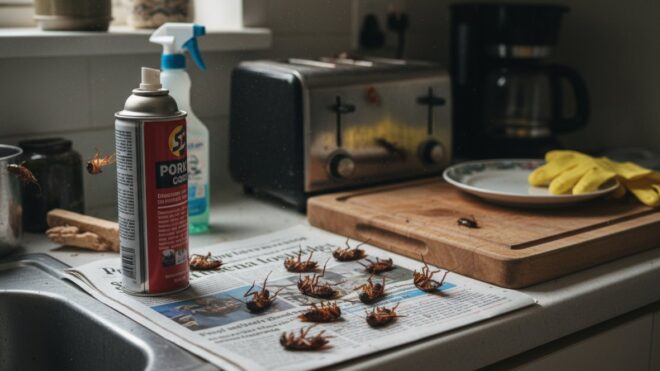
Seeing roaches scatter across your kitchen floor right after a treatment is one of the most disorienting things a homeowner can experience. Understanding why do roaches appear after spraying is the first step toward knowing whether your treatment is working or failing. At Zoifia Pest Control, we field this question constantly from Metro Boston homeowners who assume the sudden surge of pest activity means the spray didn’t work. It almost always means the opposite. Below, we’ll walk you through exactly what’s happening inside your walls, how to tell a dying roach from an active one, and what you should do in the days following treatment.
Why Do Roaches Appear After Spraying? The Flushing Effect Explained
The flushing effect is the primary reason roaches appear after spraying. When a pest control technician applies an insecticide, the active ingredient penetrates hiding spots, nesting materials, and wall voids where roaches shelter during daylight hours. The chemical irritates them, disrupting their nocturnal behavior and forcing them out into the open before they would naturally emerge.
This is not a sign of treatment failure. It’s the treatment doing exactly what it’s designed to do.
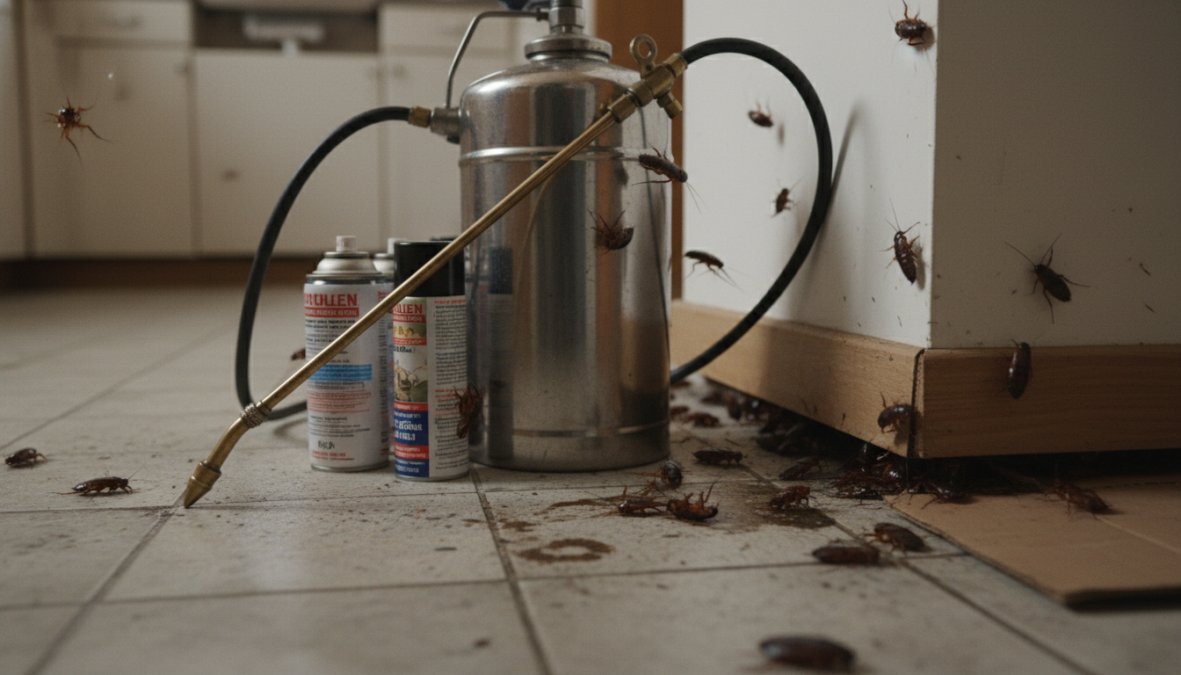
Many professional-grade insecticides contain a dedicated flushing agent, a compound designed specifically to drive insects out of harborages so the residual spray can contact them. Think of it as a two-stage system: the flushing agent pushes them out, the residual spray finishes the job. According to the National Pesticide Information Center’s guidance on insecticide formulations, many pyrethroid-based products combine contact-kill chemistry with flushing properties that produce exactly this kind of visible pest activity post-application.
What Is a Flushing Agent and How Does It Work?
A flushing agent is a chemical irritant included in many insecticide formulations that triggers immediate movement in insects without necessarily killing them on contact. It forces roaches out of cracks, gaps, and nesting areas so the lethal residual spray can reach them.
Common flushing agents include pyrethrins, which are natural compounds derived from chrysanthemum flowers. They act on the insect’s nervous system, causing rapid, disoriented movement. The confused behavior you observe, roaches running in circles or appearing in daylight, is a direct result of nervous system disruption. They’re not thriving. They’re dying in slow motion.
Species Behavior: How German Cockroaches React Differently
Not all roaches respond to treatment the same way. The German cockroach (Blattella germanica) is the species most commonly found in Metro Boston kitchens and apartment buildings, and it has a particularly pronounced flushing response compared to larger species like the American cockroach.
German cockroaches live in tightly packed harborages near heat and moisture sources, typically behind refrigerators, inside cabinet hinges, and under dishwashers. When a flushing agent penetrates these dense colonies, the scatter effect is dramatic. You may see dozens emerge within hours of treatment. This is a signal that the infestation was concentrated and the chemical reached it directly.
American cockroaches, by contrast, tend to live in larger, less concentrated areas like basement drains and utility spaces. Their flushing response is less visually striking, which sometimes leads homeowners to assume the treatment wasn’t effective when it was.
If you see a large number of German cockroaches emerging within 24 hours of treatment, that’s actually one of the clearest signs the application reached the colony’s core harborage. Fewer visible roaches immediately after treatment sometimes means the product didn’t penetrate deeply enough.
Is It Normal to See More Roaches After Treatment?
Yes, seeing more roaches after treatment is completely normal and expected for the first 24 to 72 hours. The increase in visible pest activity is a direct result of the flushing effect, not evidence that the infestation is worsening or that the product failed.
The key distinction is timing. Elevated activity in the first three days is normal. Sustained high activity beyond two weeks is a signal that either the infestation is larger than initially assessed, a follow-up visit is needed, or the product used wasn’t suited to the specific species present.
Visual Guide: Telling the Difference Between Dying and Active Roaches
This is the part most guides skip entirely, and it matters enormously for your peace of mind.
Dying roaches typically display these behaviors:
- Erratic, uncoordinated movement (spinning, stumbling, inability to right themselves)
- Daytime activity in species that are normally nocturnal
- Slow movement with frequent stops
- Appearing on their backs with legs moving weakly
- Clustering near water sources as nervous system disruption causes dehydration
Active, healthy roaches display these behaviors:
- Fast, directional movement that changes course smoothly when disturbed
- Rapid retreat to dark areas when exposed to light
- Coordinated antenna movement and alert posture
- Appearing primarily at night, not during daylight hours
If the roaches you’re seeing after treatment fall into the first category, your pest management application is working. If you’re seeing roaches with the second set of behaviors two weeks post-treatment, contact your exterminator for a follow-up visit.
Don’t sweep up or kill roaches you find on their backs after treatment. Secondary poisoning can occur when other pests or pets consume dying insects that still carry active chemical residue. Let dead roaches remain until you can safely dispose of them with gloves.
How Long After Pest Control Do Roaches Die?
Most roaches exposed to a professional residual spray die within 24 to 72 hours of contact. The full treatment cycle, meaning the point at which visible pest activity drops to near zero, typically takes one to two weeks for a moderate infestation.
The timeline depends on several factors:
| Factor | Effect on Timeline |
|---|---|
| Infestation severity | Larger infestations take longer; egg cases (ootheca) may hatch after treatment |
| Product type | Baits work slower but more thoroughly than contact sprays |
| Roach species | German cockroaches reproduce faster, extending the treatment cycle |
| Follow-up treatment | Second application within 2-3 weeks dramatically improves outcomes |
| Sanitation conditions | Moisture and food sources sustain survivors between treatments |
One thing worth knowing: insecticide sprays do not kill roach egg cases (ootheca). A female German cockroach can carry an ootheca containing 30 to 40 eggs that are protected from chemical residue by the casing itself. This is why a single application rarely eliminates an infestation completely. The eggs hatch, the nymphs emerge, and without a follow-up treatment, the cycle resets.
Signs Pest Control Is Working (And When to Be Concerned)
The signs pest control is working are often counterintuitive. More visible roaches in the first 72 hours is a positive sign. Dead roaches appearing in open areas rather than hidden spots means the product is reaching harborages. A gradual reduction in activity each day over two weeks confirms the treatment cycle is progressing.
Here’s what a healthy treatment trajectory looks like:
- Days 1-3: Increased roach activity, flushing effect at peak
- Days 4-7: Activity begins to decline, more dead roaches visible
- Days 8-14: Significant reduction in sightings, mostly dying roaches if any
- Days 14-21: Near-zero activity if infestation was moderate
Concern is warranted when roach activity remains high past day 14, when you’re seeing fast-moving roaches at night that don’t appear disoriented, or when new egg cases appear in areas that were previously treated. These patterns suggest either a re-infestation from an adjacent unit (common in apartment buildings) or a large population that requires a second application.
According to the EPA’s integrated pest management guidelines for residential settings, follow-up inspections are a standard component of effective pest management, not an optional add-on.
Roach Bait vs Spray: Which Works Better After an Infestation?
Spray and bait work through fundamentally different mechanisms, and choosing the wrong one for your situation is one of the most common reasons infestations rebound. Residual spray kills on contact and leaves a chemical barrier that continues working as roaches walk through treated areas. Roach bait works through ingestion, killing more slowly but with a critical advantage: it spreads through the colony.
For most active infestations, a combination approach outperforms either method alone.
The Domino Effect of Baiting vs. Spraying
Here is the mechanism most pest control guides mention but never actually explain.
Professional roach baits typically use one of three active ingredients: hydramethylnon, indoxacarb, or fipronil. Each works through a different pathway, but all share one property that makes them uniquely suited to colony elimination: they are slow-acting by design. A roach that ingests a lethal dose does not die immediately. It returns to the harborage, interacts with other roaches, defecates, and eventually dies there, sometimes 24 to 72 hours after first contact.
This delay is not a flaw. It is the mechanism.
What happens next is what pest control professionals call secondary poisoning, and it is the reason bait outperforms spray for long-term colony elimination:
-
Coprophagy: Cockroaches routinely consume the feces of other colony members. This behavior, called coprophagy, is how nymphs acquire gut microbiota in the early stages of development. When a poisoned roach defecates, the feces still contain active toxicant at concentrations sufficient to affect other roaches that ingest it.
-
Necrophagy: Cockroaches are opportunistic scavengers and will consume dead colony members. A roach that dies from bait ingestion carries residual toxicant in its body tissues. Roaches that feed on the carcass receive a secondary dose.
-
Vertical transmission: In German cockroach populations, females carry their ootheca (egg case) attached to their body until shortly before hatching. Research on indoxacarb-based baits has shown that nymphs emerging from eggs laid by a poisoned female can receive a sublethal dose through the egg case itself, reducing their survival rate even without direct bait contact.
The practical result is that a single bait placement can generate a kill chain that reaches roaches three or four steps removed from the original bait station, roaches that never contacted the product directly and would have survived a spray-only treatment entirely.
Why Spray Alone Breaks the Chain
Contact spray does not produce this cascade. A roach that dies from walking across a pyrethroid-treated surface carries very little transferable residue on its body. Other roaches that encounter the carcass do not receive a meaningful secondary dose. The kill radius of each spray application is fixed at the treated surface itself.
More critically, pyrethroids are repellent at sub-lethal concentrations. A roach that detects the chemical before crossing a treated surface will avoid it. In a large infestation, a meaningful portion of the population will route around treated areas and relocate to untreated harborages, a behavior researchers sometimes call the scatter effect. Those survivors reproduce in the new location, and the infestation reestablishes.
This is why spray produces dramatic visible results in the first week and then appears to fail. It didn’t fail. It killed the roaches that contacted it. The ones that didn’t contact it are now behind your refrigerator motor.
When to Use Each Method
| Situation | Best Approach | Reason |
|---|---|---|
| Active infestation, immediate knockdown needed | Residual spray + bait in combination | Spray handles visible population; bait reaches harborage survivors |
| German cockroach infestation in kitchen | Gel bait as primary, spray as secondary | German roaches respond strongly to bait; spray alone triggers scatter |
| American cockroach in basement or utility area | Residual spray to entry points + bait near drains | Lower population density makes spray more effective; bait catches stragglers |
| Post-treatment follow-up (weeks 2-3) | Bait only | Avoids disrupting residual spray; targets hatching nymphs |
| DIY maintenance between professional visits | Bait only | Consumer sprays are often repellent-based and counteract bait uptake |
Do not place bait stations in areas you have recently sprayed with a repellent-based consumer product. Pyrethrins and many synthetic pyrethroids will deter roaches from approaching bait stations, eliminating the domino effect entirely. If you have already sprayed, wait at least two weeks before placing bait, or consult your exterminator about product compatibility.
For German cockroach infestations, the most common species in Metro Boston apartments and kitchens, gel bait is almost always the stronger long-term investment. Spray gives you faster visible results and handles the immediate population. Bait reaches the parts of the colony the spray never touches and keeps working through secondary poisoning long after the spray residual breaks down. A professional treatment that uses both in sequence is consistently more effective than either method alone.
Why Do Roaches Appear After Spraying When You DIY?
DIY pest control creates a specific and frustrating pattern: you spray, roaches appear, you spray again, they come back. The reason why roaches appear after spraying in DIY situations is often different from what happens after a professional treatment, and understanding the chemistry behind it explains why the cycle keeps repeating.
The Repellent Chemistry Problem
The single most important thing to know about consumer roach sprays is the distinction between repellent and non-repellent insecticides. Most products sold in hardware stores and big-box retailers are repellent-based. This is not a marketing failure or a labeling oversight, repellent chemistry is intentional, because it produces fast, visible results that satisfy consumers. Roaches scatter immediately. The product appears to work.
The problem is what happens next.
Repellent insecticides, most commonly synthetic pyrethroids like cypermethrin, bifenthrin, and lambda-cyhalothrin at consumer-grade concentrations, work by triggering avoidance behavior before the insect contacts a lethal dose. Roaches detect the chemical through their tarsal sensory organs (the sensory structures on their feet and antennae) and reroute around treated surfaces. They do not die. They relocate.
In a typical DIY scenario, a homeowner sprays baseboards, under the sink, and around the refrigerator. The roaches in those areas scatter to the inside of the wall void, the motor housing of the dishwasher, or the apartment unit next door. Two weeks later, when the repellent dissipates, they return. The homeowner sprays again. The cycle repeats.
Non-repellent insecticides, the class most professional exterminators use, work differently. Active ingredients like fipronil and imidacloprid are undetectable to roaches at application concentrations. A roach walks through a treated area without triggering avoidance behavior, picks up a lethal dose on its cuticle, and carries it back to the harborage before dying. This is what allows non-repellent chemistry to reach the colony rather than just displacing it.
Most non-repellent professional-grade products are not available for retail purchase in the concentrations professionals use, which is one of the structural reasons DIY treatment underperforms.
How to Identify What You Bought
Before your next application, check the active ingredient on the label:
| Active Ingredient | Type | Common in Consumer Products? | Notes |
|---|---|---|---|
| Cypermethrin | Repellent pyrethroid | Yes | Fast knockdown, high scatter effect |
| Bifenthrin | Repellent pyrethroid | Yes | Long residual, but repellent at label concentrations |
| Lambda-cyhalothrin | Repellent pyrethroid | Yes | Common in spray cans |
| Deltamethrin | Repellent pyrethroid | Yes | Some professional formulations available |
| Fipronil | Non-repellent phenylpyrazole | Primarily in bait products | Gel baits (e.g., Termidor is professional-only; Combat gel contains fipronil at consumer concentrations) |
| Indoxacarb | Non-repellent oxadiazine | Primarily in bait products | Advion gel bait; available to consumers |
| Hydramethylnon | Non-repellent | Primarily in bait products | Maxforce bait products |
If your spray contains a pyrethroid as the primary active ingredient, it is almost certainly repellent-based. If you want non-repellent chemistry in a DIY context, gel bait is your most accessible option, and it is genuinely effective for German cockroach infestations when placed correctly.
The Incomplete Application Problem
Even when a consumer selects the right product, application coverage is the second major failure point. Professional applications are guided by an inspection that identifies specific harborage zones: the motor housing of the refrigerator, the hinge gaps of lower kitchen cabinets, the void behind the dishwasher kick plate, the gap between the countertop and the wall. These are the areas where German cockroaches actually live. They are not the visible surfaces most homeowners spray.
A useful rule of thumb: if you can see the surface you’re spraying without moving anything, it is probably not where the roaches are living.
For gel bait specifically, placement matters more than quantity. Small placements (a pea-sized amount or less) placed directly in harborage zones, inside cabinet hinges, in the gap behind the refrigerator, along the underside of the dishwasher door, outperform large placements on open surfaces. Roaches are thigmotactic, meaning they prefer tight contact with surfaces on multiple sides. They will not travel far into open space to reach a bait station.
The Sanitation Interference Problem
No insecticide, professional or consumer, performs well in an environment with competing food and moisture sources. This is not a disclaimer. It is a documented mechanism.
Gel bait competes directly with available food. A roach that has access to grease residue behind the stove, crumbs under the refrigerator, or standing water from a dripping pipe has no incentive to seek out a bait station. Bait uptake drops significantly in unsanitary conditions, which is why pest management protocols treat sanitation as a prerequisite, not an afterthought.
The three highest-priority sanitation steps before any DIY treatment:
- Eliminate standing moisture, fix dripping pipes, dry under-sink areas, address condensation around refrigerator coils
- Remove grease accumulation from stove surfaces, range hood filters, and the gap between the stove and adjacent cabinets
- Store all food (including pet food) in sealed hard containers, not bags or cardboard boxes
Cardboard deserves specific mention: German cockroaches use corrugated cardboard as both a harborage and a food source. Cardboard boxes stored in kitchens, pantries, or under sinks are a significant infestation driver that no spray will overcome.
If you are going to use a DIY approach, the most effective single-product choice for a German cockroach infestation is a fipronil or indoxacarb gel bait applied in small placements directly inside harborage zones, not a spray. Reserve spray for perimeter entry points (door thresholds, pipe penetrations) using a product with a non-repellent active ingredient if you can source one. Never apply spray over or near bait placements.
As documented in Purdue University Extension’s guide to cockroach management, German cockroach control requires a combination of sanitation, targeted insecticide application, and monitoring, none of which a single can of consumer spray delivers on its own. The chemistry mismatch between consumer repellent sprays and the behavioral biology of German cockroaches is the core reason DIY treatments so often produce the frustrating cycle of spray, scatter, and return.
Pest Control Aftercare Tips: What to Do After Treatment
What you do in the 48 hours after treatment significantly affects whether the application works. Most homeowners undermine their own treatment without realizing it.
Follow these aftercare steps:
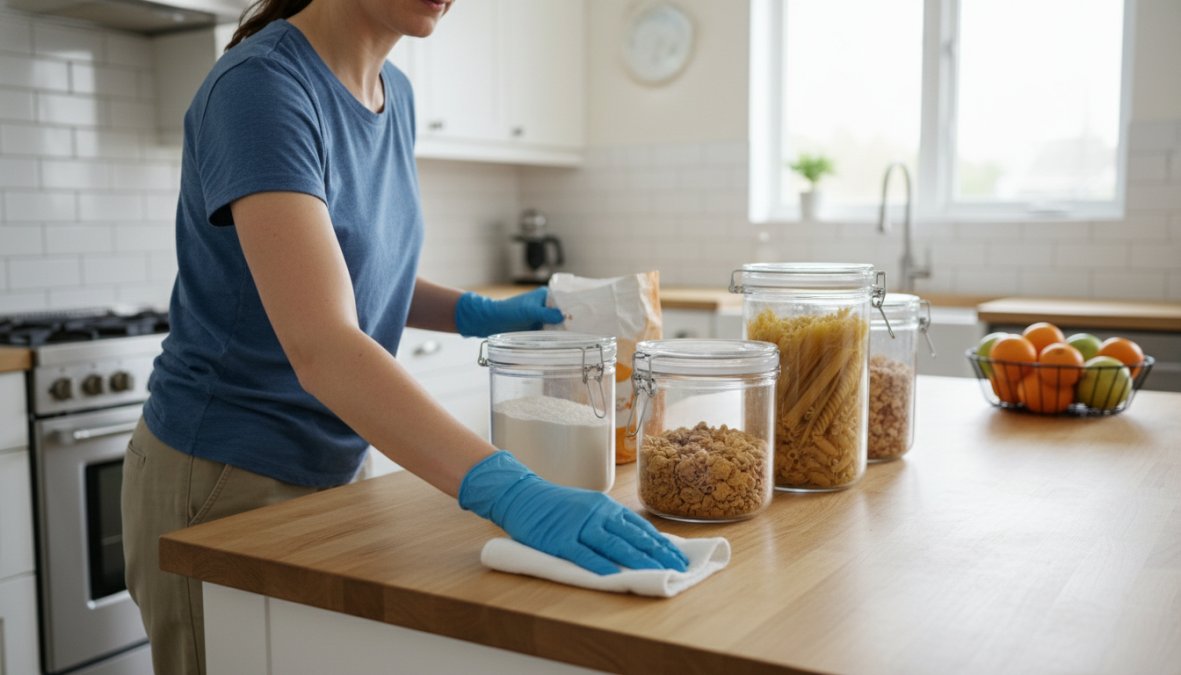
- Don’t clean treated surfaces for at least 72 hours. Mopping or wiping baseboards removes the residual spray before it has time to work.
- Seal food in airtight containers. Accessible food sources sustain surviving roaches and reduce bait uptake.
- Fix moisture sources immediately. Leaky pipes, condensation, and standing water are the primary reasons roaches survive in treated environments.
- Don’t apply additional sprays over professional treatment. Consumer repellents can interfere with professional-grade products and push roaches away from bait stations.
- Keep harborage areas clear. Cardboard boxes, paper bags, and clutter provide nesting materials that support reinfestation.
- Schedule your follow-up visit. A second application two to three weeks after the first targets hatching nymphs that survived the initial treatment inside their ootheca.
Safety Protocols for Pets and Children After Spraying
This is the section most pest control guides skip, and it’s the one families need most. Professional insecticides are formulated to be effective against insects at concentrations that are low-risk for mammals, but proper precautions still apply.
For pets:
- Keep pets out of treated areas for a minimum of two to four hours after application, or until surfaces are fully dry
- Remove pet food bowls, water dishes, and bedding from treatment zones before the technician arrives
- Fish tanks are particularly vulnerable; cover them and turn off air pumps during and for several hours after treatment
- If a pet walks through a treated area before surfaces dry, wash their paws with mild soap and water
For children:
- Children should stay out of treated rooms until surfaces are completely dry, typically two to four hours
- Wash children’s hands before meals if they’ve been in recently treated areas
- Ventilate the home by opening windows after the dry time has elapsed
According to the American Academy of Pediatrics’ guidance on pesticide exposure in children, the most effective way to reduce pesticide risk for children is ensuring treated areas are fully dry and ventilated before allowing access, which aligns with standard professional application protocols.
Zoifia Pest Control technicians walk every client through specific re-entry timing and aftercare instructions at the end of every service visit. Our licensed and insured team follows strict application protocols designed to protect both the effectiveness of the treatment and the safety of your household.
Seeing a surge of roaches after treatment is confusing, but it’s almost always a sign the process is working rather than failing. The real challenge is knowing when normal flushing activity ends and a genuine problem begins, and having a licensed team you can call when you’re not sure. Zoifia Pest Control offers fast response, a 90-day guarantee, and no long-term contracts, so you’re covered if activity persists beyond the expected treatment window. Get a quote from Zoifia Pest Control and put a professional treatment plan behind your roach problem instead of guessing with store-bought spray.
Frequently Asked Questions
Is it normal to see more roaches after pest control treatment?
Yes, it is completely normal to see more roaches after spraying. The active ingredients in many insecticides act as flushing agents, driving roaches out of their hiding spots and nesting materials into the open. This increased daytime activity typically peaks within the first 24 to 72 hours after treatment. It is actually a sign the application is working. If roach activity does not decrease after one to two weeks, a follow-up visit from your pest control technician may be needed.
How long after pest control do roaches die?
Most roaches exposed to a professional residual spray will die within one to two weeks of treatment. German cockroaches, one of the most common species, may take slightly longer due to their rapid reproduction and tendency to hide near nesting materials deep in walls. The full treatment cycle, including follow-up visits, can span four to six weeks. Roach bait works more gradually through secondary poisoning but is often more effective for long-term infestation control.
Do roaches come out more when they are dying?
Yes, dying roaches often display confused behavior and erratic movement, which makes them more visible. Unlike healthy, nocturnal roaches that avoid light and stay hidden, dying roaches may stagger into open areas during the day. If you see roaches moving slowly, spinning in circles, or lying on their backs but still twitching, these are signs the insecticide is affecting their nervous system. This daytime activity is a positive indicator that your pest control treatment is working as intended.
What should I do if I still see roaches two weeks after professional spraying?
If roach activity has not significantly decreased two weeks after treatment, contact your pest control technician to schedule a follow-up visit. In the meantime, focus on sanitation: eliminate food sources, fix moisture issues, and seal hiding spots. Check for egg cases, or ootheca, which may not be affected by surface sprays and can cause a population rebound. Zoifia Pest Control backs all treatments with a 90-day guarantee, so follow-up service is included if the infestation persists.
Is roach bait or spray better for a cockroach infestation?
Both have distinct advantages depending on the severity and location of the infestation. Residual spray works quickly and covers large surface areas, but can repel roaches away from bait stations if used incorrectly. Baiting works more slowly but creates a domino effect through secondary poisoning, where roaches carry the active ingredient back to the nest. For severe infestations, a professional pest management approach typically combines both methods in a strategic treatment cycle for the best results.
This article was written using GrandRanker
