Table of Contents
- Why You’re Seeing More Roaches After Spraying (And What It Means)
- How to Handle Roach Infestation in an Apartment: Step-by-Step
- Landlord Responsibility for Pest Control in Apartments
- How to Notify Your Landlord About a Roach Infestation
- Best Roach Bait for Apartments: Baiting vs. Spraying
- What to Expect After Professional Extermination
- Roach Prevention Tips for Renters: Keeping Them Gone for Good
- Common Mistakes That Make a Roach Infestation in Your Apartment Worse
- Conclusion
Last Updated: May 19, 2026
Roaches are one of the most persistent pest problems apartment dwellers face, and knowing how to handle roach infestation in apartment settings requires more than just grabbing a can of spray from the hardware store. At Zoifia Pest Control, we’ve worked with hundreds of Metro Boston renters who tried the DIY route first and made the problem significantly worse before calling us. This guide covers every stage of the process: from understanding why you’re suddenly seeing more roaches after treatment, to choosing the right approach, to keeping them gone for good.
Here’s what most guides get wrong: seeing more roaches after spraying is not a sign that treatment failed. It’s often a sign it’s working. Below, we’ll walk you through exactly what’s happening, what to do next, and how to avoid the mistakes that cause infestations to rebound.
Why You’re Seeing More Roaches After Spraying (And What It Means)
Seeing roaches scatter after a pest control application is normal, and it actually signals that the treatment is doing its job. Most insecticides used by professional exterminators contain a flushing agent alongside the active ingredient, which irritates roaches hiding in cracks, wall voids, and behind appliances, forcing them into the open. This scatter effect is a predictable part of the treatment cycle, not evidence of failure.
The confusion comes from expectation. Renters assume that spraying means roaches disappear immediately. The reality is that daytime activity from nocturnal insects is one of the clearest signs that chemical residue is disturbing their hiding spots.
The Flushing Agent Effect Explained
A flushing agent is a compound added to many professional insecticide formulations that stimulates roaches to leave their nesting materials and shelter, making them vulnerable to the residual spray coating nearby surfaces. Common examples include pyrethrins, which cause rapid excitation in roach nervous systems without necessarily killing on contact.
The result: roaches that were comfortably tucked behind your refrigerator motor or inside cabinet hinges suddenly emerge in daylight, looking disoriented or moving erratically. This is the scatter effect in action. It typically peaks within 24-72 hours of application and then subsides as the active ingredient does its work.
According to EPA guidance on pesticide active ingredients, pyrethrin-based products are among the most widely used flushing compounds in residential pest management because of their fast knockdown and low mammalian toxicity at standard application rates.
How to Tell a Dying Roach from an Active One
This is the part most guides skip entirely, and it matters for assessing whether your treatment is working.
Dying roaches typically show these behaviors:
- Moving in slow, uncoordinated circles
- Lying on their backs and unable to right themselves
- Twitching legs with minimal forward movement
- Visible tremors, especially in the antennae
Active roaches move with purpose: fast, directional, and responsive to light. If you’re seeing mostly disoriented, slow-moving roaches after treatment, that’s a positive sign. If roaches are moving normally and quickly several days post-treatment, the infestation may not be responding to the product used, or the application missed key harborage areas.
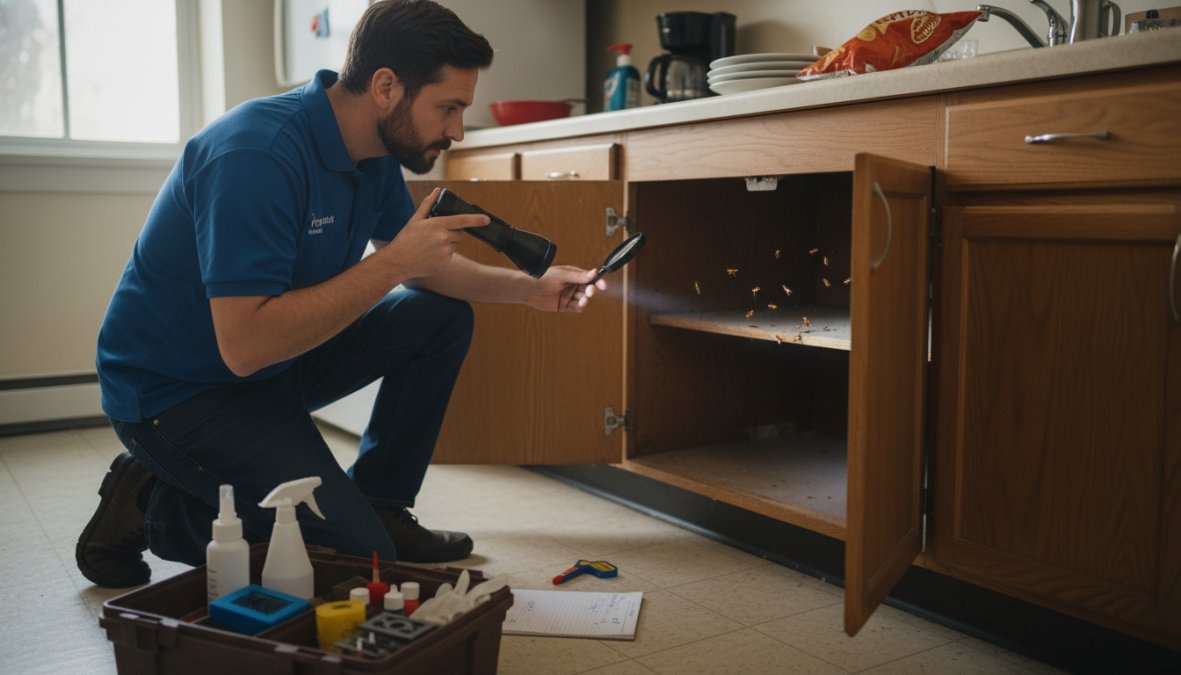
After any professional treatment, do a flashlight inspection of your [kitchen](/blog/how-to-get-rid-of-ants-in-kitchen) and bathroom at night, roughly 48 hours post-application. The ratio of dying to active roaches tells you more about treatment efficacy than anything else.
How to Handle Roach Infestation in an Apartment: Step-by-Step
Tackling a roach infestation in your apartment is most effective when you treat it as a process, not a single event. The pest management industry consistently finds that single-application approaches fail against established infestations because they don’t account for egg cases (called ootheca) that survive initial treatment.
Step 1: Confirm the Infestation and Identify the Species, Then Change Your Strategy Accordingly
Most pest control guides list roach species as if you’re studying for a biology exam. This one will tell you why the species you’re dealing with changes every decision you make about treatment, timing, and what "success" looks like.
German cockroach (Blattella germanica): The most common apartment species in the northeastern U.S. Small (about 1/2 inch), light brown, with two dark parallel stripes behind the head. Reproduces faster than any other common household roach, a single female can produce up to 300-400 offspring in her lifetime, and egg cases hatch in roughly 28 days under warm conditions.
How German roaches respond to treatment differently: German cockroaches are harborage specialists. They cluster tightly in warm, humid microenvironments, inside cabinet hinges, behind the motor housing of refrigerators, inside the control panel of stoves, and they rarely travel far from their colony. This tight clustering is actually an advantage for gel bait: a single well-placed bait dot near a harborage can expose dozens of individuals through the secondary poisoning (domino) effect. However, it also means spray-only approaches frequently miss the core colony entirely, because the spray coats open surfaces while the roaches remain tucked inside voids that the spray never reaches.
German roaches also show the strongest documented insecticide resistance of any common apartment species. If a spray-only treatment appears to reduce activity for a week and then rebounds, resistance is a likely explanation, not re-infestation from outside. Bait rotation (alternating between different active ingredient classes, such as indoxacarb and hydramethylnon) is the standard professional response to suspected resistance.
American cockroach (Periplaneta americana): Larger (up to 2 inches), reddish-brown with a distinctive pale yellow figure-8 pattern on the back of the head. More common in basements, utility rooms, boiler rooms, and building sewer infrastructure than in individual apartment kitchens.
How American roaches respond to treatment differently: American cockroaches are peridomestic, they live primarily in building infrastructure and enter individual units opportunistically, usually through floor drains, pipe chases, and gaps around utility penetrations. A single American cockroach in your apartment is often a building-level problem, not a unit-level one. Treating only your unit with bait or spray will not resolve it, because the source population is in shared building spaces your landlord controls. The correct response is to seal entry points (floor drain covers, pipe penetrations) and notify your landlord that the building’s common infrastructure needs treatment. American roaches are also significantly easier to kill with residual sprays than German roaches, they have not developed the same level of resistance, so spray-based approaches are more viable when the species is confirmed.
Oriental cockroach (Blatta orientalis): Dark brown to nearly black, slower-moving, and strongly associated with drains, damp basements, and areas with decaying organic matter. Often called "water bugs" by renters.
How Oriental roaches respond to treatment differently: Oriental cockroaches thrive in cool, damp conditions, the opposite of the warm, dry harborage German roaches prefer. They are highly moisture-dependent, which means moisture control (fixing leaks, improving ventilation in damp areas) is a more decisive intervention for Oriental roaches than it is for German roaches. Gel bait is less effective against Oriental cockroaches than against German roaches because Oriental roaches are less attracted to the protein-based bait matrices most gel products use. Residual spray applied near drains and damp entry points is typically the more effective primary tool.
If you’re unsure which species you have, photograph the roach next to a coin for scale and send it to your local cooperative extension service or a licensed pest management professional before purchasing any product. Misidentifying the species is one of the most common reasons DIY treatment fails.
Step 2: Document the Problem Before Treatment
Photograph every location where you’ve seen roach activity: droppings (small, dark, pepper-like specks for German roaches; larger, cylindrical with ridged sides for American roaches), egg cases, shed skins, and live or dead insects. Note the time of day you’re seeing activity. This documentation serves two purposes: it gives a pest control technician the information needed to target treatment, and it creates a paper trail for your landlord notification.
Check these high-probability zones:
- Under and behind the refrigerator and stove
- Inside cabinet hinges and along the back walls of lower cabinets
- Behind the dishwasher and under the sink
- Around pipe penetrations in walls
- Inside electronics (roaches are attracted to warmth)
- Floor drains and the area immediately around them (especially relevant for American and Oriental roaches)
Step 3: Choose Between DIY and Professional Treatment
DIY pest control products available at retail stores are almost always repellent-based sprays. This is a critical problem: repellent insecticides don’t kill roaches, they scatter them. In a multi-unit apartment building, this pushes the infestation into neighboring units and wall voids, creating a rebound that’s worse than the original problem.
Professional exterminators use non-repellent residual sprays and gel baits that roaches walk through or consume without detecting. For any German cockroach infestation in an apartment building, professional treatment is not optional if you want lasting results. For a confirmed American cockroach entry problem, the most important step, sealing pipe penetrations and coordinating building-wide treatment, requires landlord involvement regardless of whether you hire a professional for your unit.
Landlord Responsibility for Pest Control in Apartments
Landlord responsibility for pest control is a legally significant issue that varies by state, but the general principle across most U.S. jurisdictions is consistent: landlords are required to maintain habitable living conditions, which includes freedom from pest infestations. Understanding where that obligation begins and ends, and what you can do when a landlord ignores it, is the part most guides skip.
The Legal Baseline: What Landlords Are Actually Required to Do
In Massachusetts, where Zoifia Pest Control operates, the Massachusetts State Sanitary Code (105 CMR 410) explicitly lists cockroach infestation as a violation of the minimum standards of fitness for human habitation. This is a "condition" violation, meaning your landlord has a legal obligation to remediate it, not a discretionary one.
The same framework applies in most other states under the implied warranty of habitability, a legal doctrine recognized in nearly all U.S. jurisdictions. The specific enforcement mechanisms differ, but the underlying obligation is consistent: a landlord who knowingly allows a documented roach infestation to persist without remediation is in violation of the lease and, in most states, housing code.
The key nuances that determine who bears responsibility:
- Pre-existing infestation: If evidence suggests the infestation existed before your tenancy (roach droppings behind appliances that were present on move-in, for example), landlord responsibility is clear and unambiguous. Document move-in conditions with photographs dated on or before your move-in date.
- Building-wide or neighboring-unit source: If the infestation is entering your unit through shared plumbing chases, electrical conduits, or from an adjacent unit, the landlord is responsible for coordinating building-wide treatment. You cannot solve a building-infrastructure problem by treating only your unit.
- Tenant-contributed conditions: If the infestation is directly and demonstrably tied to sanitation conditions within your unit, accumulated food waste, standing water, extensive clutter, responsibility becomes more contested. Landlords in this situation may argue that the tenant’s own conduct created the condition. This is why documenting your own sanitation practices matters.
The Escalation Pathway: What to Do When Your Landlord Doesn’t Act
This is the section most guides omit entirely. Knowing your rights is only useful if you know how to enforce them.
Step 1: Written notice to the landlord (required first step in most states)
Send a formal written notice via email and, if possible, certified mail. Email creates a timestamp; certified mail creates a delivery record. Keep copies of both. The notification template in the section below covers the required elements.
Step 2: Allow a reasonable response window
Most state housing codes define a reasonable remediation period for pest infestations. In Massachusetts, the standard is 24 hours for conditions that constitute an immediate health hazard, and a longer window (typically defined as "reasonable time") for conditions that are serious but not immediately dangerous. A documented roach infestation generally falls into the latter category. Fourteen days is a commonly cited reasonable window in tenant-landlord disputes, though this is not a universal statutory number, check your state’s specific code.
Step 3: File a complaint with your local board of health or housing authority
If your landlord does not respond or fails to arrange treatment within the reasonable window, file a formal complaint with your local board of health (in Massachusetts) or the equivalent housing inspection authority in your jurisdiction. A housing inspector can issue a formal violation notice to your landlord, which creates legal pressure and an official record. In Massachusetts, you can find your local board of health through the Massachusetts Association of Health Boards directory.
Filing a complaint does not require you to have an attorney. It is a standard administrative process, and inspectors are accustomed to tenant-initiated complaints.
Step 4: Understand rent withholding and repair-and-deduct, carefully
Some states allow tenants to withhold rent or arrange their own pest control and deduct the cost from rent when a landlord fails to remediate a habitability violation. Massachusetts does permit rent withholding under specific conditions, but the procedural requirements are strict. Doing it incorrectly, withholding rent without following the required legal steps, can result in eviction proceedings regardless of the underlying pest issue.
Never withhold rent or use repair-and-deduct remedies without first consulting a tenant’s rights attorney or your local legal aid organization. In Massachusetts, Greater Boston Legal Services ([Greater Boston Legal Services](https://www.gbls.org)) provides free legal assistance to income-eligible tenants on housing issues including habitability complaints.
Step 5: Document the landlord’s non-response as carefully as you documented the infestation
Save every email, text message, and voicemail related to the pest complaint. Note dates and times of any verbal conversations. If a pest control technician visits and does not treat (or treats inadequately), ask for a written service report. This documentation record is what makes a housing court case or rent escrow proceeding viable if the situation escalates.
What Building-Wide Treatment Actually Means, and Why It Matters
One detail that most renters don’t understand until it’s too late: treating only your unit in a multi-unit building with a German cockroach infestation is almost always insufficient for long-term resolution. Roaches move through shared wall voids, plumbing chases, and electrical conduits between units. A professionally treated unit can be re-infested within weeks from an untreated neighboring unit.
Effective building-wide treatment requires the landlord to coordinate simultaneous or sequential treatment of all affected units and common areas. This is logistically complex and more expensive than single-unit treatment, which is why some landlords resist it. It is also, in most jurisdictions, their legal obligation when the infestation is building-wide in origin.
When you notify your landlord, explicitly state that you are requesting building-wide inspection and treatment, not just treatment of your unit. Put this request in writing. If the landlord arranges treatment of only your unit and the infestation returns, you have documented grounds to escalate the complaint.
Your strongest position as a tenant is a clear paper trail: written notice with a date, a reasonable response window stated explicitly, and a documented escalation to the board of health if the landlord fails to act. The legal framework supports you, but only if you’ve followed the procedural steps that make the complaint actionable.
How to Notify Your Landlord About a Roach Infestation
The way you notify your landlord matters as much as the notification itself. Verbal complaints are easily ignored and leave no record. A written notification creates the paper trail you need if the situation escalates.
Here’s a practical template:
Subject: Written Notice of Pest Infestation, Unit [Number], [Address]
Dear [Landlord/Property Manager Name],
I am writing to formally notify you of a cockroach infestation in my unit at [address], which I first observed on [date]. I have documented evidence including photographs, which I am happy to share upon request.
Per Massachusetts State Sanitary Code 105 CMR 410, this constitutes a condition requiring prompt remediation. I request that you arrange for a licensed pest control technician to inspect and treat my unit within [7-14] days of this notice.
Please confirm receipt of this notice and provide a remediation timeline.
Sincerely,
[Your Name]
Send this via email (creates a timestamp) and keep a copy. If your landlord fails to respond within a reasonable period, contact your local housing authority or board of health.
Never withhold rent without first consulting a tenant’s rights attorney or local housing authority. While Massachusetts law does allow rent escrow in some habitability situations, doing it incorrectly can result in eviction proceedings regardless of the underlying pest issue.
Best Roach Bait for Apartments: Baiting vs. Spraying
The best roach bait for apartments is gel bait applied in small, targeted dots near harborage areas, not broadcast spray applied to open surfaces. This is where most DIY pest control efforts fail, and understanding why changes everything about how you approach the problem.
Gel baits work by attracting roaches to consume a slow-acting insecticide. The roach returns to its harborage, dies, and is consumed by other roaches, creating secondary poisoning that spreads through the colony. This is fundamentally different from spray, which kills on contact but leaves survivors.
The Domino Effect: Why Baiting Outperforms Spraying in Most Apartments
The domino effect is the mechanism that makes baiting uniquely effective in multi-unit apartment settings. A single roach that consumes bait and returns to its nest can transfer lethal doses to dozens of nestmates through contact and cannibalism. Egg cases in the nest may also be exposed to the active ingredient, disrupting the next generation before it hatches.
Spraying, by contrast, creates a repellent barrier that roaches learn to avoid. Over multiple generations, this can even contribute to insecticide resistance. According to research on German cockroach insecticide resistance, German cockroaches have demonstrated resistance to multiple classes of pyrethroid insecticides, making bait rotation and non-repellent formulations increasingly important in urban pest management.
| Approach | Kills on Contact | Secondary Poisoning | Affects Egg Cases | Risk of Scatter |
|---|---|---|---|---|
| Residual Spray | Yes | No | No | High |
| Gel Bait | No | Yes | Indirect | Low |
| Professional Non-Repellent | Yes | Partial | No | Low |
| Combined Bait + Spray | Yes | Yes | Indirect | Low |
The combined approach, bait plus targeted non-repellent spray, is what most professional pest management programs use for established German cockroach infestations.
What to Expect After Professional Extermination
After professional extermination, expect increased roach activity for the first 24-72 hours due to the flushing effect described earlier. Activity should decline noticeably by day 5-7, with a significant reduction by the two-week mark. If you’re still seeing active (not dying) roaches after two weeks, a follow-up visit is warranted.
Most professional pest control programs include a follow-up treatment within 2-4 weeks. This second application is not optional; it’s essential for catching newly hatched nymphs from egg cases that survived the first treatment. Ootheca are remarkably resistant to insecticides, which is why a single treatment cycle rarely achieves full elimination against German cockroaches.
What to do in the days after treatment:
- Do not clean treated surfaces for at least 72 hours (you’ll remove the residual spray)
- Avoid using your own sprays or repellents in treated areas
- Keep monitoring with sticky traps near the stove, refrigerator, and under the sink
- Report any significant roach activity to your pest control technician before the follow-up visit
Safety Protocols for Pets and Children After Treatment
This is an area where most pest control guides are frustratingly vague. Here’s what actually matters.
For residual spray applications, keep pets and children out of treated rooms until surfaces are completely dry, which typically takes 30-60 minutes under normal ventilation. For gel bait applications, the risk to pets and children is minimal because bait is applied in tiny amounts in locations that are inaccessible (inside cabinet hinges, behind appliances), but some dogs will seek out and consume gel bait if it’s applied in accessible areas.
Specific precautions:
- Remove pet food and water bowls from treatment areas before application
- Cover fish tanks and turn off their air pumps during spray application (insecticide aerosols can be toxic to fish)
- Wash any countertop surfaces used for food preparation after treated surfaces dry
- For children with respiratory sensitivities, ventilate treated rooms thoroughly before re-entry
The 72-hour rule covers most residual spray applications for pets and adults. Fish tanks and birds are the most sensitive to airborne insecticide particles and require the most careful protection during and after treatment.
Roach Prevention Tips for Renters: Keeping Them Gone for Good
Prevention is where renters have the most control, even in buildings where neighboring units are the original source of the problem. Roach prevention tips for renters focus on two things: removing what attracts roaches and blocking the routes they use to enter.
Roaches need three things: food, water, and shelter. Eliminate any one of those consistently and you make your unit significantly less hospitable than your neighbors’.
- Seal all food in hard-sided containers, not bags or boxes
- Fix any dripping faucets or moisture issues under the sink immediately
- Take out trash daily, or use a sealed bin
- Clean behind and under the refrigerator and stove at least monthly
- Seal gaps around pipe penetrations with steel wool and caulk
- Don’t leave dirty dishes in the sink overnight
- Reduce clutter, especially cardboard boxes, which are ideal nesting materials for German cockroaches

Moisture control deserves special emphasis. Roaches are drawn to water sources more reliably than food. A slow drip under your sink is more attractive to a German cockroach than an open bag of chips. Fix plumbing issues fast.
Common Mistakes That Make a Roach Infestation in Your Apartment Worse
The most damaging mistake renters make is using repellent sprays from a hardware store as a first response. This feels productive, but it scatters roaches into wall voids and neighboring units, making professional treatment more difficult and expensive later. The second-most common mistake is stopping treatment after the visible population drops.
Here’s a summary of the mistakes that consistently cause infestations to rebound:
| Mistake | Why It Backfires | Better Approach |
|---|---|---|
| Using repellent sprays | Scatters roaches, doesn’t eliminate them | Use gel bait or hire a professional |
| Cleaning after treatment | Removes residual insecticide from surfaces | Wait 72 hours before cleaning treated areas |
| Skipping the follow-up visit | Newly hatched nymphs survive first treatment | Complete the full treatment cycle |
| Treating only your unit | Roaches re-enter from building infrastructure | Coordinate with landlord for building-wide treatment |
| Over-applying bait | Roaches detect and avoid large bait deposits | Apply small dots (rice grain-sized) in multiple locations |
A common mistake is also assuming that a clean apartment can’t have roaches. German cockroaches in apartment buildings spread through shared plumbing and electrical conduits regardless of individual unit cleanliness. Sanitation reduces your attractiveness as a harborage, but it doesn’t create a barrier against roaches entering from adjacent units.
According to CDC guidance on cockroach allergens and urban housing, cockroach infestations in multi-unit housing are a significant public health concern beyond the nuisance factor, with cockroach allergens linked to asthma triggers, particularly in children. This makes addressing the problem thoroughly, not just superficially, a health priority.
The real difference between a roach problem that gets resolved and one that drags on for months comes down to one thing: whether the treatment cycle is completed. One application, no follow-up, DIY repellent spray in between visits. That’s the pattern that keeps infestations alive.
Roach infestations in apartment buildings are genuinely difficult to eliminate without professional support, especially when German cockroaches are involved and the infestation spans multiple units. Zoifia Pest Control serves the Metro Boston area with licensed and insured roach treatment backed by a 90-day guarantee, with no long-term contracts required. Get a quote from Zoifia Pest Control and get a treatment plan designed to eliminate the infestation completely, not just push it into the walls.
Frequently Asked Questions
Is it the landlord's responsibility to get rid of roaches in an apartment?
In most states, landlords are legally required to provide a habitable living environment, which includes addressing pest infestations. If roaches were present before you moved in or result from structural issues like gaps and moisture problems, the landlord is generally responsible. However, if the infestation stems from a tenant's poor sanitation habits, responsibility may shift. Always check your lease and local tenant protection laws, and document everything in writing before escalating.
How do I tell my landlord about a roach infestation?
Notify your landlord in writing, email or a formal letter, so you have a dated record. Describe where you've seen roaches, how frequently, and in which rooms. Include photos if possible. Reference your lease's habitability clause and request a response within a specific timeframe, such as 5 to 7 business days. If your landlord does not act, you may have grounds to contact local housing authorities or withhold rent depending on your state's tenant rights laws.
What is the fastest way to get rid of roaches in an apartment?
The fastest approach to handle a roach infestation in an apartment is to combine professional extermination with gel bait placement and immediate sanitation improvements. A licensed pest control technician can apply residual spray and targeted bait in hiding spots, while you eliminate food sources, seal entry points, and reduce moisture. DIY sprays alone often cause a scatter effect that spreads the infestation. Follow-up visits are critical to break the roach treatment cycle and address egg cases and ootheca.
Can roaches travel between apartments and affect my unit even if I keep it clean?
Yes. Roaches, especially the German cockroach, can move through shared walls, plumbing, electrical conduits, and ventilation systems between units. Even a spotless apartment can experience pest activity if neighboring units have an active infestation. In these cases, renters should notify their landlord immediately, use roach bait along shared walls, seal gaps around pipes, and request that the building undergo a coordinated treatment cycle rather than treating a single unit in isolation.
What are the best roach killers and baits for apartment use?
Gel baits are widely considered the best roach bait for apartments because they work without repelling roaches away from treated areas. Products containing active ingredients like indoxacarb or fipronil are effective against German cockroaches. Place gel bait in small dots near hiding spots, under appliances, inside cabinet hinges, and along baseboards. Avoid using repellent sprays near bait stations, as this can cause roaches to scatter and reduce bait effectiveness. Rotating bait products can also help prevent resistance.
How long does it take for roach treatment to work in an apartment?
Most professional roach treatments begin showing results within 24 to 72 hours, but full elimination of a roach infestation in an apartment typically takes two to four weeks, depending on the severity. Seeing increased roach activity in the first few days is normal, it usually means the flushing agent in the insecticide is working. A follow-up visit from your pest control technician at two to four weeks is essential to treat any surviving roaches and newly hatched nymphs from egg cases.
This article was written using GrandRanker
