Table of Contents
- Contract vs On-Demand: Core Differences for Landlords
- Landlord Pest Control Responsibility by State
- Pest Control Lease Clause Template and Legal Protection
- Preventative Pest Control for Multi-Family Housing
- Financial Analysis: Contract vs On-Demand ROI
- Liability and Insurance: Who Pays When Pests Return
- How to Choose the Right Pest Control Strategy for Your Properties
- Conclusion
Last Updated: August 7, 2026
Contract vs On-Demand: Core Differences for Landlords
A pest control contract locks you into regular quarterly or monthly treatments regardless of pest presence. On-demand service means you call only when needed, paying per visit. For landlords, this choice shapes your budget, liability exposure, and tenant relationships.
Contract plans typically cost $500-$1,000 annually for general pest control, while on-demand visits range from $100-$500 per call. The real difference isn’t just price: it’s who bears the risk when pests return. With a contract, you have documented preventative maintenance, strengthening your position if a tenant claims habitability violations. With on-demand service, you’re reactive, creating documentation gaps and potential liability.
At Zoifia Pest Control, we work with landlords managing single-family and multi-unit properties across Metro Boston. Many discover their best strategy combines both: a contract for baseline prevention and on-demand calls for seasonal surges or unexpected infestations.
Contract service = predictable costs and documented prevention. On-demand = flexibility and lower baseline expense. Most landlords benefit from combining both strategies based on property type and pest pressure.
Landlord Pest Control Responsibility by State
Your legal obligations for pest control vary by state and local jurisdiction. Massachusetts and most northeastern states impose the implied warranty of habitability, requiring landlords to maintain rental properties fit for human occupancy.
Pest infestations, bed bugs, rodents, cockroaches, directly violate habitability standards. The Massachusetts Sanitary Code and Boston Housing Code explicitly require landlords to maintain properties free from health-hazard infestations. If the infestation stems from structural defects or entry points, the landlord is liable. Tenants may bear responsibility only if negligence caused the problem.
Connecticut, Rhode Island, and New Hampshire follow similar frameworks. New York State is particularly strict: landlords must provide pest control services and cannot charge tenants for extermination related to structural or building-wide infestations.
Document everything: when you discovered pests, when you scheduled treatment, and what the exterminator found. A pest control contract creates automatic documentation; on-demand service requires careful manual record-keeping.
Ignoring tenant complaints or delaying treatment exposes you to habitability claims and rent withholding. State housing codes treat pest infestations as health hazards. Document all reports and treatment dates.
Pest Control Lease Clause Template and Legal Protection
Essential Language for Your Lease
Your lease should clearly define pest control responsibilities and set expectations upfront, preventing disputes and establishing your legal position.
Here’s a template clause you can adapt:
Pest Control and Infestation Responsibility
The Landlord shall maintain the rental property in a pest-free condition and shall be responsible for structural pest prevention, including sealing entry points, maintaining building integrity, and scheduling regular professional pest control treatments as required by local housing codes. The Landlord shall arrange and pay for all pest control services related to building-wide infestations or structural defects.
The Tenant shall be responsible for maintaining sanitary conditions within the unit, including promptly removing trash, not accumulating food waste, and reporting any signs of pest activity to the Landlord within 24 hours of discovery. The Tenant shall not be responsible for pest control costs related to building-wide infestations, structural entry points, or conditions beyond the Tenant’s control.
If pest activity is discovered in the Tenant’s unit due to the Tenant’s failure to maintain sanitary conditions, the Tenant may be charged for the cost of treatment. The Tenant shall provide the Landlord access to the unit for pest inspections and treatments as scheduled.
This language establishes your commitment to habitability standards, defines tenant obligations around sanitation, clarifies payment responsibility, and creates a framework for unit access.
A separate pest control addendum is even stronger legally. It signals you take the issue seriously and have clear protocols. Include language about service guarantees and specify your pest control strategy: contract, on-demand, or hybrid. This removes ambiguity and demonstrates a documented plan.
Include a clause requiring [tenant notification of pest treatments](/how-to-notify-tenants-for-pest-treatment/) 24 hours in advance and stating that tenants must provide access to units. This protects you legally and ensures treatments are effective.
Preventative Pest Control for Multi-Family Housing
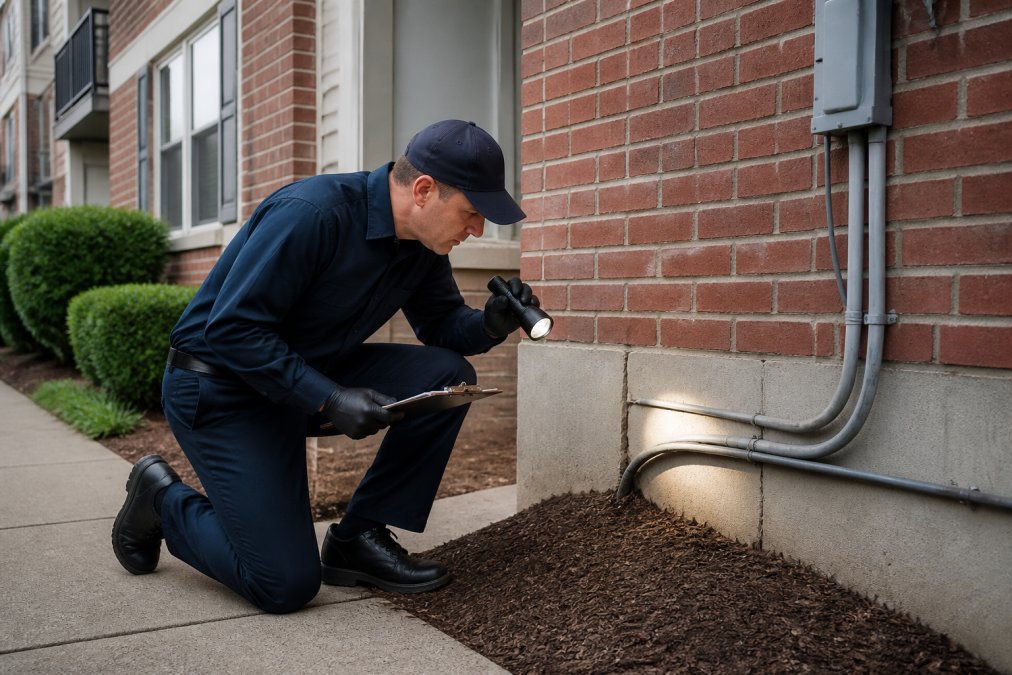
Preventative pest control is the most cost-effective approach for multi-family properties. It stops infestations before they spread across units, critical in apartment buildings where pests travel through shared walls, pipes, and ventilation systems.
(/pest-prevention-strategies-apartment-buildings/)]
Older Boston-area buildings with brick construction, shared walls, and decades-old plumbing are particularly vulnerable to rodents and cockroaches. A single unit’s infestation can become building-wide within weeks if not addressed immediately.
Preventative maintenance includes:
- Regular exterior inspections to identify and seal entry points
- Sealing gaps around pipes, utilities, and foundation cracks
- Installing or maintaining door sweeps and window screens
- Clearing debris and vegetation away from building foundations
- Inspecting common areas for signs of pest activity
- Educating tenants about sanitation and early reporting
A pest control contract for multi-family housing typically includes quarterly inspections and treatments, with additional visits triggered by tenant reports. This creates baseline protection while allowing surge capacity when needed.
Waiting for tenant complaints and calling for on-demand service leaves gaps. If one unit has pests but the tenant doesn’t report immediately, the infestation spreads to adjacent units, resulting in multiple treatment calls, higher costs, and potential habitability complaints from multiple tenants.
For multi-family properties, a contract-based approach usually makes financial and legal sense. The predictable cost prevents costly infestations and protects your liability position.
Financial Analysis: Contract vs On-Demand ROI
The financial comparison depends on your property type, pest pressure, and risk tolerance.

Contract Service Economics:
A contract typically costs $500-$1,000 per year for general pest control on a single-family rental or small multi-unit building. You pay whether you see pests or not. You have documented preventative treatment, strengthening your legal position if habitability questions arise.
For a landlord managing 5-10 properties, annual contract costs range from $2,500 to $10,000. This is predictable, budgetable, and insurable.
On-Demand Service Economics:
On-demand visits cost $100-$500 per service call. If you never have pest problems, your cost is zero. If you have one infestation per property per year, you might spend $200-$500 annually. But multiple infestations or seasonal surges can exceed contract pricing quickly.
A single bed bug infestation in a multi-unit building can require 3-5 professional treatments at $300-$500 each, totaling $900-$2,500. Add tenant turnover, cleaning, and potential lost rent while units are treated, and total impact reaches $2,000-$5,000.
The Hidden Cost of On-Demand:
On-demand service creates liability gaps. Delayed treatment documents negligence. If pests spread to other units before you respond, you face multiple treatment costs plus potential habitability claims. A tenant in Massachusetts can withhold rent or break a lease if you fail to remedy pest infestations within a reasonable timeframe.
Contract service builds in response time and creates a paper trail of preventative action, invaluable if a tenant later claims you failed to maintain habitability standards.
Hybrid Approach ROI:
Many landlords use a contract for baseline prevention (quarterly treatments) plus on-demand service for emergencies. This costs $600-$1,200 annually for the contract, plus occasional on-demand calls. The contract provides legal protection and prevents most infestations; on-demand handles unexpected seasonal issues.
For a landlord with 5 properties, a hybrid approach might cost $3,000-$6,000 annually, less than five emergency bed bug treatments and far cheaper than a habitability claim.
Contract service: predictable cost, legal documentation, prevents escalation. On-demand: lower baseline cost, higher risk of expensive emergencies. For most landlords, the hybrid approach delivers the best ROI.
Liability and Insurance: Who Pays When Pests Return
Pest control liability is a critical blind spot for many landlords. Your insurance policy may not cover pest-related damage or tenant claims, and your pest control provider’s guarantee has limits.
Most pest control contracts include a guarantee, often 30, 60, or 90 days, meaning if pests return within that period, the provider treats again at no charge. Zoifia Pest Control’s 90-day guarantee is stronger than typical industry standards, but even a 90-day guarantee has boundaries. It usually covers the specific pest treated in the specific area treated, not new infestations or pests in other units.
Landlord’s Liability: You’re responsible for maintaining habitability. Failure to address a known pest infestation allows tenants to withhold rent, break leases, or file complaints with housing authorities. You could face civil claims for damages.
Tenant’s Liability: If the infestation results from tenant negligence, hoarding, or unsanitary conditions, some liability shifts to the tenant. But proving this requires documentation showing you offered treatment and the tenant refused access or created conditions that attracted pests.
Pest Control Provider’s Liability: The provider guarantees their work within contract terms. If they treat for cockroaches and cockroaches return within 30 days, they retreat at no charge. But they don’t cover tenant claims or habitability violations.
Insurance Implications:
Standard landlord insurance policies typically don’t cover pest control costs or pest-related damage. You should:
- Review your policy to understand pest coverage limits
- Ask your insurer whether pest control is covered under maintenance or excluded
- Consider adding a rider if pest coverage is important
- Document all pest control efforts to strengthen your position if a claim arises
A contract service provides documented proof of preventative action. On-demand service provides proof only of reactive treatment. From an insurance and liability perspective, the contract creates a stronger defense.
How to Choose the Right Pest Control Strategy for Your Properties
The right strategy depends on your specific situation. Ask yourself:
1. What’s your property type? Single-family rentals have lower pest pressure than multi-unit buildings. Single-family homes might use on-demand service; 10-unit buildings almost always benefit from a contract.
2. What’s the building age and condition? Older buildings with structural issues need preventative contracts. Newer, well-maintained buildings can often rely on on-demand service.
3. What’s your tenant turnover rate? High turnover increases pest risk. High-turnover properties benefit from contracts.
4. What pests are common in your area? Boston-area landlords face significant rodent and cockroach pressure, especially in older housing stock. Seasonal bed bug surges are also common. These warrant contract service.
5. What’s your risk tolerance? If you can’t afford a habitability claim or tenant withholding, contract service is worth the premium. If you have strong cash flow and can respond quickly to emergencies, on-demand is viable.
6. How many properties do you manage? One or two properties? On-demand might work. Five or more? A contract becomes economically sensible.
Practical Decision Framework:
- Choose Contract If: Multi-unit building, older construction, high tenant turnover, or low risk tolerance
- Choose On-Demand If: Single-family rental, new/well-maintained property, low turnover, strong cash flow
- Choose Hybrid If: Managing multiple properties, mixed property ages, or seasonal pest pressure
At Zoifia Pest Control, we work with landlords using both approaches. Some start with on-demand service and upgrade to a contract after experiencing an infestation. Others use quarterly contracts for baseline prevention and call for on-demand service when seasonal issues spike.
Document your approach in your lease agreement. Tenants should know whether you’re using contract or on-demand service, what their responsibilities are for reporting, and how quickly you’ll respond to complaints.
| Strategy | Best For | Annual Cost Range | Key Advantage | Main Drawback |
|---|---|---|---|---|
| Contract Service | Multi-unit buildings, older properties, high turnover | $500-$1,000+ per property | Documented prevention, predictable costs, liability protection | Higher baseline cost even if no pests present |
| On-Demand Service | Single-family rentals, new construction, low turnover | $0-$500+ per property (variable) | Lower baseline cost, flexibility | Liability gaps, higher emergency costs, reactive only |
| Hybrid Approach | Multiple properties, mixed conditions, moderate risk | $600-$1,200+ per property annually | Balanced prevention and flexibility, strong documentation | More complex to manage |
The pest control contract vs on-demand decision shapes your entire property management strategy. Contract service provides legal documentation, prevents costly escalations, and aligns with your habitability obligations. On-demand service offers flexibility and lower baseline costs but leaves you vulnerable to infestations spreading and tenant claims.
For landlords in the Boston area managing rental properties, the hybrid approach, quarterly contract service for prevention plus on-demand calls for emergencies, typically delivers the best return on investment. It protects your legal position, prevents expensive infestations, and maintains flexibility for seasonal surges.
Zoifia Pest Control specializes in flexible pest management for landlords and property managers across Metro Boston. Our 90-day guarantee and no-contract-necessary approach let you start with on-demand service and scale to contract-based prevention as your needs evolve. Get a quote today and protect your properties without long-term commitments.
Frequently Asked Questions
Are landlords legally required to provide pest control in the US?
Landlord responsibility for pest control varies by state and local housing codes. Most states recognize an implied warranty of habitability, which requires landlords to maintain properties free of infestations that affect health and safety. However, some states place responsibility on tenants if the infestation results from tenant negligence or poor sanitation. Check your state and local housing laws to clarify your specific obligations. Massachusetts, for example, enforces strict habitability standards that typically require landlords to address pest infestations promptly.
What should a pest control lease clause template include?
A strong pest control addendum should specify: (1) who is responsible for routine preventative pest control and emergency extermination, (2) whether the landlord will conduct quarterly inspections or only respond to tenant reports, (3) whether tenants must maintain sanitation standards to prevent infestations, (4) how quickly the landlord will respond to pest complaints, and (5) whether costs are covered by rent or billed separately. It should also clarify that bed bugs, rodents, and structural pests are typically landlord responsibility, while tenant-caused infestations may be billed to the tenant. Include language requiring tenants to report infestations within 24-48 hours.
What's the main advantage of a pest control contract over on-demand service?
Contracts provide predictability and prevention. Regular quarterly or monthly treatments catch infestations early before they spread across units or cause property damage. For multi-family housing, contracts reduce emergency callouts and tenant complaints. The trade-off is higher upfront cost and less flexibility. On-demand service costs less initially but leaves you vulnerable to surprise infestations and higher emergency fees. Contracts also typically include a guarantee, if pests return between scheduled visits, the provider retreats at no charge.
Can I pass pest control costs to tenants in Massachusetts?
Massachusetts law generally prohibits landlords from charging tenants for pest control related to structural infestations (rodents, termites) or conditions caused by building defects. However, you may charge tenants for pest control if the infestation is directly caused by tenant negligence, such as unsanitary conditions or failure to seal food waste. Document the cause carefully and include clear language in your lease about tenant sanitation responsibilities. For preventative pest control in common areas, costs typically remain the landlord's responsibility. Consult local housing authorities or a property management attorney to confirm current regulations.
How quickly can pest control companies respond to emergency infestations?
Response time varies by provider and location. National providers like Terminix and Orkin typically offer same-day or next-day scheduling in urban areas like the Boston metro. Local providers like Zoifia Pest Control often provide faster response times, sometimes within hours for urgent situations like bed bug infestations. On-demand platforms like Pest Share can match requests with local providers within 48 hours in most areas. Contract plans often include emergency clauses guaranteeing faster response than standard on-demand services. For urgent infestations, always call directly rather than relying on online scheduling.
This article was written using GrandRanker
