Table of Contents
- What Are Landlord Pest Control Responsibilities in Massachusetts?
- Massachusetts Sanitary Code Pest Control Standards
- Tenant Rights and Pest Control in Massachusetts
- Who Pays for Pest Control in a Rental Property in Massachusetts?
- How to Notify Your Landlord of a Pest Problem in Massachusetts
- Step-by-Step Dispute Resolution for Pest Control Issues
- Hiring Licensed Pesticide Applicators and Record Keeping
- Multi-Unit vs. Single-Family Property Pest Control Nuances
Landlord Pest Control Responsibilities in Massachusetts: A Legal Guide
Last Updated: July 28, 2026
Understanding landlord pest control responsibilities in Massachusetts is essential for staying compliant with state law and avoiding costly disputes. Massachusetts imposes strict obligations on landlords, not tenants, when it comes to pest infestations. According to the Massachusetts Sanitary Code (105 CMR 410), landlords must maintain rental properties free from pest infestations. Below, we’ll walk you through the specific legal requirements, your financial obligations, how to handle disputes, and the practical steps to protect yourself legally.
What Are Landlord Pest Control Responsibilities in Massachusetts?
The implied warranty of habitability is the cornerstone of Massachusetts landlord-tenant law. This legal principle requires landlords to provide rental units that are safe, sanitary, and fit for human occupancy. A pest-infested apartment violates this warranty because it creates unsanitary conditions and poses health risks.
The Massachusetts Supreme Judicial Court has recognized that pest infestations breach the implied warranty of habitability. Tenants have legal recourse if you fail to address the problem promptly: they can withhold rent, break their lease without penalty, or file a complaint with the local health department. This obligation applies regardless of whether your lease explicitly mentions pest control.
Document everything from day one. Take photos of the property before a tenant moves in, keep records of all pest control treatments, and maintain a file of tenant communications about pest issues. This documentation becomes critical if a dispute escalates to court.
105 CMR 410: Massachusetts Sanitary Code Requirements
Massachusetts Sanitary Code section 105 CMR 410 requires that residential buildings be maintained in a sanitary condition and free from pest infestations. Landlords must take affirmative steps to prevent and eliminate pest infestations through sealing cracks, maintaining proper sanitation in common areas, and addressing structural issues that allow pests to enter.
Health departments enforce the Sanitary Code by conducting inspections and issuing notices of violation when standards aren’t met. A notice of violation triggers mandatory remediation timelines, and failure to comply can result in fines. The code also requires that landlords use licensed pesticide applicators for chemical treatments, you cannot hire unlicensed individuals or attempt DIY pest control with restricted pesticides.
105 CMR 410 creates a legal duty independent of your lease. Even if your lease says tenants are responsible for pest control, the Sanitary Code overrides that provision.
Pests Covered Under State Law
Massachusetts Sanitary Code applies to all pest infestations that affect habitability and sanitation. Rodent infestations are particularly serious because they pose direct health risks through contamination and disease spread. A single rodent sighting typically triggers a landlord’s obligation to conduct full pest control treatment and implement rodent-proofing measures.
Cockroach infestations are explicitly covered and treated as serious sanitation violations. Bed bugs, while not disease-transmitting, cause significant distress and are difficult to eliminate; Massachusetts courts recognize bed bug infestations as a breach of the implied warranty of habitability. Other covered pests include ants, fleas, termites, and wasps when they affect the safety or sanitation of the rental unit.
Common Areas vs. Individual Rental Units
Common areas, hallways, basements, stairwells, laundry rooms, and shared outdoor spaces, are always your responsibility as the landlord. You must maintain these areas pest-free because you have exclusive control over them.
For individual rental units, you’re responsible for eliminating infestations that originate from building defects or conditions you control. Tenant behavior can contribute to pest problems, but Massachusetts courts have held that you still have an obligation to provide a pest control solution even if tenant negligence contributed. For multi-unit buildings, if an infestation in the basement or walls spreads to individual units, you’re liable for treatment of those units as well.
Never assume that a pest problem in one unit is isolated. Rodents and cockroaches move through walls and shared spaces. If one unit has an infestation, treat the entire building or risk a cascade of tenant complaints and health department violations.
Tenant Maintenance Obligations
Tenants must keep their units clean, dispose of garbage properly, and report pest problems promptly. However, tenant maintenance obligations are limited. A tenant cannot be held responsible for infestations caused by structural defects, building-wide pest pressure, or conditions in common areas. If the building has gaps around pipes, cracks in the foundation, or poor sealing of entry points, those are landlord responsibilities.
Tenant cooperation is essential for successful pest control. Even if you hire a licensed pest control professional, the treatment won’t work if the tenant won’t allow access or continues to create unsanitary conditions. Clear communication about the tenant’s role in the pest control process is important.
When Tenants Can Withhold Rent or Break a Lease
If you don’t address a pest problem within a reasonable timeframe, typically 14 days for serious infestations like rodents or bed bugs, tenants can legally withhold rent. Tenants can also break their lease without penalty if the rental unit becomes uninhabitable due to a pest infestation.
For severe infestations, 14 days is typically considered reasonable. Courts also consider whether you’ve taken immediate action; scheduling a pest control professional within a few days demonstrates good faith even if full treatment takes longer. Tenants can also file a health department complaint, which strengthens their legal position if they later withhold rent or break the lease.
How to Notify Your Landlord of a Pest Problem in Massachusetts
Tenants should provide written notice of a pest problem via email, text message, or letter. Written notice creates a paper trail valuable if disputes escalate. The notice should describe the pest problem, when it was first observed, and affected areas.
Landlords should respond within 24 hours by acknowledging receipt and providing a timeline for addressing the problem. Many landlords use a pest control complaint form that captures essential information: pest type, location, when first noticed, and frequency of sightings.
Create a simple written process for pest complaints. Provide tenants with an email address or phone number for pest-related issues, and commit to responding within 24 hours. This demonstrates good faith and reduces escalation risk.
Documentation and Written Notice Requirements
Documentation is your primary defense if a pest control dispute escalates to court or involves a health department investigation. For each pest complaint, document the date received, pest type, affected unit or area, date you contacted a pest control professional, treatment date, and follow-up results.
Pest control companies should provide detailed reports after each treatment, including date of service, pesticides used, areas treated, and recommendations for follow-up. Photographs before and after treatment provide visual evidence that you addressed the problem. This documentation proves you hired a licensed professional and supports any claims for tenant reimbursement.
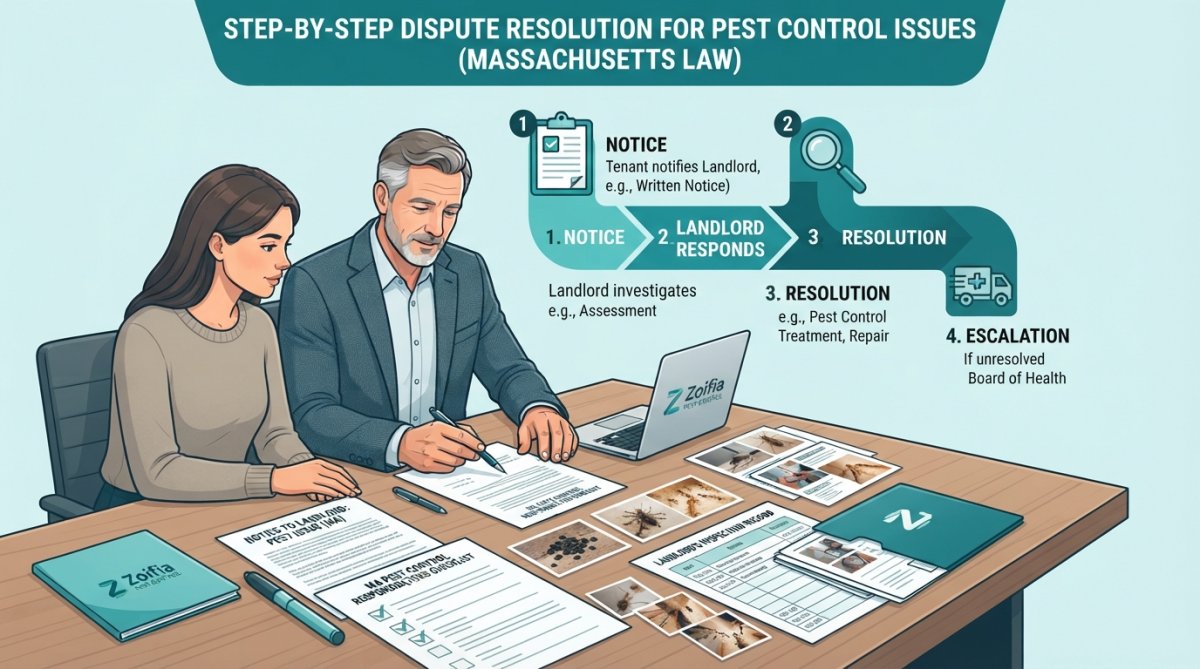
Step-by-Step Dispute Resolution for Pest Control Issues
Step 1: Receive and Acknowledge the Complaint
Respond within 24 hours. For severe infestations (rodents, bed bugs), commit to scheduling a pest control professional within 3 business days. For less severe problems, 7-10 days is reasonable.
Step 2: Schedule a Licensed Pest Control Professional
Contact a licensed pest control company and schedule an inspection and treatment. Provide details from the tenant’s complaint so the professional can prepare appropriately.
Step 3: Notify the Tenant of the Scheduled Treatment
Inform the tenant of the date and time the pest control professional will visit. Provide information about any preparation needed and confirm access to the unit.
Step 4: Conduct the Treatment
Ensure the pest control professional completes thorough treatment. Request a detailed written report after completion.
Step 5: Follow Up with the Tenant
After treatment, contact the tenant to confirm pest activity has stopped. If the problem persists, schedule a follow-up treatment.
Step 6: Implement Prevention Measures
Work with the pest control professional to identify and address conditions that allowed the infestation, such as sealing cracks, improving drainage, or removing clutter in common areas.
Step 7: Resolve Financial Disputes
If you believe tenant negligence contributed to the infestation, provide a detailed invoice and explain which costs you’re requesting reimbursement for. Be prepared to negotiate; Massachusetts courts are skeptical of landlord claims that tenants should bear full responsibility.
Pre-Occupancy Inspections and Prevention
The best pest control strategy is prevention. Before a new tenant moves in, conduct a thorough pre-occupancy inspection to identify and address any existing pest problems. This protects you by preventing the incoming tenant from inheriting a pest-infested unit and creates documentation that any pest problems arising during the tenancy are not your responsibility.
A pre-occupancy inspection should include visual examination of the entire unit, including closets, cabinets, and spaces behind appliances. Look for signs of pest activity: droppings, dead insects, gnaw marks, or musty odors. Check the exterior for gaps, cracks, or other entry points.
If you discover pest problems during inspection, hire a licensed pest control professional to treat the unit before the tenant moves in. Prevention measures should include sealing entry points, maintaining proper drainage, removing harborage areas, and keeping common areas clean.
Health Department Complaints and Notice of Violation
If a pest infestation is severe or you’re not responding promptly, a tenant may file a complaint with the local health department. The health department will conduct an inspection and, if they find a violation of the Sanitary Code, issue a notice of violation requiring remediation within a specific timeframe, often 7-14 days for serious pest infestations.
A notice of violation creates legal liability and formal documentation that your property violates state housing standards. If a tenant later withholds rent or breaks their lease, they can cite the health department violation as evidence that you breached the implied warranty of habitability. Failure to comply can result in fines or legal action.
To avoid health department complaints, respond promptly to tenant pest reports and maintain documentation of your actions. Some landlords use health department violations as motivation to implement building-wide pest prevention measures.
Hiring Licensed Pesticide Applicators and Record Keeping
Massachusetts law requires that pesticide applications in residential rental properties be conducted by licensed pesticide applicators. You cannot hire unlicensed individuals or attempt to apply restricted pesticides yourself.
A licensed pesticide applicator holds a state license from the Massachusetts Department of Agricultural Resources. When you hire a pest control company, verify that they employ licensed applicators and that their license is current.
The pest control company should provide documentation of pesticides used, application method, and date of application. Keep these documents for at least three years, as they may be needed if a health department inspector visits or if a dispute arises with a tenant.
Build a relationship with a licensed pest control professional who understands Massachusetts rental property requirements. A good pest control company will provide detailed documentation, follow up on treatments, and help you implement prevention measures.
Pest Control Records and Legal Compliance Documentation
Maintaining detailed pest control records is critical for legal compliance and liability protection. Your records should include:
- Date of tenant complaint or initial observation
- Description of the pest problem
- Date you contacted the pest control company
- Name and license number of the pest control professional
- Date and time of treatment
- Pesticides or treatments used
- Areas treated
- Cost of treatment
- Follow-up dates and results
- Photographs before and after treatment
- Tenant communications regarding the issue
These records demonstrate that you acted promptly and hired licensed professionals, protect you if a tenant claims you breached the implied warranty of habitability, provide documentation for health department requirements, and create a historical record that helps identify patterns.
Multi-Unit vs. Single-Family Property Pest Control Nuances
The legal requirements for pest control are the same for single-family and multi-unit properties, but practical challenges differ. Multi-unit buildings present unique challenges because infestations can spread between units through shared walls, pipes, and common areas.
In a multi-unit building, a rodent infestation in one unit often indicates a building-wide problem. Treating a single unit without addressing the broader building issue is ineffective. Cockroach infestations spread rapidly between units, and individual unit treatments are often ineffective without coordinated building-wide pest control.
For single-family properties, pest control is typically more straightforward. However, you still need to address structural defects and prevention measures to prevent recurrence.
Bed bugs present a special challenge in multi-unit buildings because they spread through walls, electrical outlets, and shared spaces. Treatment of a single unit is often ineffective if neighboring units are also infested, making comprehensive building-wide bed bug treatment necessary.
| Property Type | Primary Challenge | Typical Response | Prevention Priority |
|---|---|---|---|
| Single-family | Structural defects | Individual unit treatment + sealing | Exterior sealing, drainage |
| Multi-unit | Spread between units | Building-wide treatment + common area focus | Common area maintenance, entry sealing |
| Older buildings | Rodent/cockroach pressure | Comprehensive IPM strategy | Structural repairs, gaps, cracks |
| Dense urban areas | High pest pressure | Regular monitoring + preventive treatment | Exterior maintenance, entry points |
Dealing with pest control issues in a Massachusetts rental property can feel overwhelming. The good news is that a clear process, prompt response, licensed professionals, and thorough documentation protect you legally and resolve most disputes before they escalate. At Zoifia Pest Control, we specialize in helping landlords meet Massachusetts Sanitary Code requirements with fast, reliable treatments backed by a 90-day guarantee. Whether you’re dealing with rodents, cockroaches, bed bugs, or other household pests, our licensed and insured team responds quickly and provides detailed documentation for your records. Get a quote from Zoifia Pest Control today and eliminate the uncertainty from your pest control obligations.
Frequently Asked Questions
Is a landlord responsible for pest control in Massachusetts?
Yes. Under Massachusetts law, landlords must maintain rental properties in compliance with the Sanitary Code (105 CMR 410) and the implied warranty of habitability. This includes providing pest-free dwellings and addressing infestations like rodents and cockroaches. Landlords must hire licensed pesticide applicators for extermination and bear the cost of pest control to meet legal compliance standards.
What pests are landlords responsible for in Massachusetts?
The Massachusetts Sanitary Code requires landlords to maintain rental units free from rodent infestation, cockroach infestations, and other pests that violate sanitation standards. Common areas must also be pest-free. Landlords are responsible for rodent-proofing structures and implementing Integrated Pest Management (IPM) strategies. Tenants must report infestations promptly, but the landlord remains liable for extermination.
What should I include when notifying my landlord of a pest problem in Massachusetts?
Send written notice describing the pest type, location, date first observed, and frequency of sightings. Include photos if possible. Document all communication in writing, email is ideal for a record. Reference the Massachusetts Sanitary Code violation and request a specific timeline for extermination. Keep copies of all notices. Written documentation protects you if you need to file a health department complaint or pursue rent withholding.
Can a landlord charge a tenant for pest control in Massachusetts?
No. Landlords cannot charge tenants for pest control required to meet Sanitary Code standards. However, if an infestation results from tenant negligence (e.g., unsanitary conditions), some costs may be deductible from the security deposit. Tenants are responsible for maintaining sanitation and reporting problems promptly. Dispute this charge by documenting that the infestation was pre-existing or structural.
What is the Massachusetts Sanitary Code requirement for pest control?
105 CMR 410 requires landlords to maintain rental properties free from rodent and cockroach infestations and other pests that pose health hazards. Buildings must be rodent-proofed, common areas must be pest-free, and landlords must use licensed pesticide applicators for extermination. Pest control records must be maintained. Violations result in a notice of violation from the health department.
Can a tenant withhold rent for pests in Massachusetts?
Yes, under certain conditions. If a landlord fails to address a serious pest infestation after written notice, tenants may pursue rent withholding or repair-and-deduct remedies. However, proper notice and documentation are critical. Tenants should first provide written notice, allow reasonable time for response, then contact the health department. Consult a tenant rights organization before withholding rent to ensure compliance with Massachusetts law.
What does the 90-day guarantee from Zoifia Pest Control cover?
Zoifia's 90-day guarantee means if pests return within 90 days of treatment, we'll return to retreat at no additional cost. This covers the specific pest type treated and applies to both residential and commercial properties. The guarantee reflects our confidence in our licensed and insured services. For specifics about your situation, contact us for a quote, no long-term contract required.
This article was written using GrandRanker
