Table of Contents
- Does Steel Wool Stop Mice From Entering?
- Best Grade of Steel Wool for Mice Protection
- How to Properly Install Steel Wool for Rodent Exclusion
- How to Seal Mouse Holes With Steel Wool and Sealants
- Copper Mesh vs. Steel Wool for Mice: Which Works Better?
- Troubleshooting Failed Steel Wool Barriers
- When to Combine Steel Wool With Professional Pest Control
- Conclusion: Steel Wool as Part of Your Rodent Exclusion Strategy
Last Updated: July 13, 2026
Does Steel Wool Stop Mice From Entering?
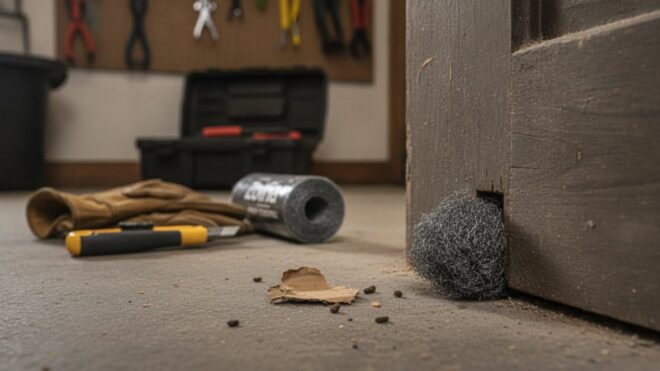
Steel wool stops mice from entering when properly installed, but only as part of a layered defense. Mice cannot chew through metal fibers, but they will pull out unsecured wool within days. The real solution combines steel wool with expanding foam and caulk to create a barrier mice cannot breach or dismantle.
Steel wool stops mice temporarily, but only when properly installed and sealed. Unsecured wool can be pulled out in days. The real power comes from combining steel wool with expanding foam and caulk.
Why Mice Chew Through Barriers
Mice chew to explore and access food, not from aggression. Their teeth grow continuously, and chewing keeps them worn down. A quarter-inch gap is large enough for a mouse to squeeze through. Once they find an opening near food sources or warm areas, they work persistently until they breach it or find an easier route.
Most DIY attempts fail because they focus only on blocking entry without understanding mouse behavior. Mice follow scent trails and established pathways. Research shows rodent exclusion requires multiple layers of defense. Steel wool alone is insufficient, it must be combined with materials mice cannot pull out or dismantle.
Mice can pull out unsecured steel wool in as little as 2-3 days. If the wool is the only barrier, you’re not solving the problem, you’re just delaying it. Always pair steel wool with a secondary sealant.
The Limitations of Steel Wool Alone
Steel wool stops chewing but has critical limitations. Mice can grab individual strands and pull them out gradually, creating a pathway through what appears to be a solid barrier. This is especially true if the wool is simply stuffed without compression or securing.
Durability is another issue. Regular steel wool rusts in damp environments like basements and crawl spaces, deteriorating within months. Stainless steel wool resists rust but costs more and still pulls out if unsecured.
Steel wool also doesn’t fill gaps effectively. A one-inch hole stuffed with wool leaves air pockets where mice can squeeze through. The wool compresses over time, and settling creates new gaps around the barrier’s perimeter.
Most critically, steel wool cannot be painted or sealed directly. You need a secondary sealant to lock it in place. Without this step, your installation fails within weeks.
Best Grade of Steel Wool for Mice Protection
Not all steel wool is equal. Coarse grades are essential for mice protection; fine grades are too soft and easily pulled apart.
Coarse Grade vs. Fine Grade
Coarse-grade steel wool (#0 or #1) has thicker, more rigid fibers that resist pulling. When compressed into a gap, it creates a dense, tangled barrier difficult for mice to manipulate. Fine-grade wool (#0000 or #000) is softer, compresses too easily, and mice can pull it apart with minimal effort.
Always use coarse-grade steel wool. The cost difference is minimal, but performance difference is dramatic.
Stainless Steel vs. Regular Steel Wool
Regular steel wool rusts when exposed to moisture, weakening the fiber structure. Stainless steel wool resists rust and maintains integrity in damp environments. For long-term exclusion in moisture-prone areas, stainless steel is worth the 2-3x higher cost. A stainless barrier lasts years; regular wool may need replacement within 1-2 years in damp conditions.
For dry areas, regular steel wool is acceptable. For any moisture risk, invest in stainless steel wool.
Buy stainless steel wool in bulk. A large box costs less per ounce than individual packages and ensures consistent material throughout your project.
How to Properly Install Steel Wool for Rodent Exclusion
Installation quality determines success or failure. Proper installation requires identifying entry points, preparing the area, and securing the wool with sealants.
Identifying Mouse Entry Points
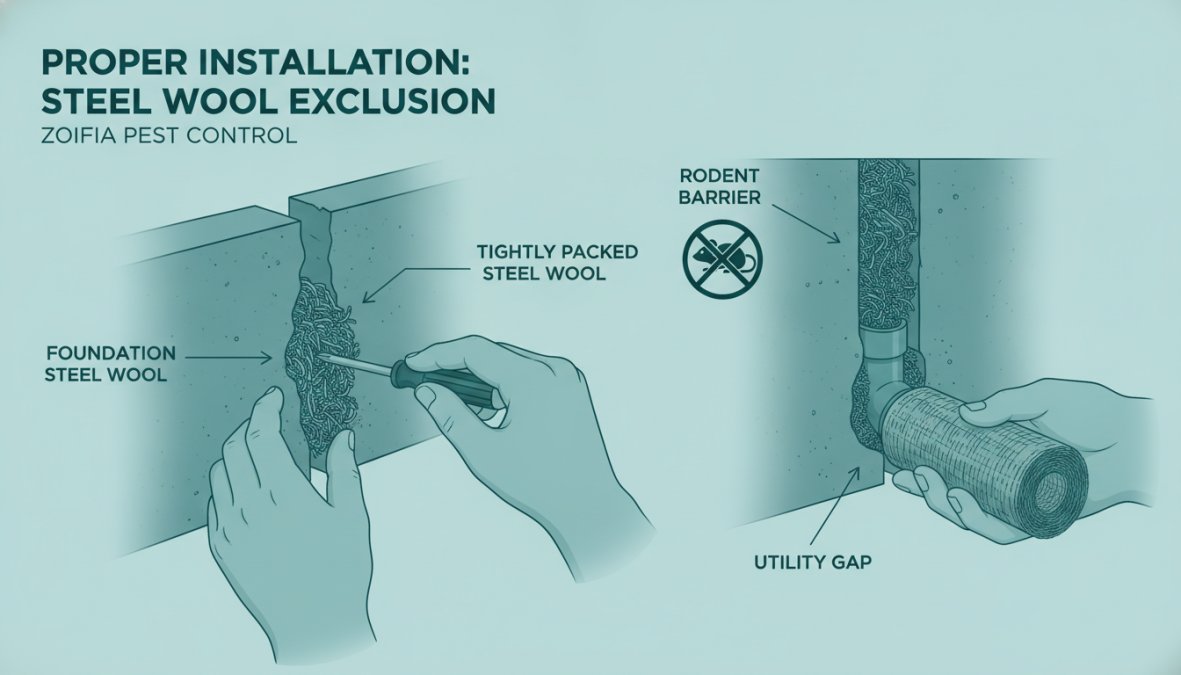
Systematically inspect your property’s exterior and vulnerable interior areas. Examine the foundation perimeter where it meets the ground for cracks and gaps where pipes or utility lines pass through. Check all utility penetrations, water pipes, gas lines, electrical conduits, and HVAC ducts are prime entry points. Inspect roof lines, soffit areas, and foundation cracks. Check door and window frames for gaps and damaged weatherstripping.
Mark entry points clearly, take photos, and note size and location. This creates your work list and helps estimate material needs.
Step-by-Step Installation Process
Step 1: Clean and Prepare the Gap (5-10 minutes)
Remove debris, old sealant, or damaged material. Use a wire brush to clean loose particles. The surface must be clean for wool and sealant to adhere properly. Allow wet gaps to dry completely.
Step 2: Compress Steel Wool Into the Gap (5-15 minutes)
Pack coarse-grade steel wool firmly into the gap using a gloved hand or wooden dowel. Density is critical, the wool should be difficult to pull out by hand. Don’t just stuff it loosely; compress each addition. Fill completely with no air pockets.
Step 3: Apply Expanding Foam (2-3 minutes)
Apply low-expansion foam around the wool’s perimeter, not directly on top. The wool should remain visible. Allow foam to cure per product instructions, typically 24 hours.
Step 4: Trim Excess Foam and Apply Caulk (5-10 minutes)
Trim excess foam flush with the surrounding surface. Apply paintable caulk over the foam and around the steel wool in a smooth, continuous bead. Smooth with a wet finger or caulk tool.
| Step | Duration | Key Point |
|---|---|---|
| Clean and prepare | 5-10 min | Remove all debris and old sealant |
| Compress steel wool | 5-15 min | Pack tightly with no air pockets |
| Apply expanding foam | 2-3 min | Use low-expansion foam around perimeter |
| Trim and caulk | 5-10 min | Seal all gaps with paintable caulk |
How to Seal Mouse Holes With Steel Wool and Sealants
The most effective strategy combines steel wool with multiple sealants using the "Sealant Sandwich" technique: steel wool in the center, flanked by expanding foam on both sides, sealed with caulk.
The Sealant Sandwich Technique
Pack steel wool into the hole but not completely. Leave a small gap on one side. Apply expanding foam to fill that gap. Once cured, pack more steel wool into remaining space, then apply another foam layer. Finally, seal with caulk.
This multi-layer approach provides redundancy. If mice pull out one section of wool, foam blocks their progress. If they find a gap in foam, the second wool layer stops them. This is what professional pest control services use because it works.
The Sealant Sandwich is especially valuable for foundation cracks and large utility penetrations. For small gaps (less than half-inch), a single wool layer plus foam and caulk suffices. For larger gaps, the sandwich technique provides long-term security.
Combining Steel Wool With Expanding Foam and Caulk
Steel wool provides resistance for expanding foam, preventing excessive expansion that cracks surrounding material. Caulk provides the final seal and finished surface. Choose paintable, flexible caulk that accommodates minor structural movement. Acrylic latex caulk is easier to work with; silicone is more durable but cannot be painted.
Always install steel wool first, then foam, then caulk. Installing caulk before foam traps air pockets that weaken the barrier. For utility penetrations, this combination is essential. Check these areas annually because settling can create new gaps.
Use a caulk backer rod for gaps wider than half-inch. Insert the rod before applying foam and caulk. This prevents caulk from sinking too deep and ensures proper seal. Backer rods are inexpensive and significantly improve durability.
Copper Mesh vs. Steel Wool for Mice: Which Works Better?
Copper mesh (also called copper screen or rodent mesh) is a woven metal screen with small openings (typically 1/4-inch). Unlike loose steel wool fibers, copper mesh is rigid and cannot be pulled apart or compressed. Mice cannot chew through or deform it.
Comparing Physical Barriers and Durability
Steel wool’s advantage is flexibility, it conforms to irregular gaps and compresses into tight spaces without special tools. The disadvantage is that it can be pulled out if unsecured.
Copper mesh’s advantage is rigidity and durability. It cannot be pulled apart or compressed and resists rust indefinitely, lasting 20+ years. The disadvantage is difficulty installing in irregular gaps, it requires heavy-duty shears and careful fitting to ensure no perimeter gaps.
For foundation cracks and irregular gaps, steel wool is easier. For clean utility penetrations, copper mesh is superior. Many professionals use both: copper mesh for primary entry points and steel wool for secondary gaps.
Durability strongly favors copper mesh. A properly installed copper mesh barrier lasts 20+ years. Steel wool may need replacement every 1-2 years in damp environments.
Cost and Rust-Resistance Considerations
Steel wool is inexpensive, a large box costs a few dollars. Stainless steel wool costs $5-15 per box. Copper mesh costs $20-50+ per roll, but the cost per year of protection is lower due to longevity.
Rust-resistance is critical in damp environments. Regular steel wool rusts within 1-2 years in basements. Stainless steel wool resists rust. Copper mesh never rusts and requires no maintenance.
For dry climates, regular steel wool is cost-effective. For humid or damp climates, choose between stainless steel wool and copper mesh based on budget and long-term durability needs.
Troubleshooting Failed Steel Wool Barriers
Barriers can fail even when installed correctly. Understanding common failure points helps diagnose and prevent problems.
Visual Inspection Checklist
Inspect barriers twice yearly, in spring and fall:
- Is the steel wool still visible and intact, or pulled out?
- Is the expanding foam intact, or cracked or separated?
- Is the caulk bonded, or peeling or cracking?
- Are there new gaps or cracks around the sealed area?
- Is there evidence of mouse activity near the sealed area?
- Has rust developed on regular steel wool?
- Are there gaps between foam and surrounding material?
- Is the caulk still flexible, or brittle and cracked?
Address problems immediately rather than waiting for mice to exploit them.
Common Installation Mistakes
Under-packing steel wool is the most common mistake. Loosely stuffed wool compresses over time, creating space for mice to pull it out. The wool should be so tightly compressed that you cannot easily pull it out by hand.
Other mistakes include applying caulk before foam fully cures (caulk cracks as foam hardens), failing to seal around the perimeter (mice go around your barrier), using wrong-grade wool, and neglecting utility penetrations, high-traffic mouse routes that should be your top priority.
When to Combine Steel Wool With Professional Pest Control
Steel wool and sealants are excellent preventive measures but not complete solutions for active infestations. If you already have mice inside, sealing entry points prevents new mice from entering but won’t eliminate existing ones.
Professional pest control services combine rodent exclusion with active trapping and removal. A licensed team identifies missed entry points, installs commercial-grade barriers, and sets traps to eliminate existing mice. Zoifia Pest Control’s 90-day guarantee ensures pest-free protection without long-term contracts.
Combine steel wool barriers with professional pest control for active infestations. Use steel wool alone for preventive measures in currently pest-free homes.
Conclusion: Steel Wool as Part of Your Rodent Exclusion Strategy
Steel wool stops mice when properly installed and combined with secondary sealants. Coarse-grade, stainless steel wool is best for durability. The Sealant Sandwich Technique provides redundancy for long-term protection.
Rodent exclusion is cost-effective pest prevention when done correctly. Zoifia Pest Control can assess your property’s vulnerabilities, identify missed entry points, and install professional-grade barriers. Our licensed and insured team provides fast, reliable solutions backed by a 90-day guarantee with no long-term contracts. Get a quote today and stop worrying about mice entering your home.
Frequently Asked Questions
Does steel wool actually stop mice from entering homes?
Steel wool can be effective at blocking mice entry points when properly installed, but it works best as part of a comprehensive rodent exclusion strategy. Mice can pull out loose steel wool over time, which is why securing it with expanding foam, caulk, or silicone sealant significantly increases its effectiveness. Steel wool alone is a deterrent and physical barrier, but combining it with other sealants creates a chew-proof barrier that mice cannot penetrate.
What is the best grade of steel wool for mice prevention?
Coarse grade steel wool (typically #2 or #3) is most effective for rodent proofing. Coarse grades are harder for mice to pull apart and more resistant to burrowing than fine grades. Stainless steel wool is preferable to regular steel wool because it resists rust and degradation over time, maintaining its structural integrity as a long-term physical barrier. Grade #2 coarse stainless steel offers the best balance of durability and mice-blocking capability.
How do I seal mouse holes properly to prevent re-entry?
Use the Sealant Sandwich Technique: pack steel wool into the hole first, then apply expanding foam around it, and finally seal the exterior with caulk or silicone sealant. This three-layer approach prevents mice from pulling out the wool and eliminates gaps where they might re-enter. Focus on gaps and crevices around utility lines, foundation cracks, and ventilation gaps, these are common entry points. Inspect quarterly to ensure the barrier maintains its structural integrity.
Can mice chew through steel wool barriers?
Mice cannot chew through steel wool itself, but they can pull it out if it's not secured properly. This is why installation method matters more than material alone. Loose steel wool will be extracted over time as nesting material. When packed tightly and reinforced with expanding foam and caulk, steel wool becomes part of a rodent exclusion system that mice cannot penetrate. Proper installation is the key difference between a failed barrier and an effective one.
This article was written using GrandRanker
