Table of Contents
- Are Bed Bug Heat Treatments Worth the Cost? The Verdict
- Bed Bug Heat Treatment Cost Breakdown by Square Footage
- Chemical vs. Heat Treatment for Bed Bugs: Effectiveness & Trade-offs
- How Long Does Bed Bug Heat Treatment Take? Timeline & Process
- Why Heat Treatment Costs More: Understanding the Premium
- Professional Heat Treatment vs. DIY Equipment: Cost-Benefit Analysis
- Post-Treatment Monitoring & Insurance: Hidden Value & Coverage
- Is Heat Treatment Worth It? When to Choose This Method
Last Updated: June 21, 2026
Bed bug infestations are psychologically exhausting, and homeowners weighing remediation options face a significant financial decision: pay a premium for thermal treatment or try cheaper chemical alternatives and risk retreatment. This guide breaks down the real cost structure, effectiveness data, and scenarios where heat treatment delivers genuine return on investment.
The short answer: for moderate to severe infestations, professional heat treatment is almost always worth the investment. For minor, localized cases, the calculus is more nuanced.
Are Bed Bug Heat Treatments Worth the Cost? The Verdict
Professional bed bug heat treatment is worth the cost when infestations are widespread, households cannot tolerate chemical pesticides, or previous chemical treatments have failed. Thermal remediation kills bed bugs at all life stages, including eggs, in a single treatment session, the core value proposition justifying the higher price.
The real question isn’t whether heat treatment works. It does. The question is whether your specific situation warrants the premium. A localized infestation in one piece of furniture differs dramatically from a whole-home infestation across multiple rooms.
A common mistake is comparing upfront costs without accounting for retreatment probability. Chemical pesticides often require multiple visits because they don’t penetrate eggs effectively. Heat treatment achieves egg mortality in a single session by sustaining lethal temperatures throughout the structure. That difference in retreatment probability significantly changes total cost of ownership.
The real cost comparison isn’t heat vs. chemical on day one. It’s total spend across 60-90 days, including retreatments, lost productivity, and replacement of discarded items.
Bed Bug Heat Treatment Cost Breakdown by Square Footage
Pricing for professional bed bug heat treatment varies based on property size, infestation severity, and regional labor costs. For the Metro Boston area, pricing generally follows square footage tiers.
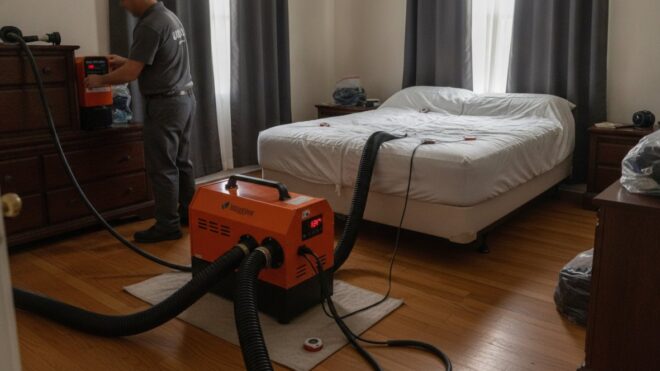
A pest control technician in protective gear carefully positions industrial electric heaters and temperature monitoring sensors throughout a residential bedroom, with cables running toward a central control unit near the doorway, bright morning light coming through curtained windows.

Professional heat treatment pricing models
Professional heat treatment pricing typically follows per-square-foot or per-room models. Per-square-foot pricing is more common for whole-home treatments and provides clearer cost structure for larger properties.
General market ranges for professional whole-home thermal remediation in the Northeast:
| Property Size | Typical Price Range | Treatment Duration |
|---|---|---|
| Studio / 1-bedroom (up to 600 sq ft) | Lower end of market | 6-8 hours |
| 2-bedroom (600-1,000 sq ft) | Mid-range | 7-9 hours |
| 3-bedroom (1,000-1,500 sq ft) | Mid-to-high range | 8-10 hours |
| Large home / multi-room (1,500+ sq ft) | Premium tier | 10-12+ hours |
| Single room / localized treatment | Lowest tier | 4-6 hours |
Note: Request a service estimate from a licensed professional exterminator for accurate local pricing.
Pricing models vary between providers. Some charge a flat fee per room; others price by heated area. Always confirm whether the quote covers a single treatment or includes follow-up inspection.
Hidden costs beyond the service quote
The service quote rarely tells the full story.
Prep work costs: Most thermal remediation providers require significant preparation: laundering and bagging clothing, removing heat-sensitive items, relocating pets, and clearing clutter. This can take a full day or more.
Heat-sensitive item management: Electronics, candles, aerosol cans, medications, and artwork cannot be exposed to lethal temperatures. Storing these items safely carries logistical cost.
Post-treatment replacement: Heavily infested items like mattresses may need replacement, independent of treatment cost.
Follow-up inspections: Even with service guarantees, follow-up visits are sometimes billed separately.
Never assume a single-line quote covers all prep and follow-up costs. Ask your professional exterminator to itemize every component before committing.
Chemical vs. Heat Treatment for Bed Bugs: Effectiveness & Trade-offs
The chemical vs. heat treatment debate comes down to a fundamental trade-off: residual protection versus single-session efficacy. Chemical pesticides leave a residual layer that kills newly introduced bed bugs for weeks after application. Heat treatment provides no residual protection but achieves near-total kill rates in a single session when properly executed.
| Factor | Heat Treatment | Chemical Treatment |
|---|---|---|
| Egg mortality | High (single session) | Variable, often requires retreatment |
| Residual protection | None | Yes, weeks to months |
| Chemical exposure | None | Present |
| Treatment sessions | Typically one | Often two or more |
| Prep requirements | Extensive | Moderate |
| Re-infestation risk | Higher without residual | Lower short-term |
| Cost per session | Higher | Lower |
| Total cost (severe infestation) | Comparable or lower | Can exceed heat if retreatment needed |
Treatment efficacy by infestation severity
Minor infestations (localized, early-stage): Chemical treatment from a licensed professional often achieves comparable outcomes to heat treatment at lower cost, since the infestation hasn’t spread to wall voids or multiple rooms.
Moderate infestations (multiple rooms, established population): Thermal remediation clearly justifies its cost here. Bed bugs are present across multiple harborage points. Heat treatment reaches everywhere air circulates, including inside furniture and behind baseboards, while chemical treatments require multiple visits and precise application.
Severe infestations (whole-home, long-established): Heat treatment is the preferred method. Structural heating eliminates the need to locate every harborage point individually. According to EPA guidance on bed bug treatment methods, heat treatment is recognized as one of the most effective non-chemical options for severe infestations.
Residual protection and re-infestation risk
The absence of residual protection after heat treatment is a genuine limitation. If a single bed bug survives in an untreated area or arrives via a visitor’s bag, re-infestation can occur. Integrated pest management (IPM) protocols address this by combining heat treatment with targeted residual chemical application to entry points or installing mattress encasements and interceptor traps post-treatment, significantly reducing re-infestation risk.
How Long Does Bed Bug Heat Treatment Take? Timeline & Process
Bed bug heat treatment takes between six and twelve hours for most residential properties, depending on property size, structural complexity, and time required to achieve and sustain lethal temperatures throughout all target areas. The process requires careful monitoring to confirm every part reaches the temperature threshold long enough for egg mortality.
What to expect during thermal remediation
A professional pest management team arrives with commercial-grade equipment, electric heaters and air movers, and positions units strategically throughout the space. Temperature sensors are placed at multiple points, including inside furniture and near the floor where cold air pools.
The team raises ambient temperature incrementally to prevent bed bugs from fleeing to cooler areas. Once the target temperature is achieved, it must be sustained for a defined dwell period to ensure egg mortality. A technician monitors temperature readings throughout. If any area fails to reach the target threshold, equipment is repositioned. The process concludes with a full walkthrough and documentation of temperature logs.
Prep work requirements
Thorough prep includes:
- Launder all clothing and bedding on high heat, then seal in plastic bags
- Remove and store aerosol cans, candles, and wax-based products
- Relocate medications and heat-sensitive electronics
- Clear clutter from floors to allow air circulation
- Relocate pets, plants, and fish tanks
- Remove or protect heat-sensitive artwork and instruments
- Leave drawers and closet doors open to allow heat penetration
Incomplete prep is a leading cause of treatment failure. Tightly packed closets and sealed containers create cold pockets where bed bugs survive.
Open every drawer, cabinet, and closet door before treatment. Eliminating cold pockets is as important as the heaters themselves.
Why Heat Treatment Costs More: Understanding the Premium
The premium price reflects real operational costs. Commercial-grade heating equipment represents significant capital investment for pest control operators. Professional-grade electric heater packages start at several thousand dollars and require maintenance and calibration.
Technician labor is the other major cost driver. A whole-home heat treatment requires a trained team on-site for six to twelve hours with active monitoring and equipment adjustment throughout. Transportation of heavy equipment, liability insurance, and temperature monitoring technology all contribute to the final estimate. According to National Pest Management Association industry resources, thermal remediation requires specialized training and certification that adds to operator overhead.
Professional Heat Treatment vs. DIY Equipment: Cost-Benefit Analysis
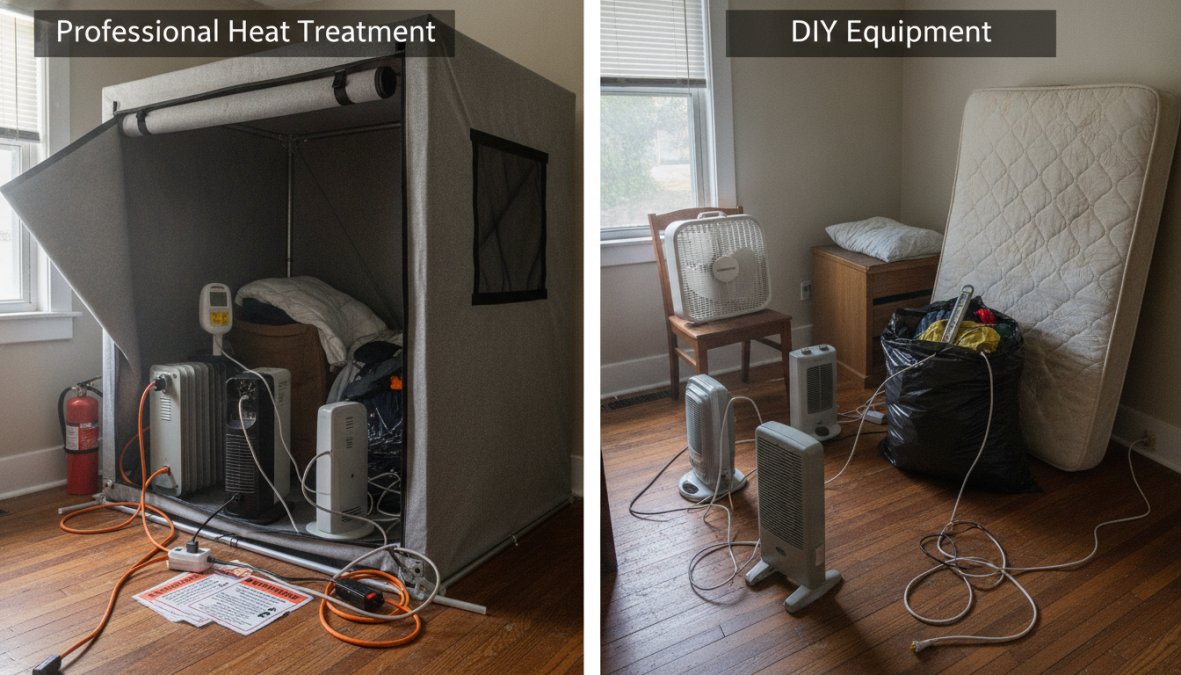
DIY heat treatment equipment exists and deserves honest evaluation. The real difference between professional and DIY treatment comes down to equipment capacity, monitoring capability, and knowledge to achieve lethal temperatures throughout a structure.
A pest control service truck with the rear doors open, revealing neatly organized commercial-grade electric heaters and air mover fans secured with straps, with orange power cables coiled on a shelf, photographed in a residential driveway on a clear day.
Commercial-grade equipment rental and purchase options
Portable chamber units, such as the ThermalStrike Ranger, treat luggage, clothing, and personal items using six-sided heating technology and cost roughly $300-$400. These are useful for travelers and individual items but cannot treat rooms.
Room-scale DIY heater rentals are less powerful than professional systems. Without proper monitoring equipment and technical knowledge, achieving uniform lethal temperatures throughout a room is difficult. Cold spots are common, and incomplete treatment often leads to re-infestation within weeks.
Technician labor vs. self-directed treatment
DIY room-scale heat treatment is high-risk for anything beyond a single, small, uncluttered room. Professional teams bring calibrated sensors, years of experience positioning equipment to eliminate cold spots, and accountability for outcomes. When professional treatment fails, service guarantees cover retreatment. When DIY treatment fails, homeowners absorb the full cost of subsequent professional service.
For travelers treating personal belongings, a portable chamber unit is cost-effective. For whole-home infestations, the cost-benefit analysis consistently favors professional service.
Post-Treatment Monitoring & Insurance: Hidden Value & Coverage
Post-treatment monitoring is the most overlooked component of bed bug remediation. Thermal remediation achieves high kill rates, but "high" is not "absolute." A monitoring protocol after treatment separates a resolved infestation from a recurring one.
Service guarantees and warranty periods
Service guarantees vary significantly. Some offer 30-day callback periods; others provide 90-day guarantees with free retreatment if live bed bugs are detected. When evaluating providers, ask:
- What triggers the guarantee: any live bed bug, or evidence of active infestation?
- Does the guarantee cover retreatment or only inspection?
- Are there prep requirements that void the guarantee?
- Does the warranty period reset after retreatment?
A strong service guarantee creates financial incentive for providers to confirm treatment success.
Insurance coverage for pest control treatments
Most standard homeowner’s insurance policies do not cover bed bug treatment costs. Pest infestations are classified as maintenance issues rather than sudden, accidental losses. Renters insurance similarly excludes pest control in most cases. According to Insurance Information Institute guidance on homeowner coverage, pest damage is typically excluded, though reviewing your specific policy is always the right first step.
Budget for bed bug heat treatment as an out-of-pocket expense.
Is Heat Treatment Worth It? When to Choose This Method
Bed bug heat treatment is worth the cost in specific scenarios. The mistake is treating this as all-or-nothing rather than situational.
Best scenarios for heat treatment ROI
Heat treatment delivers strongest return on investment in these situations:
Moderate to severe whole-home infestations. When bed bugs have spread beyond a single room, whole-home heat treatment eliminates the need to locate and treat every harborage point individually.
Chemical-sensitive households. Families with young children, individuals with respiratory conditions, or households with pets that cannot be relocated often prefer non-toxic treatment.
Failed prior chemical treatments. If chemical treatment regimens have not resolved infestation after multiple visits, heat treatment is the logical escalation.
Time-sensitive situations. Property managers and homeowners preparing for sale or rental need resolved infestations quickly. A single-day heat treatment is faster than multi-week chemical protocols.
Integrated pest management approach
The most effective approach combines heat and chemical treatment strategically within an integrated pest management (IPM) framework:
- Professional inspection to assess infestation severity
- Whole-home thermal remediation for immediate kill across all life stages
- Targeted residual chemical application to entry points and baseboards
- Mattress encasements and interceptor traps for ongoing monitoring
- Follow-up inspection at 30 and 60 days to confirm efficacy
This combined approach addresses heat treatment’s primary limitation, absence of residual protection, while preserving its core advantage: single-session egg mortality across the entire structure. According to University of Minnesota Extension bed bug management resources, IPM approaches combining multiple methods consistently outperform single-method treatments for long-term control.
For moderate to severe infestations, professional heat treatment is worth the cost, particularly when total cost of ownership is calculated across the full remediation period rather than just the initial service quote.
Frequently Asked Questions
How much does a professional bed bug heat treatment cost?
Professional bed bug heat treatment typically costs $1-$4 per square foot, with whole-home treatments ranging from $2,000-$8,000+ depending on property size and infestation severity. Smaller localized treatments may cost $800-$2,000. Prices vary by region, pest control professional expertise, and service guarantee terms. Always request a detailed service estimate that includes prep work and any additional fees.
Is heat treatment 100% effective for bed bugs, including eggs?
Thermal remediation achieves high treatment efficacy, typically 95-99%, because lethal temperatures kill all life stages: adult bed bugs, nymphs, and eggs. Success rates depend on reaching and maintaining proper heat levels throughout the structure. Infestation severity also matters; severe infestations may require follow-up treatments. A professional pest control professional ensures consistent results with monitoring equipment.
What hidden costs should I budget beyond the initial heat treatment quote?
Hidden costs include prep work (removing items from the treatment area), temporary relocation during the 6-8 hour process, replacement of heat-sensitive items if damaged, and potential follow-up inspections. Some properties require structural modifications to seal gaps. Post-treatment monitoring protocols and re-infestation prevention measures may add to the total homeowner investment. Request a comprehensive quote upfront.
Does homeowners insurance cover bed bug heat treatments?
Most homeowners insurance policies do not cover bed bug treatment costs, as infestations are typically considered a maintenance issue rather than a covered peril. However, some renters insurance or commercial property policies may offer limited coverage. Contact your insurer before treatment. Some pest control professionals offer service guarantees and warranty periods as an alternative form of financial protection.
How long does bed bug heat treatment take, and when can I return home?
Professional heat treatment typically takes 6-8 hours for whole-home treatment, including setup, heating, and cooling phases. You must vacate the property during this time. After treatment, you can return once temperatures cool to safe levels, usually within 1-2 hours after the process ends. The pest management industry standard includes a brief post-treatment walkthrough before you re-enter.
Dealing with a bed bug infestation in the Metro Boston area means you need a provider who can respond quickly, treat effectively, and stand behind the work. Zoifia Pest Control offers licensed and insured bed bug remediation backed by a 90-day guarantee, with no long-term contracts required. Get a quote from Zoifia Pest Control and resolve your infestation with a team that prioritizes your peace of mind over repeat service calls.
This article was written using GrandRanker
