Table of Contents
- Why Boston Homes Are Especially Vulnerable to Rodent Infestations
- Signs of Rodent Infestation in Your Home You Should Never Ignore
- Top Affordable Rodent Exterminators in Boston: Compared
- Zoifia Pest Control, Best for Fast, Guaranteed, No-Contract Service
- Clancy Bros. Pest Control, Best for Family-Safe Exclusion Techniques
- Modern Pest Services, Best for Tech-Driven Year-Round Protection
- Johnny B’s Pest Control, Best for South Boston Neighborhoods
- Critter Control of Boston, Best for Structural Repairs and Wildlife Removal
- Rodent Control Cost in Boston: What to Expect
- DIY Rodent Prevention Tips Before Calling an Affordable Rodent Exterminator in Boston
- What to Expect from Professional Rodent Extermination: The IPM Process
- How to Choose the Right Rodent Exterminator for Your Boston Property
- Conclusion
Last Updated: May 24, 2026
Finding a reliable, affordable rodent exterminator in Boston is harder than it should be. Boston’s dense urban environment, aging housing stock, and harsh winters create near-perfect conditions for mouse and rat infestations year-round. At Zoifia Pest Control, we work with Boston-area homeowners and property managers daily, and the same question comes up constantly: "How do I know I’m getting a fair deal?" Below, we compare the top local exterminators, break down what you should actually pay, and share the Boston-specific building challenges that most guides completely ignore. The 2026 picks we cover have been evaluated for affordability, service quality, and local expertise.
Why Boston Homes Are Especially Vulnerable to Rodent Infestations
Boston ranks among the most rodent-challenged cities in the United States. According to Orkin’s annual list of most rat-infested cities in America, Boston consistently appears in the top 10, a distinction driven by the city’s age, density, and infrastructure. The combination of underground MBTA tunnels, aging sewer systems, and tightly packed neighborhoods creates an interconnected network that rodents exploit with remarkable efficiency.
Boston-Specific Building Challenges: Brownstones, Rowhouses, and Aging Infrastructure
Brownstones and rowhouses present structural vulnerabilities that newer construction simply doesn’t have. Shared party walls between attached homes mean a rodent problem in one unit can spread to three neighboring properties within weeks. Foundation gaps, deteriorating mortar, and aging utility penetrations are common entry points that a standard pest exclusion treatment must address.
The real problem with Boston’s older housing stock is that it was never built with modern pest exclusion in mind. Pipes enter through unfinished gaps. Basement sill plates sit directly on crumbling brick. Attic spaces connect across multiple units. A rodent exterminator who doesn’t account for these structural realities is treating symptoms, not causes.
Key structural vulnerabilities common in Boston-area homes:
- Gaps around gas and water pipes entering basement walls
- Deteriorated mortar joints in brick foundations
- Shared attic spaces in rowhouses and triple-deckers
- Unscreened vents and dryer exhausts
- Aging wooden door frames with gaps at the threshold
Seasonal Patterns That Drive Rodents Indoors
Rodent pressure in Boston follows a predictable seasonal arc. As temperatures drop in late September and October, mice and rats begin actively seeking shelter. Urban environments accelerate this behavior because food sources, warmth, and harborage are concentrated in small areas. Spring brings a secondary surge as winter populations that established themselves indoors begin reproducing.
Year-round protection matters precisely because Boston’s climate doesn’t give rodents a reason to leave on their own.
Signs of Rodent Infestation in Your Home You Should Never Ignore
Rodent infestation signs fall into two categories: immediate evidence and structural damage. Both require action, but structural damage signals a longer-term problem that DIY trapping alone won’t solve.
, with a flashlight illuminating the damage in the dim space](https://cdn.grandranker.com/articles/affordable-rodent-exterminator-in-boston-top-picks-2026-content-1-1779587694.jpg)
The most common signs of rodent infestation in a home include:
- Droppings: Mouse droppings are roughly the size of a grain of rice; rat droppings are larger, about the size of an olive pit. Fresh droppings are dark and moist.
- Gnaw marks: Rodents chew constantly to keep their teeth filed. Look for marks on wood, plastic pipes, and electrical wiring.
- Grease trails: Rats travel the same paths repeatedly, leaving dark smear marks along walls and baseboards.
- Scratching sounds: Nocturnal activity in walls, ceilings, or under floors is a reliable indicator.
- Nesting material: Shredded insulation, paper, or fabric tucked into corners, behind appliances, or in attic spaces.
- Odor: A persistent musty or ammonia-like smell, particularly in enclosed spaces, often indicates an active infestation.
A common mistake is treating one sign in isolation. Finding a single dropping near the stove and setting one snap trap is not a rodent control strategy. If you’re seeing multiple signs simultaneously, the infestation is almost certainly larger than what’s visible.
Rodent droppings and urine can carry hantavirus and leptospirosis. Never sweep or vacuum droppings dry. Dampen the area with a disinfectant spray first, then use gloves and a mask during cleanup. If the infestation is significant, professional attic cleanup and odor control services are worth the investment.
Top Affordable Rodent Exterminators in Boston: Compared
The Boston market has no shortage of pest control companies, but the quality gap between providers is significant. Here’s a direct comparison of the top options, evaluated on affordability, service guarantees, local expertise, and treatment approach.
| Company | Best For | Guarantee | Contract Required |
|---|---|---|---|
| Zoifia Pest Control | Fast, no-contract service | 90-day guarantee | No |
| Clancy Bros. Pest Control | Family-safe exclusion | Indoor satisfaction warranty | No |
| Modern Pest Services | Tech-driven year-round plans | Program-based | Yes |
| Johnny B’s Pest Control | South Boston neighborhoods | Contact for details | No |
| Critter Control of Boston | Structural repairs + removal | Service-based | No |
Zoifia Pest Control, Best for Fast, Guaranteed, No-Contract Service
Zoifia Pest Control is the top pick for Boston homeowners who need fast, reliable rodent control without being locked into a long-term agreement. Licensed and insured, Zoifia serves the Metro Boston area with a focus on both residential pest control and commercial extermination.
What separates Zoifia from most competitors is the combination of a 90-day guarantee and no mandatory contract. Most pest control companies push annual service agreements as their default model. Zoifia’s approach respects the reality that some infestations are one-time events, not ongoing conditions.
Services include identification of feeding areas and entry points, targeted trapping and baiting, and one-shot treatment options for immediate needs. The 90-day guarantee means if rodents return within three months of treatment, the team comes back at no additional charge.
Best for: Homeowners and property managers who need quick response, transparent service, and results they can count on without long-term commitment.
Clancy Bros. Pest Control, Best for Family-Safe Exclusion Techniques
With over 64 years of local experience, Clancy Bros. brings deep institutional knowledge of Boston-area pest patterns to every job. Their specialty is mouse and rat exclusion: physically sealing entry points using materials like steel wool and caulk rather than relying solely on chemical treatments.
Their satisfaction warranty covers indoor treatments, which is a meaningful commitment. One important caveat: the warranty does not extend to exterior treatments or multi-family residences, so property managers of larger buildings should clarify scope upfront.
Clancy Bros. is a strong choice for families with young children or pets where minimizing chemical exposure is a priority. Their exclusion-first approach reduces the need for repeat chemical applications over time.
Modern Pest Services, Best for Tech-Driven Year-Round Protection
Modern Pest Services takes a technology-forward approach to rodent defense. Their SMART monitoring system uses digital sensors to detect rodent activity in real time, enabling proactive intervention before an infestation takes hold. This integrated pest management (IPM) model is particularly effective for commercial properties and multi-unit residential buildings where continuous monitoring adds real value.
The trade-off is cost. Modern Pest operates on a subscription program model, which means ongoing fees. For homeowners who want a one-time treatment, this isn’t the right fit. For property managers who need documented, year-round protection, it’s one of the most thorough options in the Boston market.
Johnny B’s Pest Control, Best for South Boston Neighborhoods
Johnny B’s is a South Boston institution. Their technicians know the specific building types, alley configurations, and environmental attractants unique to Southie and surrounding neighborhoods. They serve residential, commercial, and industrial clients, with notable experience working alongside housing authorities and large property management firms.
The depth of local knowledge here is genuinely useful. A technician who knows that a particular block has a shared dumpster situation or aging sewer infrastructure can make better treatment decisions than someone working from a generic protocol.
Critter Control of Boston, Best for Structural Repairs and Wildlife Removal
Critter Control occupies a specific niche: they combine rodent removal with the structural repairs needed to prevent re-entry. If your home has significant gaps in the foundation, damaged attic insulation from a rodent colony, or entry points that require carpentry work, Critter Control handles both the pest problem and the property repair in one engagement.
This is more expensive than standard extermination, but for persistent infestations where structural vulnerabilities are the root cause, it’s often the most cost-effective long-term solution.

Rodent Control Cost in Boston: What to Expect
Most pest control websites in Boston hide pricing behind a ‘Get a Free Quote’ button. That’s frustrating when you’re trying to budget for a real problem. Below are realistic price ranges based on common Boston rodent scenarios, not national averages, but the kinds of figures that come up in actual local service calls. These are ranges, not guarantees, because every job is different. Use them as a baseline to evaluate whether a quote you receive is reasonable.
Boston Rodent Extermination Price Ranges by Scenario
| Scenario | Typical Price Range | What’s Usually Included |
|---|---|---|
| Single mouse, early detection, small apartment | $150 – $275 | Inspection, 2-4 snap traps, one follow-up visit |
| Moderate mouse infestation, single-family home | $275 – $450 | Full inspection, multiple trap placements, bait stations, one return visit |
| Rat infestation, single-family home | $400 – $700 | Inspection, exterior bait stations, interior trapping, exclusion of 1-3 entry points |
| Full exclusion service (sealing entry points throughout) | $500 – $1,500+ | Labor to seal gaps, steel wool, hardware cloth, caulk, cost scales with number of penetrations |
| Multi-unit building (triple-decker or larger) | $600 – $2,000+ | Per-building pricing; common areas, shared walls, and multiple units all factor in |
| Attic cleanup and insulation replacement after infestation | $1,000 – $3,500+ | Removal of contaminated insulation, sanitization, re-insulation, often a separate line item |
| Year-round monitoring program (subscription) | $400 – $900/year | Quarterly or monthly visits, digital monitoring where offered, ongoing documentation |
These ranges reflect Metro Boston labor and material costs as of 2026. Properties in neighborhoods with severe structural vulnerabilities, particularly older triple-deckers in Dorchester, Roxbury, or Jamaica Plain with deteriorated foundations, often land at the higher end of exclusion estimates because the scope of sealing work is larger.
What Factors Affect the Price of Extermination?
Several variables drive the final cost of any rodent control job:
- Infestation severity: A single mouse caught early costs far less to resolve than an established rat colony. Rats require exterior bait stations, which add both material and monitoring costs.
- Property size and type: A 600-square-foot condo and a 2,800-square-foot triple-decker are fundamentally different jobs. Multi-unit buildings are priced per building, not per unit, but shared spaces and party walls increase scope.
- Exclusion scope: Sealing entry points is the most labor-intensive part of any rodent job. A home with 3-4 identifiable gaps is a different project than a brownstone with 15-20 deteriorated pipe penetrations and crumbling mortar joints. Ask for a written itemization of exclusion work before approving it.
- Treatment type: One-time treatments are less expensive upfront. Subscription monitoring programs cost more annually but provide documented protection, which matters for landlords, property managers, and commercial tenants with lease obligations.
- Follow-up visits: Some guarantees include return visits at no charge; others bill per service call. A 90-day guarantee with free return visits is meaningfully more valuable than a 30-day guarantee with a $75 re-service fee.
- Attic and crawl space remediation: If rodents have nested in insulation, cleanup and replacement is a separate cost that many homeowners don’t anticipate. Get this scoped and quoted separately from the extermination itself.
The Most Important Cost Question to Ask Any Exterminator
Before signing anything, ask: "What exactly is included in this price, and what would trigger an additional charge?"
A reputable company answers this clearly and in writing. Watch for these common upsell triggers that should be disclosed upfront:
- Return visits after the initial treatment (are they included or billed separately?)
- Exclusion work beyond a set number of entry points
- Attic inspection vs. attic remediation, these are often priced differently
- Rat vs. mouse treatment, some companies price these as separate service tiers
- Multi-unit surcharges if the infestation spreads to adjacent units
The ‘affordable’ exterminator isn’t always the one with the lowest initial quote. A $200 treatment with no exclusion work and no guarantee often costs more over 12 months than a $450 treatment that seals entry points and includes free return visits. Ask what the price covers, not just what it is.
DIY Rodent Prevention Tips Before Calling an Affordable Rodent Exterminator in Boston
Not every rodent situation requires a professional exterminator. Knowing the difference between a problem you can handle yourself and one that needs a licensed technician saves you money and gets you to the right solution faster. This section covers both: the DIY steps that genuinely work, and the specific thresholds that signal it’s time to call a pro.
What DIY Can Actually Accomplish
DIY rodent control is effective in a narrow but real set of circumstances: early-stage activity, a single species (mice, not rats), no evidence of nesting, and a property where you can identify and seal the likely entry points. In those conditions, the following steps work.
Exterior exclusion, the only DIY step that prevents recurrence:
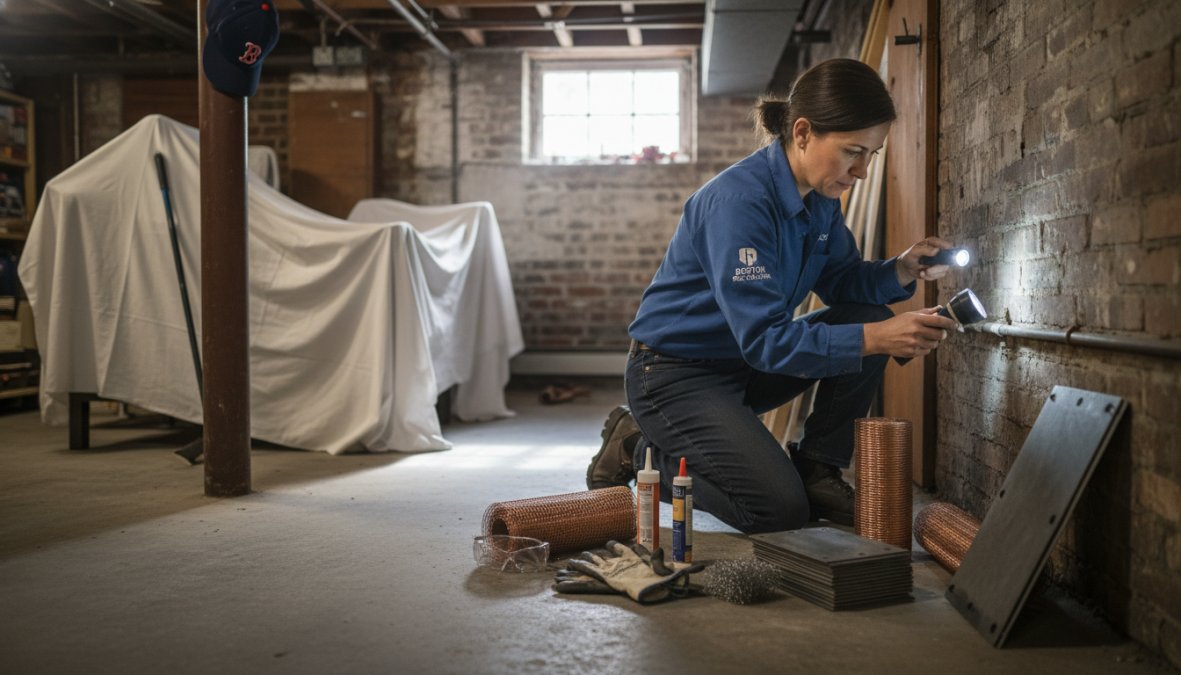
- Press steel wool firmly into gaps around pipes, cables, and conduit where they enter the building. Rodents cannot chew through steel wool, but they will push past loose material, pack it tightly.
- Follow the steel wool with caulk or expanding foam to hold it in place and eliminate air gaps that attract rodents in the first place.
- Install door sweeps on all exterior doors, particularly basement entries and garage doors. A gap of 1/4 inch is enough for a mouse to enter.
- Cover all vents, dryer exhausts, crawl space openings, foundation vents, with 1/4-inch hardware cloth secured with screws, not staples. Staples pull out; screws hold.
- Trim vegetation, woodpiles, and debris back at least 18 inches from the foundation. Ground cover adjacent to the building is harborage, not landscaping.
Trap selection and placement:
- Snap traps remain the most effective and cost-efficient option for mice. Place them perpendicular to the wall with the trigger end facing the baseboard, mice run along walls, not across open floor.
- Peanut butter outperforms cheese as bait. A small amount pressed into the trigger mechanism works better than a large glob that mice can steal without triggering the trap.
- Place traps in pairs, 2-3 inches apart, in areas of confirmed activity: behind appliances, inside cabinet bases, along basement walls.
- Check and reset traps daily. Traps that sit unattended for days lose effectiveness and create a sanitation issue.
Environmental attractant reduction:
- Store all food, including pet food and birdseed, in sealed hard-sided containers. Cardboard boxes and plastic bags are not rodent barriers.
- Keep garbage in bins with tight-fitting lids. Move bins away from the building exterior if possible.
- Eliminate standing water in basements and crawl spaces. Moisture is an attractant independent of food.
- Clear clutter from basements and attics. Stacked cardboard, old insulation, and fabric piles are nesting material.
The DIY vs. Professional Decision Framework
This is the question most guides avoid answering directly. Here is a concrete threshold framework based on the scenarios that actually come up in Boston-area homes.
DIY is appropriate when ALL of the following are true:
- You have seen one mouse, or found a small number of droppings in one localized area
- You have not heard scratching in walls, ceilings, or under floors
- You have not found nesting material (shredded insulation, paper, or fabric in a concentrated area)
- The activity is recent, not a pattern you’ve noticed over multiple weeks
- You are dealing with mice, not rats (rat droppings are roughly the size of an olive pit; mouse droppings are the size of a grain of rice)
In this scenario: set snap traps, seal visible entry points, and monitor for 10-14 days. If activity stops completely, the problem is likely resolved.
Call a professional when ANY of the following are true:
- You’ve set traps and seen continued activity after 10-14 days
- You are finding droppings in multiple rooms or on multiple floors
- You are hearing scratching or movement sounds in walls, ceilings, or under floors, this indicates an established population, not a single animal
- You have found nesting material anywhere in the home
- You are dealing with rats, not mice. Rats are neophobic, they avoid new objects including traps, and require a different, more systematic approach involving exterior bait stations and structural exclusion
- You live in a multi-unit building (triple-decker, rowhouse, condo building). Shared walls and attic spaces mean a single-unit treatment is almost never sufficient; the infestation will return from adjacent units unless the building is treated as a system
- You have a known structural vulnerability, a crumbling foundation, an unfinished basement, a shared attic, that you cannot seal yourself
Boston-specific note on multi-unit buildings: If you rent in a triple-decker or rowhouse and are handling rodent control yourself, be aware that Massachusetts landlord-tenant law generally places the responsibility for pest control on the landlord when the infestation affects habitability. Document the problem in writing before spending money on DIY solutions, your landlord may be legally obligated to address it.
Why Rats Require a Different Approach Than Mice
This distinction matters enough to state plainly. Mice and rats are not the same problem at different scales. Rats are significantly more cautious around new objects in their environment, a behavior called neophobia, which means snap traps placed by an inexperienced homeowner are often ignored for days or weeks. Rats also tend to indicate a more serious structural issue: they typically enter through larger gaps (1/2 inch or more) that require real exclusion work, not just steel wool.
If you have confirmed rat activity, the DIY path is slower, less reliable, and often more expensive in the long run than calling a professional who uses exterior bait stations, tamper-resistant bait boxes, and systematic exclusion. The cost of a professional rat treatment is almost always lower than the cost of months of ineffective DIY attempts followed by a professional treatment anyway.
The practical DIY threshold: one mouse, no nesting, traps clear within two weeks, handle it yourself. Multiple signs, persistent activity, nesting material, rats, or a multi-unit building, call a licensed exterminator. The money you save by calling earlier is real.
What to Expect from Professional Rodent Extermination: The IPM Process
Integrated Pest Management (IPM) is the current professional standard for rodent control in Boston-area homes and commercial properties. IPM is a systematic approach that combines inspection, identification, targeted treatment, and prevention rather than relying on blanket chemical application.
A professional IPM-based rodent control process typically follows these steps:
- Inspection: The technician identifies active feeding areas, entry points, harborage zones, and environmental attractants. This step determines everything that follows.
- Identification: Confirming the species (mouse vs. rat) matters because behavior, trap selection, and bait preferences differ significantly.
- Treatment: A combination of snap traps, bait stations, and targeted rodenticide application where appropriate. Humane wildlife removal options are available from some providers for specific situations.
- Exclusion: Sealing confirmed entry points using steel wool, caulk, hardware cloth, or structural repair as needed.
- Follow-up: Return visits to check trap activity, remove captured rodents, and confirm that exclusion work is holding.
- Prevention recommendations: Advising on environmental attractants and structural vulnerabilities to reduce future risk.
According to the EPA’s integrated pest management principles for schools and homes, IPM emphasizes the least-risk pest management options first, escalating to chemical controls only when necessary. This approach is particularly important for family-safe and pet-safe treatments in residential settings.
How to Choose the Right Rodent Exterminator for Your Boston Property
Choosing an affordable rodent exterminator in Boston comes down to matching the right company to your specific situation. Here’s a practical decision framework:
Choose Zoifia Pest Control if: You need fast response, a clear service guarantee, and no long-term contract. Ideal for both residential and commercial properties across Metro Boston.
Choose an exclusion specialist like Clancy Bros. if: You have young children or pets and want to minimize chemical exposure, or your building has identifiable structural entry points that need sealing.
Choose a monitoring program like Modern Pest if: You manage a commercial property or multi-unit building where continuous, documented pest control is a compliance or liability requirement.
Choose Johnny B’s if: You’re in South Boston or a nearby neighborhood and want a technician with deep local knowledge of your specific building stock.
Choose Critter Control if: Your infestation has caused structural damage, attic cleanup, or insulation replacement is needed alongside the rodent removal itself.
Before committing to any provider, ask these four questions:
- Are you licensed and insured in Massachusetts?
- What does your guarantee cover, and what are the exclusions?
- Is a contract required, and what are the cancellation terms?
- What is included in the quoted price, and what triggers additional charges?
A reputable local exterminator answers all four without hesitation. Any vagueness on licensing or guarantee terms is a signal to look elsewhere.
Frequently Asked Questions
How much does rodent extermination cost in Boston?
Rodent extermination costs in Boston vary based on infestation severity, property size, and the services included. A one-time treatment for a small residential property typically costs less than an ongoing protection plan. Most companies require an inspection before providing a firm quote. Services that include exclusion work, sealing structural vulnerabilities with steel wool and caulk, generally cost more upfront but reduce the risk of repeat infestations, making them more cost-effective long term.
How do I know if I have a rodent infestation in my home?
Common signs of a rodent infestation include droppings along walls or in cabinets, gnaw marks on food packaging or baseboards, scratching or scurrying sounds in walls or ceilings at night, and greasy rub marks along frequently traveled paths. You may also notice nesting materials like shredded paper or insulation in hidden areas. In Boston-area homes, attics and wall cavities of older brownstones and rowhouses are common hotspots to check first.
Do I need a professional exterminator for mice, or can I handle it myself?
DIY methods like snap traps, steel wool, and caulking entry points can work for early-stage or isolated rodent activity. However, if you're seeing signs in multiple rooms, hearing sounds in walls or the attic, or if DIY efforts haven't resolved the problem within a week or two, it's time to call a licensed rodent exterminator. In Boston's dense urban environment, professional pest exclusion is often necessary to fully address structural vulnerabilities that allow re-entry.
Are there eco-friendly or family-safe rodent control options in Boston?
Yes. Many affordable rodent exterminators in Boston offer family-safe and pet-safe treatment options as part of an Integrated Pest Management (IPM) approach. IPM prioritizes exclusion, trapping, and targeted treatments over broad chemical application. Companies like Zoifia Pest Control and Clancy Bros. emphasize safe treatments that minimize chemical exposure while still effectively eliminating infestations. Always ask your technician specifically about pet-safe and child-safe options before treatment begins.
What should I look for when hiring a pest control company in Boston?
Look for a company that is licensed and insured, offers a service guarantee, and provides a clear explanation of their treatment process. Transparency around pricing and what's included, such as follow-up visits or exclusion work, is a strong indicator of a trustworthy provider. Local technicians with experience in Boston-specific housing types like brownstones and multi-family properties are a plus. A free inspection offer is also a good sign the company is confident in their services.
Rodent infestations in Boston’s brownstones, rowhouses, and aging multi-family buildings don’t resolve themselves, and waiting makes the problem significantly more expensive to fix. Zoifia Pest Control offers fast, licensed, and insured rodent control across Metro Boston with a 90-day guarantee and no contract required. Get a quote from Zoifia Pest Control and have a licensed technician assess your property before a manageable problem becomes a structural one.
This article was written using GrandRanker
