Table of Contents
- Why Pet Safe Ant Repellent Matters in the Kitchen
- Natural Ant Repellent for Kitchen Environments
- Pet Safe Ant Killer Spray Options
- How to Keep Ants Out of Pet Food
- Identifying Entry Points and Prevention
- Safety Precautions for Cats and Dogs
- When to Call a Professional Exterminator
- Conclusion
Last Updated: August 25, 2026
Why Pet Safe Ant Repellent Matters in the Kitchen
Kitchen ant infestations create a genuine problem for pet owners. Your cat or dog shares the same space where ants forage for food and water, making standard pest control solutions unsafe. A pet safe ant repellent for kitchens eliminates ants without poisoning the animals you’re trying to protect.
Many pet owners face a difficult choice between tolerating an ant invasion or risking their pet’s health with conventional pesticides. Common ant killers contain ingredients that cause neurological damage in animals, even in small doses, or leave residues on surfaces where pets eat and drink. The right pet safe ant repellent eliminates this false choice entirely.
At Zoifia Pest Control, we work with homeowners who’ve dealt with this exact tension. Effective solutions exist that work on ants without harming your pets. This guide covers the most effective pet safe ant repellent options for kitchens, from natural sprays to food-grade powders to professional treatments. By the end, you’ll know exactly which solution fits your situation.
Natural Ant Repellent for Kitchen Environments
Natural ant repellent options have become genuinely effective. Many disrupt ant pheromone trails, the scent markers ants use to navigate, which stops them from recruiting other ants to your kitchen. They work without toxic residues and are safe to apply near pet food bowls and water dishes.
Essential Oils and Plant-Based Sprays
Essential oil sprays kill ants on contact while disrupting their ability to communicate with colony members. Products like Zevo Instant Action use rosemary and mint oils to deliver rapid knockdown. Essential oils work differently than neurotoxic pesticides, they don’t accumulate in your pet’s system (peer-reviewed research). A dog that brushes against a treated surface won’t develop toxicity the way it might from synthetic insecticides.
EcoVenger Ant Insect Killer combines instant kill with long-lasting deterrence, disrupting pheromone trails for up to four weeks. This dual action prevents new foraging trails from establishing, which matters significantly for kitchens where ants return repeatedly.
Wondercide Indoor Pest Control Spray uses peppermint, cedarwood, and lemongrass. The peppermint component repels ants, creating a barrier they won’t cross. This makes it ideal for applying around baseboards, cabinet edges, and entry points where ants travel.
Apply essential oil sprays along ant trails rather than randomly around the kitchen. Ants follow specific routes to food sources. Spraying these established pathways interrupts their navigation before they reach your pet’s food bowl.
Food-Grade Diatomaceous Earth
Food-grade diatomaceous earth (DE) works through physical mechanism, not chemical toxicity. The powder consists of fossilized aquatic organisms with microscopically sharp edges. When ants walk through it, these edges pierce their exoskeletons, causing dehydration (the CDC). This is fundamentally safe for pets: there’s no poison involved, just mechanical action.
Harris Food Grade Diatomaceous Earth comes with a powder duster for precise application. The critical limitation: DE only kills ants that walk through it and doesn’t eliminate the colony. Safer Brand Ant & Crawling Insect Killer combines diatomaceous earth with baits, allowing ants to carry the mixture back to the nest while maintaining the mechanical safety of DE.
Diatomaceous earth powder can irritate lungs if inhaled during application. Apply it when pets aren’t in the room. Once it settles and dries, it’s safe for pets. Never apply DE to surfaces where pets eat or drink directly.
Vinegar and Water Solutions
A simple vinegar and water solution, equal parts white vinegar and water, disrupts ant pheromone trails through scent. This costs almost nothing but doesn’t kill ants, only repels them. Ants will find alternate routes once the vinegar smell fades. Adding a few drops of peppermint or lemon essential oil enhances the repellent effect and works well for wiping down counters and cabinet edges.
Pet Safe Ant Killer Spray Options
When you need to eliminate ants rather than just repel them, pet safe ant killer sprays offer immediate results. These target individual ants and small groups, with active ingredients that break down quickly, making them safe for pets.
Contact Kill Sprays with Essential Oils
Contact kill sprays work only on ants they directly contact. Zevo Instant Action delivers rosemary and mint oils that kill on contact within minutes. For homeowners who see a line of ants crossing the counter, this spray provides immediate results. The limitation is scale: for persistent infestations, you need a different strategy.
Orange Guard Water Based Indoor/Outdoor Home Pest Control uses d-limonene, an extract from orange peel oil, killing on contact and providing some repellent action as it dries. It can leave a sticky residue requiring wiping, but the combination of contact kill plus short-term deterrence makes it more effective than straight contact sprays.
Residual Deterrent Formulas
Residual deterrent sprays create a barrier that persists after application. EcoVenger’s residual deterrent effect comes from disrupting pheromone trails. When ants cross the treated area, they pick up compounds that interfere with their ability to communicate, breaking their navigation system.
Spray once along baseboards, around cabinet edges, and near entry points, and ants stop returning to that area for an extended period. You’re not constantly respraying visible ants but creating zones where ant activity ceases.
Residual deterrent sprays are more effective for ongoing kitchen ant problems than contact sprays. They require less frequent application and address the root issue of ants establishing routes to food sources.
How to Keep Ants Out of Pet Food
Pet food bowls represent a direct line to the ant colony’s goal. Preventing access to pet food is your first line of defense.
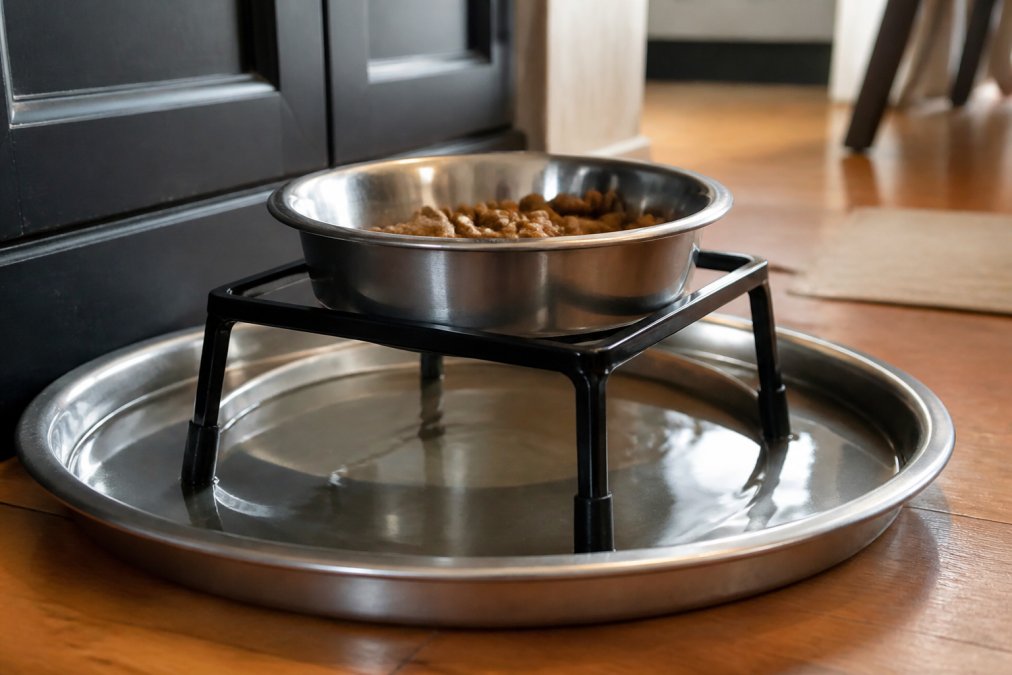
The most effective physical barrier is elevation combined with a water moat. Place your pet’s food bowl on a raised platform and surround the base with a shallow water barrier. Ants cannot cross water, creating an unreachable island (peer-reviewed research). This works because ants are excellent climbers but cannot swim or cross water barriers.
Elevated feeders designed for this purpose exist, but a DIY solution works equally well: a ceramic or stainless steel bowl on a low stool with a shallow pan of water around the base costs under twenty dollars. The water barrier requires refilling every few days as it evaporates.
Store dry pet food in airtight containers, not open bags. Ants can penetrate paper and cloth bags within hours. Glass or plastic containers with tight-sealing lids prevent ants from accessing stored food. Clean up spilled pet food immediately, a single piece of kibble becomes a recruitment point, and within an hour, dozens of ants are feeding there.
Identifying Entry Points and Prevention
Ants don’t appear randomly in your kitchen. They enter through specific openings. Walk your kitchen perimeter and look for gaps where pipes enter walls, where baseboards meet the floor, and around window frames. Ants can squeeze through openings as small as a grain of rice.
Once identified, seal gaps with caulk. For temporary solutions, apply pet safe ant repellent spray directly into the opening. Check underneath and inside cabinets where plumbing passes through. Ants also enter through walls; if they appear in a concentrated area, the nest may be in the wall cavity itself, typically requiring professional treatment.
Follow ant trails backward to find entry points and forward to see what they’re targeting. Prevention means removing the attraction: store food properly, clean up spills immediately, don’t leave pet food out between meals, and take out trash regularly.
Safety Precautions for Cats and Dogs
Pet safe ant repellent means the product won’t poison your pet if they contact it or ingest small amounts. It doesn’t mean you can spray it directly on your pet or leave it accessible for them to eat.
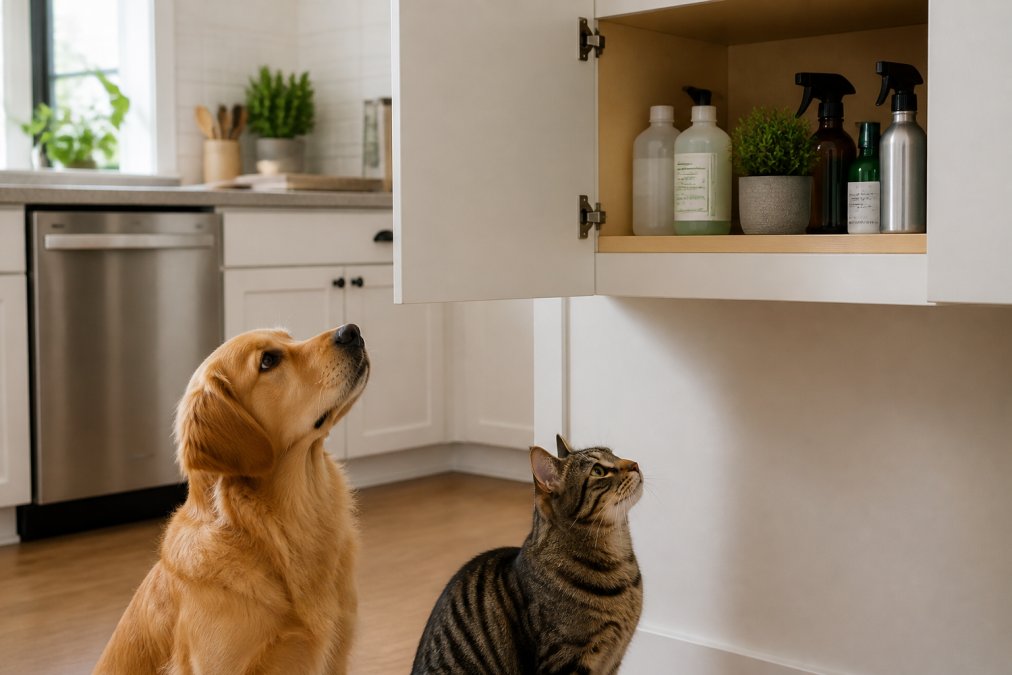
Store all ant repellent products where pets cannot reach them, a high shelf or locked cabinet works. When applying sprays, keep pets out of the treated area until it dries. Most essential oil sprays dry within minutes, but during the wet phase, concentrated oils could cause irritation if a pet walks through and licks its paws.
Diatomaceous earth powder requires similar care: apply when pets aren’t present and let it settle completely. Baits present a specific concern, place them where only ants can access them, under baseboards or in covered bait stations, never on counters or floors where pets might eat them.
Watch for signs of irritation after applying any new product: excessive licking, vomiting, or behavioral changes warrant a veterinary call. Cats metabolize certain oils differently than dogs; if your cat shows sensitivity, switch to a different product type like food-grade diatomaceous earth.
Never use conventional ant baits, roach baits, or pesticide sprays around pets. These products contain active ingredients designed to be toxic to insects, and pets may be more sensitive than ants are.
When to Call a Professional Exterminator
Some ant infestations exceed what DIY approaches can handle. Call a professional if you see ants in multiple rooms or areas of your kitchen, suggesting the colony is large or well-established. Call if you’ve tried multiple approaches over two weeks without improvement or if ants are entering through walls and you can’t identify entry points.
Zoifia Pest Control specializes in ant elimination for homes with pets. Our team uses pet safe treatments and identifies entry points that DIY approaches miss. We provide a 90-day guarantee, if ants return within that period, we treat again at no additional cost. This shifts the risk from you to us.
Professional treatment typically involves a combination approach: removing accessible food sources, sealing entry points, treating entry areas with pet safe repellents, and placing baits in locations pets cannot access. Contact a local pest control company for an estimate; many offer free inspections.
Kitchen ant infestations create genuine stress for pet owners managing two competing concerns: eliminating ants and protecting your animals. The right pet safe ant repellent solves this directly.
Start with identification: find entry points and remove food attractions. Apply pet safe sprays or diatomaceous earth along ant trails and entry areas. Keep pet food elevated and surrounded by a water barrier. Monitor for improvement over one to two weeks.
If DIY approaches don’t resolve the problem, contact Zoifia Pest Control. Our licensed and insured team specializes in ant elimination using pet safe methods. We back our work with a 90-day guarantee and flexible service options with no long-term contracts required. Get a quote today and reclaim your kitchen from ants without compromising your pet’s safety.
Frequently Asked Questions
How do I get rid of ants in the kitchen without harming pets?
Use pet safe ant repellent options like food-grade diatomaceous earth, essential oil-based sprays, or vinegar solutions. Apply these products in areas where pets cannot access them, such as baseboards and behind appliances. For severe infestations, contact a professional exterminator who can use pet-safe methods. Always read product labels to confirm pet safety before application.
What ingredients should I avoid in ant sprays if I have pets?
Avoid sprays containing permethrin, pyrethroids, organophosphates, and carbamates, which are toxic to cats and dogs. Also steer clear of products with high concentrations of undiluted essential oils, as these can harm pets through ingestion or skin contact. Always verify that any ant killer spray is labeled as pet-safe and EPA-registered for use around animals before purchasing.
Are essential oils safe for pets when used as ant repellent?
Diluted essential oils in commercial pet-safe sprays are generally safe when used as directed. However, concentrated essential oils like tea tree, eucalyptus, and citrus can be toxic to pets if ingested or absorbed through skin. Choose commercial products specifically formulated for pet safety rather than DIY solutions with pure essential oils. Always keep pets away from treated areas until they dry completely.
Can I use baking soda and sugar to eliminate ants if I have pets?
Baking soda and powdered sugar baits can work, but placement is critical for pet safety. Position baits in areas your pets cannot reach, such as inside walls or under sealed bait stations. While small accidental ingestions are less harmful than chemical baits, it's best to use this method only when you can ensure complete pet exclusion from the treated area.
This article was written using GrandRanker
