Table of Contents
- Does Peppermint Oil Actually Repel Wasps? (The Science vs. Anecdotal Evidence)
- How Menthol and Volatile Organic Compounds Affect Wasp Behavior
- DIY Peppermint Oil Wasp Repellent Recipe (With Concentration Guidelines)
- Natural Wasp Deterrents Beyond Peppermint Oil
- How to Get Rid of Wasps Naturally: Preventative Measures and Application Methods
- Peppermint Oil for Yellow Jackets: Effectiveness and Limitations
- Safety Precautions: Protecting Pets, Children, and Beneficial Insects
- Common Mistakes to Avoid When Using Peppermint Oil for Wasps
Peppermint Oil for Wasps: Does It Work? (2026 Guide)
Last Updated: July 25, 2026
Peppermint oil for wasps has become a popular natural pest control remedy, but the reality is more complicated than social media suggests. According to research from the University of Florida’s Institute of Food and Agricultural Sciences, essential oils show limited efficacy against established wasp colonies, though they may deter some insects in specific conditions. At Zoifia Pest Control, we’ve analyzed hundreds of homeowner attempts with peppermint oil solutions, and what we’ve found challenges much of the conventional wisdom circulating online.
The truth is this: peppermint oil can repel wasps under certain circumstances, but it’s not a reliable substitute for professional pest management when dealing with an active nest or aggressive species like yellow jackets. Below, we’ll show you exactly how peppermint oil affects wasp behavior, why anecdotal claims persist despite limited scientific support, and when this approach actually makes sense.
Does Peppermint Oil Actually Repel Wasps? (The Science vs. Anecdotal Evidence)
The short answer: peppermint oil may repel some wasps temporarily, but scientific evidence for its effectiveness is weak, and it won’t eliminate an established nest.
Most enthusiasm for peppermint oil comes from anecdotal reports rather than controlled studies. Homeowners report spraying peppermint solutions around patios and noticing fewer wasps. These observations are real, but there’s a critical distinction between "I saw fewer wasps after spraying" and "peppermint oil reliably repels wasps."
Research shows a more cautious picture. Menthol, the primary active compound in peppermint, does affect insect olfactory receptors. However, the concentration required to repel wasps is often higher than what homeowners typically apply. Additionally, volatile organic compounds evaporate quickly, meaning any repellent effect diminishes within hours to days depending on weather conditions and UV exposure.
What most guides get wrong is conflating "some insects avoid strong menthol odors" with "peppermint oil will keep wasps away from your home." The first has some basis in entomology. The second is an overreach.
Peppermint oil will not kill wasps or destroy nests. If you already have an active wasp nest on your property, spraying peppermint solutions wastes time while the colony grows. Wasps are highly motivated to defend their nest location; a mild odor deterrent won’t override that instinct.
How Menthol and Volatile Organic Compounds Affect Wasp Behavior
Understanding why peppermint oil has any effect requires looking at wasp neurology and how they navigate their environment.
Menthol’s Effect on Insect Olfactory Senses
Menthol is a terpene alcohol found in peppermint plants. When concentrated, it stimulates cold-sensitive nerve receptors in insects, creating a sensation similar to cooling. For some insects, this triggers an avoidance response.
Wasps rely heavily on their sense of smell to locate food sources, identify nest mates, and detect threats. However, sensitivity doesn’t mean vulnerability. A strong odor might cause temporary discomfort, but it doesn’t incapacitate the insect or override its primary behaviors like foraging or nest defense. Laboratory studies examining menthol’s effects typically use concentrations far higher than what a DIY spray bottle can deliver. A 5-10% peppermint essential oil solution may produce a noticeable odor to humans, but it’s often below the threshold needed for reliable wasp deterrence.
Repelling vs. Killing: A Critical Distinction
A repellent makes an area unpleasant enough that the insect chooses to leave or avoid it. Peppermint oil, at best, functions as a repellent. It doesn’t poison the wasp or interfere with its nervous system in a lethal way.
A pesticide disrupts the insect’s physiology in ways that lead to paralysis or death. Neem oil, for example, interferes with insect hormones and can kill wasps at certain concentrations. Peppermint oil doesn’t work this way.
If you’re dealing with an active nest or a wasp problem interfering with your daily life, you need a killing agent, not a repellent. Peppermint oil won’t solve that problem.
If you want to experiment with peppermint oil, use it as a preventative measure in early spring before nests are established, not as a treatment for an existing problem.
DIY Peppermint Oil Wasp Repellent Recipe (With Concentration Guidelines)
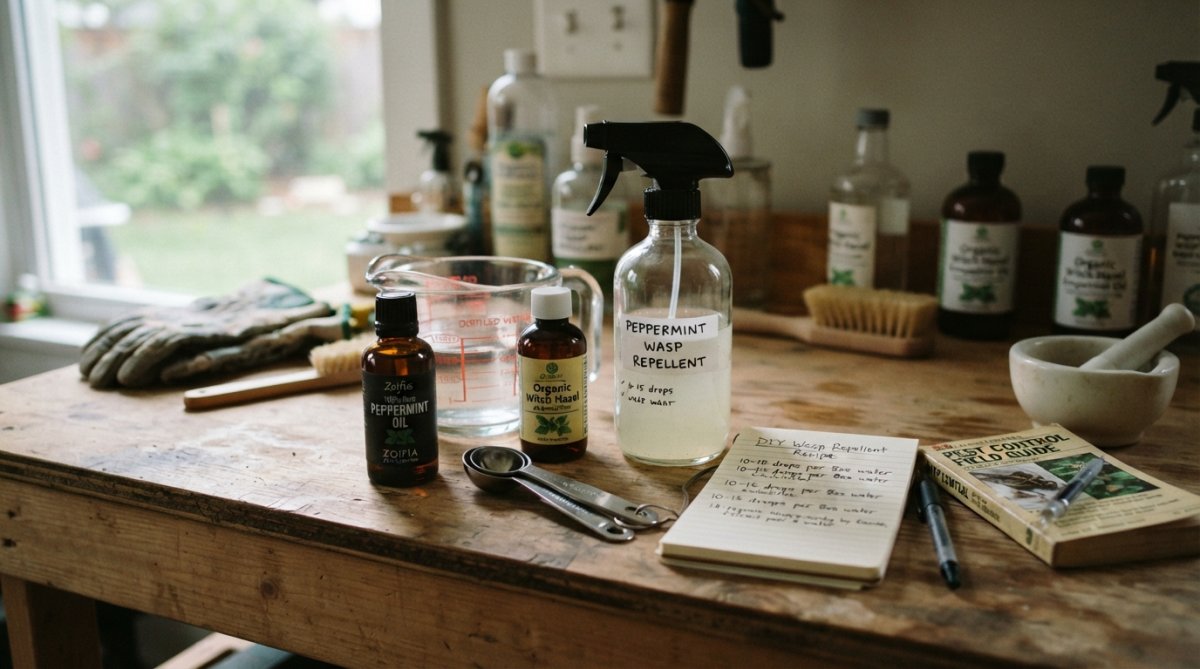
If you want to try peppermint oil as a deterrent, here’s how to make a properly diluted spray.
What You’ll Need
- 1 bottle of pure peppermint essential oil (15-30 mL)
- 1 spray bottle (32 oz / 1 quart capacity)
- Dish soap or castile soap (liquid, unscented preferred)
- Water (filtered or distilled works best)
- Measuring spoon or dropper
Step-by-Step Instructions
-
Fill the spray bottle halfway with water. Use cool water if possible; heat can degrade essential oils.
-
Add 15-20 drops of peppermint essential oil to the water. This creates approximately a 1-2% concentration by volume.
-
Add 1 tablespoon of dish soap. The soap acts as an emulsifier, helping the oil and water mix rather than separate.
-
Fill the bottle to the top with water. Cap it tightly and shake vigorously for 30 seconds.
-
Shake again before each use. Essential oils and water naturally separate.
-
Test on a small area first. Spray a small section of your patio or deck and observe for 24 hours to ensure the solution doesn’t stain or damage surfaces.
-
Apply to target areas. Spray around the perimeter of patios, near trash cans, around garden beds, or anywhere you’ve noticed wasp activity. Reapply every 3-7 days or after rain.
Dilution Ratios and Concentration Matters
| Concentration | Preparation | Best For | Limitations |
|---|---|---|---|
| 0.5-1% | 5-10 drops per quart | Sensitive areas, near plants | Weak effect, minimal repellency |
| 1-2% | 15-20 drops per quart | General deterrent use | Moderate strength, good balance |
| 2-3% | 25-30 drops per quart | Heavy infestation areas | Strong odor, potential plant damage |
| 3%+ | 30+ drops per quart | Concentrated applications | Risk of phytotoxicity, not recommended |
Most commercial peppermint-based insect repellents contain 5-10% peppermint oil, significantly stronger than typical DIY recipes. If you want results closer to commercial products, increase your drops to 30-40 per quart, but test thoroughly first.
Natural Wasp Deterrents Beyond Peppermint Oil
Peppermint isn’t your only botanical option for natural wasp deterrence. Several other essential oils show promise in research and field reports.
Other Essential Oils That May Help
Clove oil contains eugenol, a compound that repels various insects including some wasp species. Lemongrass oil’s citral compounds may confuse wasp navigation systems. Eucalyptus oil has been tested against multiple insect species with mixed results.
Combining multiple essential oils, peppermint, clove, and lemongrass together, may achieve a stronger deterrent effect than any single oil alone, though this is based on logical reasoning rather than peer-reviewed studies on wasp behavior.
Non-Oil Natural Alternatives
Removing food sources is far more effective than any scent-based deterrent. Wasps are attracted to sugary drinks, fallen fruit, pet food, and garbage. Securing trash cans, cleaning up spills, and removing accessible food sources reduces wasp activity more reliably than any essential oil.
The most effective natural wasp deterrent is prevention: eliminate food and water sources, seal entry points to structures, and remove potential nesting sites like dense vegetation or sheltered eaves.
How to Get Rid of Wasps Naturally: Preventative Measures and Application Methods
If you’re committed to a natural approach, focus on application technique and timing rather than hoping peppermint oil alone will solve the problem.
Spray Application Techniques
The way you apply peppermint spray matters more than most people realize. Use a spray bottle with a fine mist setting, not a stream setting. Apply until surfaces are noticeably wet but not dripping.
For maximum effect, spray in the early morning or late evening when wasps are less active. Wear protective clothing: long sleeves, pants, and closed-toe shoes.
When and Where to Apply Your Spray
Focus on areas where wasps congregate or where you want to prevent nesting: around trash cans, near outdoor dining areas, along fence lines, under eaves and porch ceilings, and near water sources.
Don’t spray directly on plants you intend to eat or harvest within 48 hours.
Environmental Factors Affecting Residual Effect
Peppermint oil’s repellent properties degrade quickly. Rain washes it away entirely. Heat accelerates evaporation. Direct sunlight breaks down menthol through UV degradation.
Expect the spray to remain effective for 3-7 days under ideal conditions. In full sun or after rain, you’re looking at 1-3 days of efficacy at best. This frequent reapplication requirement is one of the biggest practical limitations of peppermint oil for wasps.
Peppermint Oil for Yellow Jackets: Effectiveness and Limitations
Yellow jackets deserve special attention because they’re significantly more aggressive than paper wasps and respond differently to deterrents.
Why Yellow Jackets Are Harder to Deter
Yellow jackets are scavengers and predators with extremely strong motivation to forage. They’re driven by hunger and colony survival in ways that make them less responsive to mild deterrents like peppermint oil. They’ll return to a food source repeatedly, even if they encounter a deterrent. A peppermint-sprayed trash can might cause a yellow jacket to hesitate momentarily, but it won’t prevent the colony from targeting your garbage repeatedly.
Yellow jackets are also more aggressive in defending their territory. If you spray peppermint near an active yellow jacket nest, you risk triggering a defensive attack.
Dealing with Established Nests
If you have an active yellow jacket nest on your property, peppermint oil is not a viable solution. Established nests require physical removal or targeted pesticide application. Professional pest control services use methods like nest injection with residual insecticides or physical nest removal. These approaches actually eliminate the problem rather than hoping for temporary deterrence.
Safety Precautions: Protecting Pets, Children, and Beneficial Insects
Peppermint oil is generally recognized as safe by the FDA for human consumption in food, but concentrated essential oils are a different story.
Pet and Child Safety Considerations
Essential oils are concentrated plant extracts, not diluted food-grade peppermint flavoring. Pets and young children are more vulnerable to toxicity from concentrated oils than adults.
Cats are particularly sensitive to essential oils because they lack certain liver enzymes that metabolize these compounds. Keep peppermint spray away from areas where children crawl or play. If a child ingests even a small amount of concentrated peppermint oil, contact poison control immediately.
Dogs are less sensitive than cats but still at risk. Avoid spraying peppermint directly on surfaces where dogs rest or play.
Protecting Bees and Other Beneficial Insects
Peppermint oil’s repellent effects aren’t selective. It may deter wasps, but it also repels bees and other beneficial insects.
Honeybees and native bees are crucial pollinators for your garden. If you spray peppermint oil around flowering plants, you risk driving away the insects that pollinate those plants.
Apply peppermint spray to non-flowering areas only. Avoid spraying near vegetable gardens during bloom, fruit trees while flowering, or ornamental flowers that attract pollinators.
Never spray peppermint oil directly on flowering plants or near active pollinator areas. The repellent effect is non-selective and will drive away beneficial insects along with wasps.
Common Mistakes to Avoid When Using Peppermint Oil for Wasps
Homeowners make predictable errors when trying the peppermint oil approach.
Mistake 1: Using Too Weak a Concentration
The most common error is mixing peppermint oil so diluted that it has no effect whatsoever. If you’re going to try this method, use the concentration guidelines above. Start at 1-2% and increase to 2-3% if you see no results after a week of applications.
Mistake 2: Expecting Results Against Established Nests
Homeowners often discover a wasp nest and immediately spray peppermint oil around it, hoping the smell will make the wasps leave. This doesn’t work. The colony is established, the queen is laying eggs, and the workers are committed to that location.
Mistake 3: Not Reapplying Frequently Enough
Because peppermint oil evaporates quickly, weekly applications at best maintain any deterrent effect. Commit to a reapplication schedule: every 3-5 days if you’re serious about this approach.
Mistake 4: Spraying During Peak Wasp Activity
Spraying peppermint oil in the middle of a hot afternoon when wasps are actively foraging increases your risk of getting stung. Apply spray in early morning (before 9 AM) or late evening (after 6 PM).
Mistake 5: Ignoring Food and Water Sources
Peppermint oil is a weak deterrent at best. If your property has abundant food and water sources, wasps will tolerate the smell and stay anyway. Secure garbage cans, remove fallen fruit, clean up spills, drain standing water, and remove pet food bowls at night.
The reality of peppermint oil for wasps is that it’s a supplementary tool, not a primary solution. It may reduce wasp activity in specific situations, early-season prevention or low-pressure areas, but if you’re dealing with an active nest, aggressive yellow jackets, or a serious wasp problem, peppermint oil alone won’t solve it.
For homeowners in the Boston area facing persistent wasp problems, [Zoifia Pest Control(/best-pest-control-for-boston-apartments-2026-guide/) offers professional wasp removal and nest elimination | zoifiapestcontrol.com]. Our licensed technicians use proven methods to eliminate active nests and prevent future infestations, backed by a 90-day guarantee. We work with both residential and commercial properties and provide fast, reliable service without long-term contracts. If peppermint oil hasn’t worked or you need immediate results, get a quote from Zoifia Pest Control today.
Frequently Asked Questions
How do you make a peppermint oil spray for wasps?
Mix 15-20 drops of peppermint essential oil with 1-2 tablespoons of dish soap (acts as an emulsifier) and 2 cups of water in a spray bottle. Shake well before each use. The dish soap helps the oil and water combine and improves spray adhesion. Apply to areas where wasps congregate, focusing on entry points and nest locations. Reapply every 7-10 days or after rain for best results.
Does peppermint oil actually repel wasps, or is it just anecdotal?
Evidence is mixed. While menthol and volatile organic compounds in peppermint oil may trigger avoidance responses in some insects through their olfactory senses, scientific studies on peppermint oil's effectiveness against wasps specifically are limited. Many reports are anecdotal. Peppermint oil works better as a deterrent than an extermination method, it may reduce wasp activity but won't eliminate an established nest or guarantee complete prevention.
What's the difference between peppermint oil repelling wasps and killing them?
Repellents discourage wasps from approaching or settling in an area by affecting their behavior. Peppermint oil is strictly a repellent, it does not kill wasps. If you have an active wasp nest, repellents alone are unlikely to solve the problem. You'll need removal or extermination services. Repellents work best for prevention and discouraging wasps from returning to treated areas.
Is peppermint oil safe to use around pets and children?
Undiluted essential oils can be toxic to pets, especially cats. Always dilute peppermint oil thoroughly with water and dish soap before spraying. Avoid spraying directly on areas where children or pets play or rest. Keep the spray bottle stored safely out of reach. Test a small area first and monitor for any skin irritation. If ingested, contact poison control or your veterinarian immediately. Consider using peppermint oil only in perimeter areas away from frequent pet and child activity.
This article was written using GrandRanker
