Table of Contents
- What Makes a Rental Expense Ordinary and Necessary
- Deducting Pest Control for Rental Properties
- Capital Improvements vs Repairs: Where the Line Falls
- Allocating Shared, Personal, and Partial-Year Costs
- Your Rental Property Tax Deductions Checklist
- Landlord Expense Tracking Tools and Audit-Ready Records
- Conclusion
- Frequently Asked Questions
Last Updated: October 21, 2026
What Makes a Rental Expense Ordinary and Necessary
Rental expenses are ordinary and necessary when they are common and accepted in the landlord business and helpful and appropriate for maintaining or managing the property.
The same question comes up constantly: is this bill deductible, or does it have to be capitalized? The answer almost always traces back to whether the expense clears the ordinary and necessary test.
The stakes are real. Claim a personal cost as a rental expense and you inflate your deductions; capitalize something that should be a repair and you lose a year of write-offs. Neither mistake is fatal, but both cost money.
The Two-Part Test in Practice
Ordinary means the expense is common and accepted in your industry. Necessary means it is helpful and appropriate for your rental business, not that it is indispensable.
A practical test: ask two questions. Would a typical landlord in your market incur this cost? And does it serve the business purpose of renting or maintaining the property? If both answers are yes, you likely have a deductible operating expense.
A Four-Question Decision Framework
Most practitioners find that four questions resolve nearly every borderline receipt. Run each expense through them in order before you categorize it.
- Is it common in the landlord business? A water heater replacement, a lock change, and a quarterly pest plan are all routine. A riding mower for a postage-stamp duplex yard is not.
- Does it serve the rental business? The cost must relate to acquiring tenants, keeping them, or maintaining the property. Your own travel to inspect a property you were already visiting for vacation fails this question.
- Is it a repair or an improvement? If the cost restores working condition, it is generally currently deductible. If it makes the property better, bigger, or longer-lasting, it generally must be capitalized and recovered over time.
- Is it documented with a business purpose? A receipt with a one-line note (“replaced failed water heater, unit 2”) is far easier to defend than an unlabeled invoice.
If an expense fails question 1 or 2, stop: it is not deductible. If it passes both but fails question 3, it is still a legitimate cost, just capitalized rather than deducted now. Question 4 is the one landlords skip and the one auditors ask about first.
Borderline Cases and What Changes the Answer
The facts, not the label, drive the treatment. A few patterns come up repeatedly:
- Mixed-use costs. A home office or a vehicle used for property management is deductible only to the extent of business use. A dedicated mileage log and a square-footage measure beat a year-end estimate.
- Unusual services. A one-time bed bug treatment in a single unit is ordinary and necessary for that property. Fumigating during a full structural renovation is tied to a capital improvement and follows the improvement’s treatment.
- Travel. Driving to a rental to meet a contractor is a business expense. Extending the same trip into a family vacation does not make the personal portion deductible.
- Upgrades. Replacing a broken faucet restores function and is a repair. Remodeling the bathroom adds value and function and is an improvement.
- Tenant-caused damage. A repair after tenant damage is still ordinary and necessary for the property, even if the tenant’s habits caused the problem.
The IRS publishes guidance on rental income and expenses in IRS Publication 527, Residential Rental Property, and it is worth reading before you categorize anything unusual. Federal guidance sets the baseline; state rules can differ, and thresholds and rules can change by tax year, so confirm the current year’s treatment before filing.
Keep a one-line note on each receipt explaining the business purpose (“replaced failed water heater, unit 2”). The ordinary and necessary test is easier to defend with a sentence of context than with a shoebox of unlabeled invoices.
Deducting Pest Control for Rental Properties
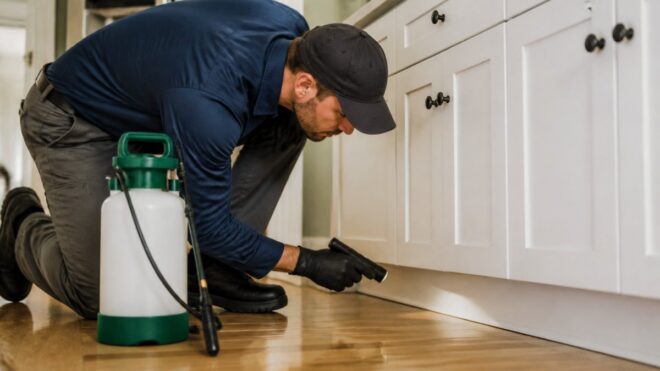
Pest control is a textbook ordinary and necessary rental expense.
The nuance is in recurring versus one-time treatment. A quarterly prevention plan is an operating expense. A one-time bed bug treatment in a single unit is also an operating expense.
Landlords often ask whether tenant-caused infestations change the answer. They do not. The expense is still ordinary and necessary for the property, even if a tenant’s habits brought the pests in.
For landlords managing multi-family buildings, recurring pest maintenance is the cleaner record: predictable invoices, clear business purpose, and no ambiguity at tax time.
Capital Improvements vs Repairs: Where the Line Falls
A repair restores property to its working condition; an improvement makes it better, bigger, or longer-lasting, and must be capitalized and depreciated. That distinction is the single biggest source of landlord tax errors.
Replacing a broken faucet is a repair. Remodeling the bathroom is an improvement. Patching drywall after a tenant moves out is a repair. Adding a new room is an improvement.
The IRS guidance on capital improvements to rental property sets out the rules, including the useful-life and betterment tests. When an expense both repairs and improves, the improvement portion gets capitalized.
| Expense | Treatment | Why |
|---|---|---|
| Fix a leaky pipe | Repair (deduct now) | Restores working condition |
| Replace entire plumbing system | Capital improvement | Betterment, longer life |
| Patch a hole in drywall | Repair | Routine maintenance |
| Add a new bathroom | Capital improvement | Adds value and function |
| Replace a broken window pane | Repair | Restores function |
| Install energy-efficient windows throughout | Capital improvement | Upgrade beyond original |
How Capitalization Works in Practice
When a cost is capitalized, you generally cannot deduct it in the year you pay it. Instead, you recover it over time through depreciation, which spreads the deduction across the property’s recovery period.
That is why the repair-versus-improvement call matters so much. A repair is a dollar-for-dollar deduction now. An improvement is a smaller deduction spread forward.
A common pattern is a project that contains both. A bathroom remodel that also fixes a leaking supply line is mostly improvement with a repair component.
Allocation for Mixed and Partial-Year Costs
Mixed-use property requires allocation, and sloppy allocation is an audit red flag.
The common approach is to allocate by square footage or by unit count. Utilities, insurance, and property taxes get split by the percentage of the property used for rental.
Personal use complicates things further. Days you or your family use the unit for personal purposes reduce the deductible share.
Landlords with a home office or a vehicle used for property management should track mileage and square footage separately. A dedicated log beats a year-end estimate every time.
Bundling repairs into a renovation project can force capitalization of costs you could have deducted. If a repair is genuinely separate from the improvement, document it separately and keep the invoices distinct.
Documentation That Survives Review
Audit-ready records for repairs and improvements come down to three things: the receipt or invoice, a business-purpose note, and a system that keeps them together. For each capitalized project, keep the contract, the invoice, and a short description of what changed and why. For each repair, keep the service invoice with the property and unit noted. The IRS expects contemporaneous records, and reconstructed logs are harder to defend. Track as you go, and the repair-versus-improvement question answers itself at filing time.
Allocating Shared, Personal, and Partial-Year Costs
Mixed-use property requires allocation, and sloppy allocation is an audit red flag.
The common approach is to allocate by square footage or by unit count. Utilities, insurance, and property taxes get split by the percentage of the property used for rental.
Personal use complicates things further. Days you or your family use the unit for personal purposes reduce the deductible share.
Landlords with a home office or a vehicle used for property management should track mileage and square footage separately. A dedicated log beats a year-end estimate every time.
Your Rental Property Tax Deductions Checklist
Use this checklist to organize your rental expenses before filing. Each item should have a receipt, invoice, or bank record attached.
- Mortgage interest on the rental property
- Property taxes
- Insurance premiums (landlord policy, liability, flood)
- Repairs and maintenance (including pest control)
- Utilities you pay: water, electricity, gas, trash removal
- Property management fees
- Advertising and listing costs
- Tenant screening and credit check fees
- Legal and professional fees
- Travel and vehicle expenses for property business
- Office supplies, software, and phone services
- Postage and printing
- Depreciation on capital improvements
Each line should pass the ordinary and necessary test and be documented. If a category feels shaky, write down the business purpose before you file.
Landlord Expense Tracking Tools and Audit-Ready Records
Audit-ready records come down to three things: receipts, a business-purpose note, and a system that keeps them together. The tool matters less than the habit.

What matters most is the record itself. Save invoices as PDFs, photograph paper receipts the day you get them, and note the property and unit on each one.
A common mistake is reconstructing a year of expenses in April. The IRS expects contemporaneous records, and reconstructed logs are harder to defend. Track as you go.
The strongest audit defense is a boring one: a receipt, a date, a property, and a one-line business purpose. Build that habit and the ordinary and necessary question answers itself.
Conclusion
The hardest part of rental property taxes is not the math; it is the judgment call on every borderline receipt. Get the ordinary and necessary test right, separate repairs from improvements, allocate shared costs honestly, and keep records you would be comfortable showing an auditor.
If pests are part of your maintenance picture, Zoifia Pest Control can help. Our licensed and insured technicians handle ants, roaches, rodents, and bed bugs with fast response, a 90-day guarantee, and no long-term contract, so your pest control invoices stay clean and easy to categorize.
Get a quote from Zoifia Pest Control and keep your rental property pest-free without complicating your books.
Frequently Asked Questions
What is the IRS definition of ordinary and necessary for rental expenses?
An ordinary expense is one that is common and accepted in the rental property business, like insurance premiums or property management fees. A necessary expense is one that is helpful and appropriate for maintaining your rental, such as repairs after tenant damage. The expense does not have to be unavoidable, just appropriate and connected to your business purpose of earning rental income. Both tests must be met before you claim the deduction.
Can I deduct pest control services as a rental property expense?
Yes. Treating roaches, rodents, or bed bugs in a rental unit is generally an ordinary and necessary operating expense, since pest problems are common and treating them keeps the property habitable and rentable. You can deduct the full cost in the year you pay it, provided the treatment is for the rental portion of the property. Keep the invoice showing the service address, date, and amount.
What is the difference between a repair and an improvement for tax purposes?
A repair restores your property to its working condition without adding value, like fixing a leaky faucet or replacing a broken lock. You deduct repairs in full the year you pay them. An improvement adds value, extends the property’s life, or adapts it to a new use, such as a new roof or a remodeled kitchen. Improvements are capitalized and recovered through depreciation over time, so the classification changes your taxable income in the current year.
Are property management fees considered ordinary and necessary expenses?
Yes. Management fees are a standard operating expense in the rental business, so they pass both the ordinary and necessary tests. This includes fees for collecting rent, handling tenant screening, coordinating repairs, and managing the property day to day. Deduct the fees in the year paid or incurred, and keep the management agreement plus monthly statements showing the amount charged and the property it relates to.
How do I document rental expenses for tax filing?
Keep receipts, invoices, and bank or card statements for every deduction, and note the property, date, and business purpose on each one. For shared or partial-year costs, write down the allocation method you used, such as square footage or rental days divided by total days. Store records digitally with a backup, and keep them for at least three years after filing, longer if you claim depreciation on improvements.
Can I deduct expenses for a rental property that was only rented part of the year?
You can deduct expenses only for the portion of the year the property was available for rent or actually rented. For example, if a unit sat vacant for two months while you used it personally, those two months of utilities and insurance are not deductible. Prorate shared costs by rental days or square footage and keep a written record of how you calculated the split.
