Table of Contents
- Why Construction Sites Are Prime Targets for Rat Infestation
- Signs of Rat Infestation at Construction Sites You Shouldn’t Ignore
- How to Prevent Rats at Construction Sites: Site Sanitation and Waste Management
- Rodent-Proofing Structural Techniques and Physical Barriers
- Best Rat Traps for Construction Sites and Baiting Strategies
- How to Prevent Rats at Construction Sites Using Phase-Specific Strategies
- Building Your Construction Site Pest Management Plan
- Conclusion
Last Updated: May 26, 2026
Construction sites are among the most rodent-friendly environments on earth, and knowing how to prevent rats at construction sites is one of the most overlooked aspects of site management. This guide from Zoifia Pest Control covers the full spectrum of prevention, from structural exclusion techniques to phase-specific protocols that most site managers never implement. The consequences of ignoring rodent pressure go beyond nuisance: rats compromise structural integrity, contaminate materials, and expose project owners to serious regulatory liability.
Here’s what most guides get wrong: they treat rat prevention as a reactive problem. By the time you see a rat on site, the infestation is already established. The strategies below are designed to stop that from happening in the first place.
Below, we’ll show you exactly how to eliminate harbourage, close access points, manage waste, and build a monitoring system that catches rodent activity before it becomes a crisis.
Why Construction Sites Are Prime Targets for Rat Infestation
Construction sites offer everything rodents need to survive: disturbed soil for burrowing, abundant food debris, stacked materials for harbourage, and constant changes to the environment that make detection difficult. A site that looks chaotic to a project manager looks like prime real estate to a rat.
The disruption caused by excavation sites is particularly significant. Ground-breaking operations displace existing rodent populations from surrounding areas, funneling vermin directly onto the active site. Temporary structures, open drainage channels, and exposed foundations create a network of access points that rats exploit within days of site establishment.
Pest minimisation at this scale isn’t just a hygiene issue. Rodent activity can delay projects, trigger regulatory inspections, and create liability exposure for contractors who haven’t documented a formal pest management plan.
The Role of Rattus norvegicus and Mus musculus on Active Sites
The two species responsible for the vast majority of construction site infestations are Rattus norvegicus (the Norway or brown rat) and Mus musculus (the house mouse). Understanding their behavior is the foundation of effective prevention.
Rattus norvegicus is the more destructive of the two. It is a burrowing species that prefers ground-level harbourage, making excavation sites and foundation areas its natural habitat. Norway rats can gnaw through concrete, soft metals, and electrical conduit, creating structural and fire risks that extend well beyond the pest problem itself.
Mus musculus is smaller, faster to reproduce, and capable of squeezing through gaps as small as 6mm. It tends to nest inside temporary structures, inside stacked insulation, and within wall cavities of partially completed buildings.
Both species are neophobic initially, meaning they avoid new objects in their environment. This is why bait stations placed on an active construction site often go untouched for days before rodents begin interacting with them.
Signs of Rat Infestation at Construction Sites You Shouldn’t Ignore
Identifying an infestation early is the difference between a targeted intervention and a full-scale extermination effort. The signs are specific and, once you know what to look for, unmistakable.
The most reliable indicators include:
- Droppings: Norway rat droppings are roughly 20mm long, capsule-shaped, and dark brown. Fresh droppings are soft; older ones harden and lighten in color.
- Gnaw marks: Look for fresh gnaw marks on timber beams, cable sheathing, and foam insulation boards. Lighter-colored wood beneath the surface indicates recent activity.
- Burrow entrances: Rat burrows are typically 60-90mm in diameter, with smooth, compacted soil around the entrance and a fan of loose earth kicked out behind.
- Smear marks: Rats follow the same paths repeatedly, leaving greasy smear marks along walls, pipes, and beams from the oils in their fur.
- Tracks and runways: Disturbed dust, mud, or debris along the base of walls or between material stacks indicates an established runway.
- Live sewers activity: Rats frequently access construction sites through live sewer connections and drainage channels. Check drain covers for signs of gnawing or displacement.
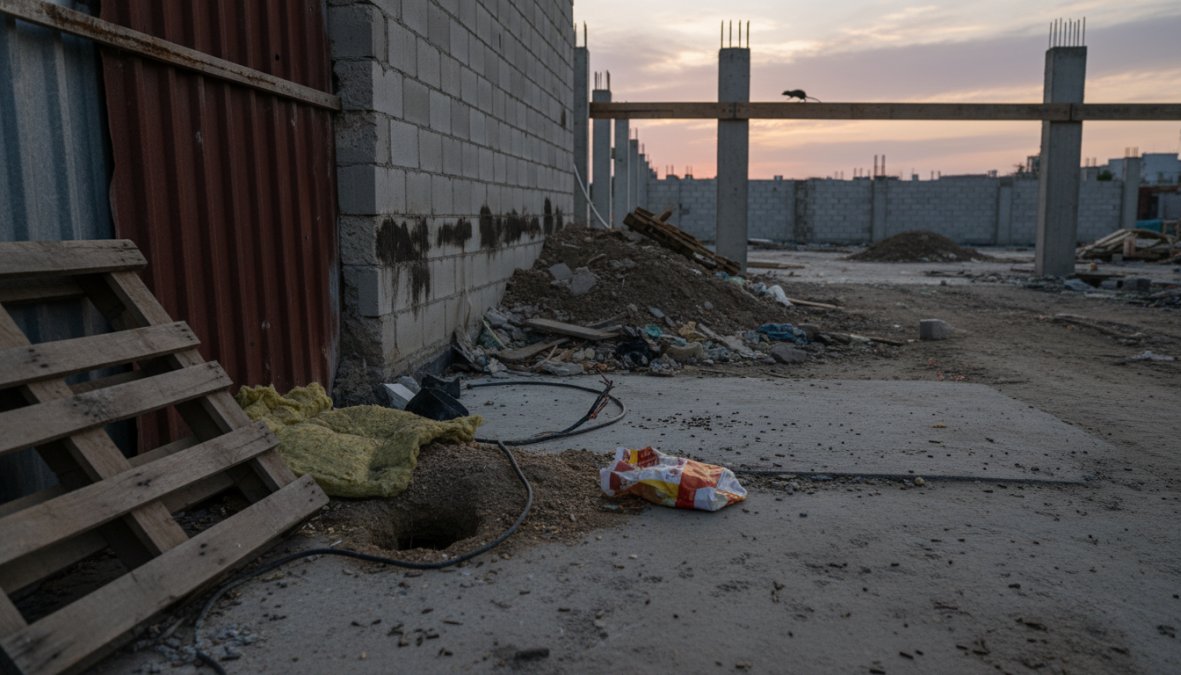
A single confirmed sign warrants immediate action. Two or more signs in the same area indicate an established population, not a transient visitor.
Never assume a single rat sighting means a single rat. Norway rats live in colonies, and a visible individual usually means dozens more are active nearby but unseen. Delaying your response by even a week allows exponential reproduction.
How to Prevent Rats at Construction Sites: Site Sanitation and Waste Management
Sanitation is the single most effective lever in any construction site pest management plan, and it is also the most consistently mismanaged. Rats cannot establish a breeding population without a reliable food source within roughly 30-50 metres of their harbourage. Remove that source and you make the site biologically hostile to colonisation, regardless of how many bait stations you deploy.
The reason sanitation fails on construction sites is not ignorance, it is operational fragmentation. Food waste is generated by workers on break, by canteen or vending facilities in welfare units, by demolition debris containing organic material, and by packaging on material deliveries. Each of these streams is managed by a different person or subcontractor, and without a unified protocol with named accountability, at least one stream will be left unmanaged overnight. That is all a rat colony needs.
The framework below is built around shift transitions, because that is when sanitation discipline breaks down most predictably.
The Shift-Transition Sanitation Protocol
Rats are primarily nocturnal. The window between the end of the last working shift and the start of the next morning’s work is when rodents are most active and when food debris left on site does the most damage. A shift-transition protocol closes that window deliberately.
End of every shift, site-wide:
- Clear all eating areas completely. All food packaging, containers, and organic waste must go into lidded, rodent-proof bins before the last worker leaves. Open skips, even partially filled ones, should have a fitted lid or be covered with a tarpaulin secured at the edges. An open skip left overnight is the single most common driver of rat attraction on active construction sites.
- Empty all bins in welfare units and site offices. Bins inside temporary structures are frequently overlooked because they are out of sight. Rats will enter welfare units through gaps as small as 6mm to access an unemptied bin. Assign this task to a named individual on each shift, not to ‘everyone.’
- Remove standing water. Rats require water daily and will establish territory within close range of a reliable source. Drain or fill puddles, empty water containers, and clear blocked drainage channels before the site closes. In wet climates, this requires a specific walkthrough rather than a visual check from a distance.
- Inspect delivery areas. Pallets, bulk bags, and timber deliveries from external yards can carry hitchhiking rodents or rodent nesting material. A brief inspection of incoming deliveries before they are moved to storage is a low-effort, high-value habit.
Weekly, site management level:
- Audit all waste contractor collection schedules. Waste that accumulates for more than 48-72 hours provides both food and cover. If collection frequency is falling behind site waste generation rates, escalate immediately.
- Walk the perimeter of all canteen and eating areas with a torch after dark, or review any motion-activated camera footage from those zones. Rodent activity near food sources is almost always detectable within the first week of establishment if you are looking for it.
- Check that all rodent-proof bin lids are intact and closing properly. Damaged lids are a common failure point that goes unreported.
Demolition Waste: The Overlooked Food Source
Demolition phases generate a category of food waste that most sanitation guides ignore entirely: organic material embedded in building fabric. Old kitchens, food storage areas, and waste pipes in buildings being demolished contain residual food matter that attracts rats immediately when disturbed. This is one of the reasons rat activity spikes at the start of demolition projects even before any worker food waste is present on site.
During demolition, the following additional steps apply:
- Segregate demolition waste containing organic material (old kitchen fittings, food storage units, waste pipe sections) and remove it from site within 24 hours rather than allowing it to accumulate in a skip.
- Pre-bait the perimeter of structures scheduled for demolition at least two weeks before work begins. This intercepts displaced rat populations before they migrate onto the active site.
- Notify the pest control contractor before demolition begins so that bait station density can be increased in anticipation of population displacement.
Proper Storage of Construction Materials to Reduce Rodent Harbourage
Stacked materials are a rat’s preferred nesting environment. The space between pallets, rolls of insulation, timber stacks, and bagged aggregates creates exactly the dark, sheltered, undisturbed harbourage that rodents seek. The problem compounds over time: a material stack that is inspected on delivery and found clear can become an active nest site within two weeks if it is left undisturbed.
The fix requires both physical standards and a rotation discipline:
- Store timber and insulation on raised platforms at least 300mm off the ground, with clear space underneath to allow visual inspection without moving the stack.
- Keep all material stacks at least 600mm away from perimeter walls, fences, and other stacks. This eliminates the enclosed corridor spaces that rats use as runways between harbourage and food sources.
- Rotate and physically inspect stored materials on a weekly cycle, prioritising long-term stock that has not been moved recently. Rats will not nest in materials that are regularly disturbed.
- Store bagged cement, plaster, sand, and other granular materials in metal bins or sealed containers. Rats gnaw through paper and polypropylene bags readily and will nest inside the contents.
- Clear debris, off-cuts, and packaging from around material storage areas at the end of each working day. A clean perimeter around material stacks removes the secondary harbourage that allows rats to move between nesting and feeding areas undetected.
According to CDC guidance on rodent control and sanitation, eliminating food and water access is the most effective long-term rodent control strategy, consistently outperforming trapping or baiting alone when applied systematically.
The most common sanitation failure on multi-subcontractor sites is the assumption that someone else is responsible. Assign named individuals to each sanitation task in writing, include it in subcontractor induction documentation, and make compliance a condition of site access. A pest management plan that exists only on paper provides no protection against a regulatory inspection or a civil liability claim.
Rodent-Proofing Structural Techniques and Physical Barriers
Physical exclusion is the most permanent form of rat prevention available to construction managers. Unlike baiting or trapping, which manage existing populations, exclusion methods prevent reinvasion at the structural level.
The principle is simple: rats need a gap of at least 12mm to enter a structure. Close every gap below that threshold and you’ve denied access. The execution, however, requires attention to detail across multiple building systems.
Concrete Curtain Walls, Foundation Sealing, and Drainage Stoppers
Concrete curtain walls installed around the perimeter of a construction site act as a physical barrier against burrowing. Rattus norvegicus can burrow at depths of up to 500mm, so curtain walls must extend at least 600mm below grade to be effective. This is a standard exclusion method on larger commercial sites, but frequently omitted on smaller projects where it would make the biggest difference.
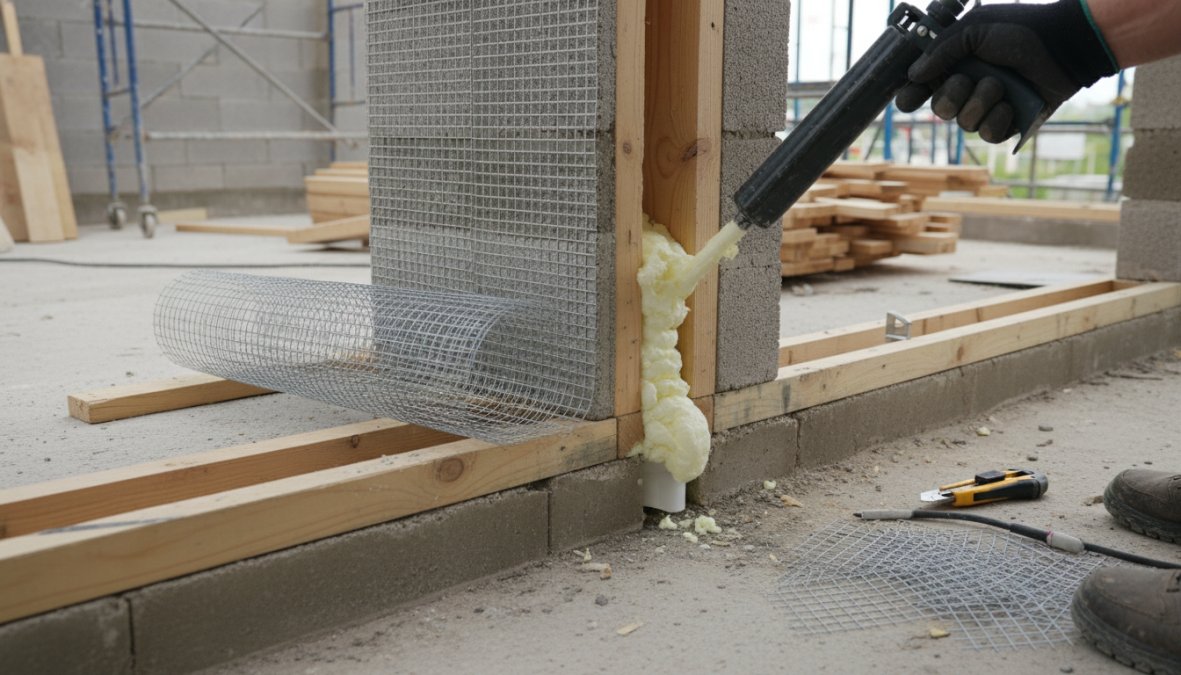
Foundation sealing is equally critical. Every pipe penetration, cable entry, and service duct that passes through the foundation slab or walls is a potential access point. These openings should be sealed with:
- Wire mesh (minimum 19-gauge) packed tightly around penetrations before applying mortar or foam sealant.
- Concrete collar seals around pipe penetrations at grade level.
- Drainage stoppers on all open drain pipes and inspection chambers. Rats routinely enter buildings through live sewer connections, and an uncapped drain is an open invitation.
As documented in NPMA guidelines on rodent exclusion for commercial properties, foundation sealing combined with perimeter barriers reduces rodent reinvasion rates significantly compared to baiting-only programs.
Securing Temporary Structures and Managing Excavation Sites
Temporary structures present a unique challenge. Site offices, welfare units, and storage containers are rarely sealed to the same standard as permanent buildings, yet they often contain the food sources (canteen waste, vending machines) that attract rats in the first place.
Inspect the underside and perimeter of every temporary structure on site. Gaps between the base of a welfare unit and the ground surface are a common entry point that gets overlooked entirely. Fit brush strip seals to all door bases and use expanding foam to close any gap larger than 6mm around service penetrations.
Excavation sites require daily inspection. Open trenches, pile bores, and service ducts create new burrowing opportunities every day. At the end of each working day, inspect open excavations for burrow entrances and cap or fill any that are found before the site closes.
Place a thin layer of sand or fine soil around the base of temporary structures and check it every morning for footprints or track marks. This low-cost technique gives you a daily readout of overnight rodent activity without any electronic equipment.
Best Rat Traps for Construction Sites and Baiting Strategies
Trapping and baiting are the active management layer of your construction site pest management plan, not the foundation. They work best when sanitation and exclusion are already in place, because at that point you are dealing with a reduced, stressed population rather than a thriving colony with unlimited food and harbourage. Deploying bait stations on a site with unmanaged food waste is the pest control equivalent of bailing a boat without plugging the hole.
With that framing established, the mechanics of trap and bait placement on a construction site are more specific than most guides acknowledge, and the differences matter.
Snap Traps: Placement Geometry and Operational Requirements
Snap traps are the most immediately lethal and cost-effective option for targeted rat control on active construction sites. The key variables are placement geometry, housing, and inspection frequency.
Placement geometry: Rats travel along edges. They follow walls, pipes, beams, and the base of material stacks because open ground exposes them to predation. Snap traps must be placed perpendicular to the wall or runway surface, with the trigger mechanism facing the wall. A trap placed parallel to a wall, or in open space away from a travel route, will go untouched indefinitely regardless of bait quality.
Spacing along confirmed runways should be 3-5 metres apart in areas of high activity, widening to 10 metres in lower-activity perimeter zones. On a large site, this means maintaining a significant number of traps, budget accordingly rather than under-deploying and wondering why catch rates are low.
Housing: On a construction site, snap traps must be placed inside enclosed bait boxes or tunnel stations. This is not optional. Open snap traps in a working environment create an unacceptable risk of injury to workers and non-target animals, and in many jurisdictions their use without protective housing on a commercial site violates health and safety regulations. Tunnel stations also increase catch rates because they replicate the enclosed, dark conditions rats actively seek.
Inspection frequency: Check and reset snap traps daily. A trap that has been triggered and not reset is a wasted asset. A dead rat left in a trap for more than 24 hours creates a secondary hygiene problem and, in warm weather, an odour issue that is difficult to manage inside a partially completed building.
Rodenticide Bait Stations: Placement, Spacing, and Legal Compliance
Poisonous baiting using rodenticide bait stations is the most common approach on large construction sites, and it is also the most legally regulated. Getting this wrong creates liability exposure that goes beyond the pest problem itself.
Bait station placement standards:
- Position bait stations at intervals of 10-15 metres along the site perimeter as a baseline. In areas of confirmed activity, burrow entrances, established runways, near food waste sources, reduce spacing to 5-7 metres.
- Secure every bait station to a fixed point (stake, wall anchor, or cable tie to a fence post) to prevent movement by workers, machinery, or weather. A displaced bait station that is no longer on a rat runway provides no control value.
- Orient bait station entrances parallel to the wall or runway surface, with both entrance holes accessible. Rats enter bait stations more readily when they can pass through rather than having to reverse out.
- Keep bait stations away from drainage channels and water courses. Most jurisdictions restrict or prohibit the use of rodenticide bait near open water due to secondary poisoning risk to wildlife. The UK Health and Safety Executive guidance on rodenticide use on construction sites specifies minimum distances and documentation requirements for rodenticide application near drains and watercourses.
Rodenticide generations, why this matters on construction sites:
First-generation anticoagulant rodenticides (such as warfarin and coumatetralyl) require multiple feeds over several days to be lethal. They are less likely to cause secondary poisoning in predators but are slower acting and less effective against populations with established resistance. Second-generation anticoagulants (brodifacoum, bromadiolone, difenacoum) are lethal after a single feed but carry a higher secondary poisoning risk and are subject to stricter regulatory controls in many jurisdictions, particularly in the UK where the Campaign for Responsible Rodenticide Use (CRRU) stewardship code restricts their use to situations where first-generation products have demonstrably failed.
For most construction sites, a licensed pest control professional will make this determination based on local regulations, site-specific risk, and evidence of resistance. The practical point for site managers is to ensure that whoever is applying rodenticide on your site is licensed to do so and is documenting their product selection rationale. This documentation is your protection in a regulatory inspection or a liability claim.
Bait station record-keeping, the minimum viable log:
Every bait station on site must be recorded in a pest log. Each entry should capture:
- Station reference number and location (tied to a site map)
- Date of inspection
- Bait level (full / partial / empty)
- Signs of rodent activity (gnaw marks on station, droppings nearby, bait consumption rate)
- Any dead rodents found and disposal method
- Technician name or initials
Bait consumption rate is the most useful leading indicator of population pressure. A station that goes from full to empty between weekly inspections indicates a much higher activity level than one showing partial consumption, and should trigger an immediate increase in bait density and a review of nearby sanitation and harbourage conditions.
Eco-Friendly and Non-Toxic Deterrents Worth Considering
Not every site manager wants to rely on rodenticides, and in some jurisdictions their use near watercourses, in occupied structures, or on sites pursuing LEED or BREEAM certification is restricted or incompatible with project requirements. Non-toxic deterrents are a legitimate part of an integrated approach when their limitations are understood clearly.
Ultrasonic repellers generate high-frequency sound intended to disturb rodents. The evidence base is mixed at best. Studies reviewed by pest management bodies consistently find that rats habituate to ultrasonic frequencies within days to weeks, particularly in environments with competing noise sources, which describes every active construction site. Ultrasonic devices are not a standalone solution and should not be relied upon as a primary control method.
Electromagnetic and vibration devices operate on a similar principle with similar limitations. They may provide short-term disruption in small, enclosed spaces but offer no reliable perimeter protection on an open construction site.
Peppermint oil and plant-based repellent sprays work through olfactory deterrence. Their effective range is very short, typically less than a metre from the application point, and they require reapplication every few days, particularly in outdoor environments subject to rain and wind. They are most useful as a supplementary deterrent around specific, high-value access points (cable entry points into a site office, for example) rather than as a perimeter solution.
Live capture traps are the most genuinely non-toxic option, capturing rodents unharmed for relocation. The practical constraints on a construction site are significant: live traps require daily inspection (a legal requirement in most jurisdictions, a live trap that is not checked daily constitutes an animal welfare violation), and the volume of traps required to cover a large site makes daily management labour-intensive. For smaller sites, sites near ecologically sensitive areas, or projects where rodenticide use is contractually excluded, live trapping combined with rigorous exclusion is a viable and defensible approach.
The honest integration model: Non-toxic methods work best as a complement to physical exclusion, not as a replacement for rodenticide baiting where baiting is appropriate. On a LEED-targeted project, the correct approach is to maximise exclusion and sanitation to the point where rodenticide use is genuinely unnecessary, rather than to substitute ineffective deterrents for an effective chemical program. Document this approach explicitly in your pest management plan, it demonstrates intent and due diligence to both certifying bodies and regulatory inspectors.
The most common baiting mistake on construction sites is deploying too few stations too far apart and checking them too infrequently. A bait station network that looks adequate on a site map but is inspected fortnightly will not detect a developing infestation in time to prevent it from establishing. Treat bait station inspection as a daily operational task during high-risk phases, not a scheduled maintenance item.
How to Prevent Rats at Construction Sites Using Phase-Specific Strategies
Understanding how to prevent rats at construction sites across different project phases is where most pest management plans fall apart. A strategy that works during groundworks is completely wrong for the fit-out phase, and treating the whole project as a single environment is a common and costly mistake.
Phase 1: Groundworks and Excavation
This is the highest-risk phase. Ground disturbance displaces existing rat populations, and open trenches create immediate harbourage. Priority actions: perimeter curtain walls, daily burrow inspection, bait stations at the site boundary, and strict waste management from day one.
Phase 2: Structural Frame and Envelope
As the building rises, focus shifts to closing access points before they become permanent. Every floor penetration, service duct, and external opening should be temporarily sealed at the end of each working day. Rats will explore a building under construction at night.
Phase 3: Fit-Out and Finishing
The introduction of insulation, plasterboard, and joinery creates new harbourage opportunities. Inspect all material deliveries. Increase bait station frequency inside the structure. Pay particular attention to ceiling voids, underfloor spaces, and service risers.
Phase 4: Pre-Handover
Conduct a full site inspection with a pest control professional before handover. Document all bait station activity, confirm all access points are permanently sealed, and provide the client with a pest management handover report.
Technology-Driven Monitoring: Smart Traps and Digital Site Inspection
Smart monitoring is the most significant development in construction site pest management in recent years. Connected trap systems use sensors to alert site managers the moment a trap is triggered, eliminating the need for daily manual checks and providing a real-time picture of rodent activity across the site.
Digital site inspection platforms allow pest control professionals to log findings on a tablet or smartphone, generating automatic reports that feed directly into a site’s health and safety documentation. This matters for regulatory compliance: a digital audit trail of pest management activity is increasingly expected by building control bodies and insurance underwriters.
The practical benefit goes beyond compliance. Heatmaps of trap trigger locations allow site managers to identify hotspots, adjust bait station placement dynamically, and measure the effectiveness of sanitation interventions over time. This is a level of data that a manual inspection log simply cannot provide.
Smart trap systems don’t replace a pest control professional, but they dramatically improve response times and give site managers actionable data between scheduled inspections. On large sites, this can mean catching an emerging infestation days earlier than traditional monitoring would allow.
Building Your Construction Site Pest Management Plan
A construction site pest management plan is a documented, site-specific protocol that covers prevention, monitoring, intervention, and record-keeping for the duration of a project. Every commercial construction site should have one before groundworks begin, not after the first rat is spotted.
A functional plan includes the following components:
- Site-specific risk assessment identifying rodent pressure from surrounding land use (agricultural land, sewers, neighboring infestations)
- Map of all bait station and trap locations, updated as the site layout changes
- Sanitation schedule with named responsibility for each task
- Weekly inspection log with fields for droppings, gnaw marks, burrow activity, and bait consumption
- Escalation protocol: at what point does site management call a licensed pest control professional?
- Material storage and waste management policy signed off by site management
- Phase-specific pest control actions tied to the project programme
- Handover documentation for the building owner
This checklist is the minimum viable plan. Larger or higher-risk sites will require more detailed protocols, particularly around rodenticide use, non-target species protection, and contractor coordination.
Regulatory Compliance, Legal Liability, and When to Call a Pest Control Professional
Regulatory compliance around construction site pest control is tightening across most jurisdictions. In the UK, the Prevention of Damage by Pests Act places a legal duty on landowners to keep land free from rats and mice. In the US, OSHA standards require employers to maintain a sanitary work environment, and rodent infestations directly implicate those standards. Local health authorities in the Metro Boston area and across Massachusetts have the power to issue stop-work orders on sites where pest conditions pose a public health risk.
The legal liability dimension is frequently underestimated. A rat infestation that spreads from a construction site to neighboring residential properties can result in civil claims against the site owner or principal contractor. Documented evidence of a proactive pest management plan is a critical defense in those situations.
The question of when to call a pest control professional has a clear answer: before you have a problem, not after. A licensed pest control professional should conduct an initial site survey before groundworks begin, establish the baseline bait station network, and carry out scheduled inspections throughout the project. The cost is marginal relative to the liability exposure and project delay risk of an unmanaged infestation.
According to EPA integrated pest management guidance for commercial and institutional settings, an integrated pest management approach combining prevention, monitoring, and targeted intervention consistently outperforms reactive extermination in both cost and long-term effectiveness.
Zoifia Pest Control provides licensed and insured commercial pest management services across the Metro Boston area, with no long-term contracts required. For construction projects of any scale, the team conducts site-specific assessments and establishes monitoring programs that run alongside the project programme from groundworks to handover.
Construction sites will always attract rodents. The ground is disturbed, the materials are stacked, and the site is busy enough that early warning signs go unnoticed for days. The difference between a site that manages this well and one that ends up with a serious infestation comes down to how early and how systematically prevention is built into site operations. Zoifia Pest Control works with commercial clients across Metro Boston to build those systems before problems start, backed by a 90-day guarantee and no requirement for long-term contracts. Get a quote from Zoifia Pest Control and establish a pest management plan that covers your project from the first day of groundworks to final handover.
Frequently Asked Questions
Why do construction sites attract rats?
Construction sites attract rats because they provide three things rodents need most: food, shelter, and water. Food debris from workers' lunches, construction waste, and unsecured bins all draw vermin in. Disturbed soil, excavation sites, and piles of stored materials create ideal burrowing conditions and rodent harbourage. Live sewers exposed during groundwork and stagnant water further increase the appeal, making active sites a prime target for both Rattus norvegicus and Mus musculus.
What are the best methods for rodent control on construction sites?
The most effective approach combines multiple exclusion methods: eliminating food sources, sealing access points with foundation sealing and concrete curtain walls, using bait stations and trapping, and maintaining strict sanitation protocols. A written construction site pest management plan that assigns daily responsibilities is essential. For persistent infestations, engaging a licensed pest control professional ensures proper poisonous baiting is handled safely and in compliance with local regulations, reducing the risk of reinvasion.
Are construction companies legally required to control pests on site?
In most jurisdictions, construction companies do have legal obligations around site sanitation and pest minimisation, typically enforced through health and safety regulations and local authority environmental management rules. Failure to manage a rat infestation can result in fines, stop-work orders, or liability claims if vermin spread to neighboring properties. Checking with your local authority and maintaining a documented construction site pest management plan is the best way to stay compliant and limit legal exposure.
How do you get rid of rats during demolition?
Demolition is a high-risk phase because burrowing rodents are disturbed and scatter to adjacent properties. Before demolition begins, pre-bait the site with bait stations for several weeks to reduce the population. Install perimeter insulation barriers and physical exclusion methods around the site boundary. Notify neighboring properties so they can take precautions. Work with a pest control professional to conduct a thorough site inspection before and during demolition, and remove construction waste promptly to avoid creating new rodent harbourage.
What signs of rat infestation at construction sites should managers look for?
Key signs include dark, pellet-shaped droppings near food storage or temporary structures, gnaw marks on wood, cables, or insulation, and burrow holes along foundations or excavation edges. Smear marks, dark greasy streaks along walls and beams, indicate regular rat runs. You may also notice shredded materials used for nesting, a strong ammonia-like odor, or visible rats during daylight hours, which often signals a large infestation requiring immediate attention from a pest control professional.
This article was written using GrandRanker
