
Table of Contents
- What Counts as an Emergency Pest Removal Situation in Boston
- Signs of a Pest Infestation in Boston Homes You Should Never Ignore
- Emergency Rodent Removal Boston: How the Process Works
- Cost of Emergency Pest Control Services vs. Routine Treatment
- Pests Covered by Emergency Pest Removal Boston Services
- Integrated Pest Management and Eco-Friendly Solutions in Boston
- Annual Pest Control Plans, Guaranteed Service, and What to Look For
- Conclusion: Act Fast and Choose the Right Emergency Exterminator in Boston
Last Updated: June 10, 2026
Pest emergencies do not follow business hours. Whether you wake up to rodent droppings across your kitchen counter or discover a bed bug infestation before hosting guests, knowing how to access emergency pest removal Boston services fast is the difference between a contained problem and a full-blown crisis. At Zoifia Pest Control, we handle exactly these situations every day across the Metro Boston area. This guide covers which pests require immediate professional attention, what to do while you wait, how removal works, and what to expect on cost and response time.
Most guides treat every pest problem as equally urgent. They are not. Some infestations can wait a week for a routine appointment. Others cannot wait 24 hours without spreading, causing structural damage, or creating serious public health risks. Knowing the difference saves money and stress.
What Counts as an Emergency Pest Removal Situation in Boston
An emergency pest situation is one where delay causes measurable harm: health risk, structural damage, rapid spread, or regulatory consequences. Not every pest sighting qualifies, but several common Boston scenarios absolutely do.
Boston’s dense urban environment, aging housing stock, and active restaurant scene cause pest problems to escalate faster than in suburban settings. A single Norway rat entering through a foundation crack can establish a colony in weeks. A small bed bug population can spread to adjacent units in a multi-family brownstone within days.
Pests That Require Immediate Professional Attention
Some pests demand same-day service, no exceptions:
- Rodents (rats and mice): Active Norway rat activity inside living spaces poses immediate health risks through contaminated surfaces and potential electrical damage from gnawed wiring.
- Bed bugs: Confirmed infestations spread rapidly in multi-unit buildings. Every night you wait is another night of feeding and reproduction.
- Stinging insects (wasps, hornets): Active nests inside walls or near entry points create serious injury risk, especially for households with allergic individuals.
- Cockroaches (heavy infestation): Large roach populations in food preparation areas can trigger health code violations within 24 hours of an inspection.
- Termites (active swarmers): Visible swarmers inside the home signal an active colony. Structural damage compounds quickly.
A common mistake is calling for a routine appointment when the situation is urgent. Live rodents during daylight hours signal a large population, not a single stray animal.
DIY Immediate Mitigation Steps While You Wait for a Technician
Calling a licensed exterminator is step one. These actions can slow the spread before your technician arrives.
For rodents:
- Seal all accessible food sources in hard-sided containers immediately
- Block obvious entry gaps temporarily with steel wool (rodents cannot chew through it)
- Do not set snap traps near children or pets without proper placement guidance
For bed bugs:
- Do not move mattresses or furniture to other rooms; this spreads the infestation
- Bag and seal all bedding in plastic before washing on the highest heat setting
- Avoid sleeping in a different room; bed bugs will follow you and expand their territory
For cockroaches:
- Remove all food debris and standing water from surfaces
- Seal gaps around pipes under sinks with temporary caulk
- Do not use aerosol sprays without guidance; many cause roaches to scatter into walls, making treatment harder
Never use over-the-counter foggers (“bug bombs”) for bed bugs or cockroaches. Research consistently shows these products push insects deeper into wall voids and can make professional treatment significantly less effective. Tell your technician if you used any products before their arrival.
Signs of a Pest Infestation in Boston Homes You Should Never Ignore
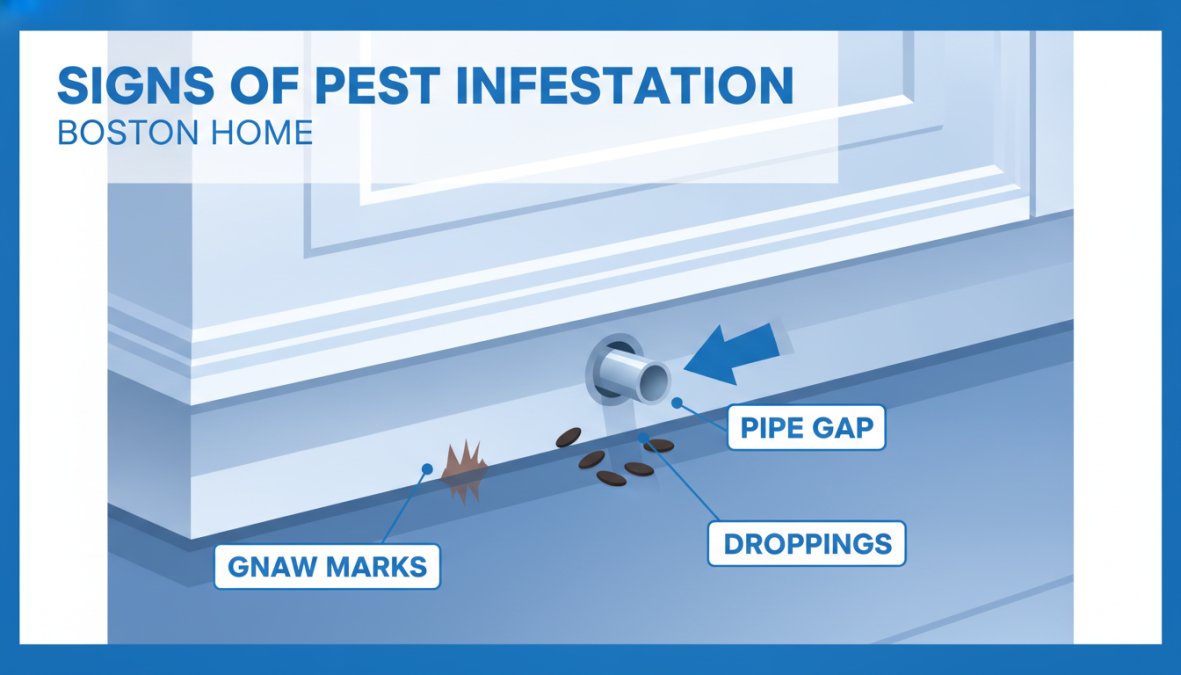
The signs of a pest infestation in Boston homes often appear weeks before homeowners recognize them. By the time a problem becomes obvious, the infestation is usually well-established.
Watch for these indicators:
- Gnaw marks on baseboards, food packaging, or electrical wiring insulation
- Dark, pellet-shaped droppings near walls, under sinks, or inside cabinets
- Grease trails along walls or floor edges (a signature of heavy rodent traffic)
- Musty or sweet odors in enclosed spaces (bed bugs produce a distinctive scent)
- Shed insect skins or egg casings in corners and along wall junctions
- Rustling or scratching sounds inside walls at night
- Small blood spots or rust-colored staining on mattress seams
Neighborhood-Specific Pest Profiles Across Boston
Boston’s neighborhoods have distinct pest pressure patterns shaped by building age, density, and proximity to transit and waterways.
Allston and Brighton: High-density student housing with frequent tenant turnover creates persistent bed bug pressure. Furniture left on curbs is a primary transmission vector.
South End and Back Bay: Historic brownstones with original brick foundations and aging pipe chases provide ideal Norway rat entry points. Rodent activity here tends to be structural and chronic.
East Boston and Chelsea: Proximity to the waterfront and industrial corridors elevates both rodent and cockroach pressure, particularly in restaurant-dense blocks.
Dorchester and Roxbury: Older triple-deckers with shared wall cavities allow cockroach and rodent populations to move freely between units, making single-unit treatments less effective without building-wide coordination.
Downtown and the Financial District: Commercial kitchen density drives cockroach and rodent activity that spills into adjacent residential buildings, particularly in mixed-use developments.
Understanding your neighborhood’s risk profile helps you choose the right treatment approach and set realistic expectations for ongoing prevention.
Emergency Rodent Removal Boston: How the Process Works
Emergency rodent removal in Boston goes well beyond setting a few traps. A properly executed program addresses three things simultaneously: eliminating the existing population, cutting off food and harborage sources, and sealing entry points. Skipping any one of these steps guarantees the problem returns.
Baiting, Trapping, and Entry Point Sealing
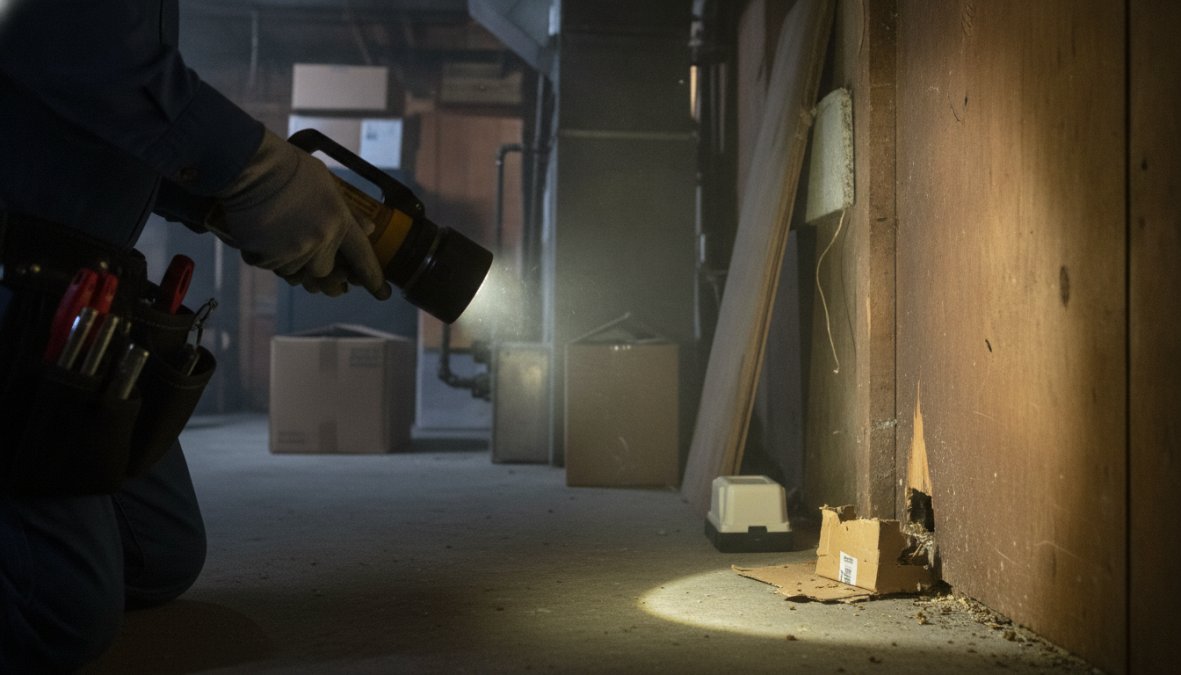
A licensed technician begins with a thorough pest inspection, mapping active rodent runways, identifying entry points, and assessing infestation scale. This inspection drives every subsequent decision.
Baiting: Tamper-resistant bait stations are placed along active runways and near entry points. Child- and pet-safe when properly installed, they provide population control over a 7-14 day period following initial treatment.
Trapping: Snap traps and mechanical traps are deployed in high-activity zones for immediate knockdown and require follow-up visits to check and reset.
Entry point sealing: Mice can enter through gaps as small as a quarter inch; rats need only a half-inch opening. Technicians use steel wool, hardware cloth, expandable foam, and caulk to seal identified entry points permanently.
According to the Massachusetts Department of Agricultural Resources pest management guidelines, licensed pest control operators in Massachusetts must follow Integrated Pest Management principles that prioritize exclusion and baiting over broad pesticide application for rodent control.
Ask your technician to document every entry point they seal with photos. This creates a record for future reference and helps you identify if new gaps open up over time due to settling or construction nearby.
Cost of Emergency Pest Control Services vs. Routine Treatment
Emergency pest control costs more than routine treatment for straightforward reasons: same-day scheduling, priority dispatch, and the complexity of active infestations all add to the service cost.
| Service Type | Typical Scope | Response Time | Relative Cost |
|---|---|---|---|
| Emergency / Same-Day | Active infestation, health risk | Same day or next morning | Higher |
| Routine Treatment | Preventive or low-level activity | 3-7 days | Standard |
| Annual Maintenance Visit | Scheduled inspection and barrier treatment | Pre-scheduled | Lowest per visit |
| One-Time Initial Treatment | New infestation, full assessment | 1-3 days | Moderate to high |
Zoifia Pest Control does not require long-term contracts, meaning you are not locked into a subscription to access emergency services. The 90-day guarantee on treatments means that if the problem returns within that window, you are covered without an additional service charge.
Emergency Response Time Benchmarks: What to Expect in Boston
- Same-day service: Available from most local providers for rodents, bed bugs, and stinging insects. Expect a 2-6 hour window from call to technician arrival during business hours.
- Next-morning service: Standard for calls placed after 4 PM. Most reputable Boston exterminators dispatch by 8-9 AM the following day.
- 24/7 phone support: Some providers offer live phone answering around the clock, though physical dispatch may still be next-morning.
- Weekend availability: Varies significantly by provider. Clancy Brothers Pest Control offers Saturday service, which is valuable for residential customers who cannot take weekday appointments.
Response time is only meaningful if the technician who arrives is fully equipped for your specific pest. Confirm before booking that the provider has the materials and trained staff for your situation, not just general availability.
Pests Covered by Emergency Pest Removal Boston Services
Emergency pest removal Boston services from qualified local providers cover a broad range of urban pest challenges:
- Rodents: Norway rats, house mice, and roof rats
- Bed bugs: Full heat treatment or chemical treatment protocols
- Cockroaches: German cockroach (the dominant species in Boston kitchens), American cockroach, Oriental cockroach
- Ants: Carpenter ants (which cause structural damage), pavement ants, odorous house ants
- Stinging insects: Yellow jackets, bald-faced hornets, paper wasps, carpenter bees
- Termites: Eastern subterranean termite, the primary species in Massachusetts
- Wildlife: Squirrels, raccoons, and bats in attic spaces (requires wildlife management protocols distinct from standard extermination)
- Stored product pests: Pantry moths, grain beetles, and weevils in food storage areas
Providers specializing in wildlife management, such as Critter Control of Boston, handle bat and raccoon removals under different regulatory frameworks than standard insect extermination. Confirm your provider is licensed for the specific pest category before scheduling.
As documented in the EPA’s Integrated Pest Management guidelines for urban environments, effective urban pest control requires pest-specific treatment protocols rather than generalized pesticide application, which is why provider specialization matters.
Integrated Pest Management and Eco-Friendly Solutions in Boston
Integrated Pest Management (IPM) is the science-based approach that prioritizes prevention, monitoring, and targeted treatment over blanket pesticide application. It is a structured methodology with measurable outcomes, not just a marketing term.
IPM is defined as a systematic approach that combines biological, cultural, physical, and chemical tools to minimize economic, health, and environmental risks from pests and pest management.
In practice, IPM for Boston properties means conducting a thorough inspection before any treatment, prioritizing exclusion and habitat modification over chemical treatment, using pesticides only when monitoring confirms necessity, and evaluating results to adjust the approach based on data.
Eco-friendly solutions have expanded significantly. Providers like Eco Cure Pest Control focus on pet-safe and child-safe protocols that align with IPM principles, particularly relevant for Boston’s historic brownstones where chemical application near original plaster and wood is a concern. The National Pest Management Association’s resource on IPM practices provides further technical guidance on how licensed technicians apply these principles in urban settings.
Pesticide reduction does not mean less effective treatment. An IPM-based rodent program that seals every entry point will outperform repeated bait-only applications every time.
The most effective pest control programs in Boston combine immediate treatment for the active infestation with structural exclusion work and an ongoing monitoring plan. One-time treatments without follow-through rarely hold.
Annual Pest Control Plans, Guaranteed Service, and What to Look For
Routine pest control is why some Boston homeowners never face emergencies in the first place. Annual maintenance plans create a barrier treatment schedule that intercepts pest pressure before it becomes an infestation. Four factors separate a strong plan from a weak one:
1. Inspection frequency: Quality plans include at least quarterly visits, with additional check-ins during peak pest seasons (spring for ants and termites, fall for rodents seeking warmth).
2. Guaranteed service: Look for providers that back their work with a written guarantee. Zoifia Pest Control’s 90-day guarantee means that if covered pests return within 90 days of treatment, the follow-up service costs you nothing.
3. No mandatory long-term contracts: Many national franchises lock customers into annual contracts with cancellation penalties. Reputable local providers offer flexible service without that commitment.
4. Licensed and insured technicians: Massachusetts requires pest control operators to hold a current license through the Department of Agricultural Resources. Always verify before allowing anyone to treat your property.
National providers like Ehrlich Pest Control offer standardized protocols and broad service networks, valuable for commercial clients managing multiple locations. For residential clients in Boston who want personalized service and direct technician accountability, a local licensed provider typically delivers better outcomes and faster response. When reviewing customer feedback, look specifically for mentions of follow-up visits and how the company handled situations where the first treatment did not fully resolve the problem, that is where you see the real character of a provider.
Pest problems in Boston do not get smaller on their own. The longer an infestation goes unaddressed, the more expensive and disruptive the resolution becomes. Zoifia Pest Control offers licensed, insured emergency pest removal services across the Metro Boston area, backed by a 90-day guarantee and flexible scheduling with no long-term contracts required. Whether you are dealing with a rodent intrusion, a bed bug outbreak, or a persistent cockroach problem in a commercial kitchen, the team is equipped to respond fast and resolve it completely. Get a quote from Zoifia Pest Control and stop the problem before it compounds.
Frequently Asked Questions
What constitutes a pest control emergency in Boston?
A pest control emergency typically involves a situation that poses an immediate health or safety risk, such as a Norway rat infestation near food prep areas, a severe bed bug outbreak, a wasp nest inside a wall, or visible termite damage to structural wood. In Boston's dense urban environment, rapid spread between units in brownstones and multi-family homes makes even a moderate infestation an urgent matter. When in doubt, call a licensed exterminator the same day for a pest inspection.
How quickly can emergency pest removal Boston services respond?
Response times for emergency pest removal in Boston vary by provider. Many local and regional companies offer same-day service, with some targeting arrival within two to four hours of your call during business hours. After-hours and weekend availability depends on the company. When contacting a provider, always ask for a specific estimated arrival window, not just 'we'll get there soon.' Zoifia Pest Control prioritizes fast response for Metro Boston residential and commercial properties.
Are emergency pest control services more expensive than routine treatments?
Yes, emergency pest control services generally cost more than scheduled routine treatments. The premium reflects after-hours availability, priority scheduling, and the urgency of the response. Routine residential pest control in the Boston area may cost less per visit when bundled into an annual maintenance plan, while a one-time emergency call-out will typically carry a higher base rate. Getting a free quote upfront helps you compare emergency versus standard pricing before committing to a service.
Can I handle a pest infestation myself, or do I need a professional exterminator?
For minor issues, a few ants near a window or a single mouse, DIY measures like sealing entry points and using store-bought traps can help as an immediate mitigation step. However, infestations involving rodents inside walls, bed bugs in mattresses, or any sign of termite activity require licensed technicians with professional-grade treatments. DIY approaches rarely address the root cause, and delays can allow the infestation to spread significantly, especially in Boston's multi-unit housing stock.
What pests in Boston require immediate professional attention?
Several pests common to Boston MA demand fast professional action: Norway rats and house mice (which spread disease and breed rapidly), bed bugs (which spread between units quickly in apartments and brownstones), termites (which cause structural damage), and stinging insects like wasps or hornets nesting inside walls. Cockroach infestations also escalate quickly in urban settings and pose public health risks. For any of these, same-day emergency pest removal services are strongly recommended over waiting.
This article was written using GrandRanker
