Table of Contents
- What Are Bed Bugs and How Do They Spread in Multi-Unit Housing?
- Landlord Responsibilities for Bed Bugs in Rental Properties
- Bed Bug Inspection Checklist for Landlords Before Treatment
- Effective Bed Bug Treatment for Rental Units: Heat vs. Chemical Control
- Bed Bug Extermination Cost for Apartments: What to Expect
- Bed Bug Lease Addendum Template and Landlord Communication
- Choosing Effective Bed Bug Treatment for Rental Units: Post-Treatment Monitoring
- Conclusion
Last Updated: June 8, 2026
Bed bugs in a rental property are a legal liability, a tenant relations crisis, and a pest control challenge that gets harder the longer it goes unaddressed. Effective bed bug treatment for rental units requires a coordinated strategy covering inspection, legal compliance, treatment selection, and post-treatment monitoring. This guide from Zoifia Pest Control covers every stage, from identifying the first signs of infestation to choosing between heat and chemical control.
Here’s what most guides get wrong: they treat bed bug control as a single event rather than a process. A one-time spray does not solve a bed bug problem in an apartment building. It relocates it.
What Are Bed Bugs and How Do They Spread in Multi-Unit Housing?
Bed bugs (Cimex lectularius) are small, nocturnal arthropods that feed exclusively on human blood. Adults are roughly the size of an apple seed, flat, and reddish-brown. Nymphs are smaller and nearly translucent until they feed. Eggs are white, about 1mm long, and nearly impossible to see without magnification.
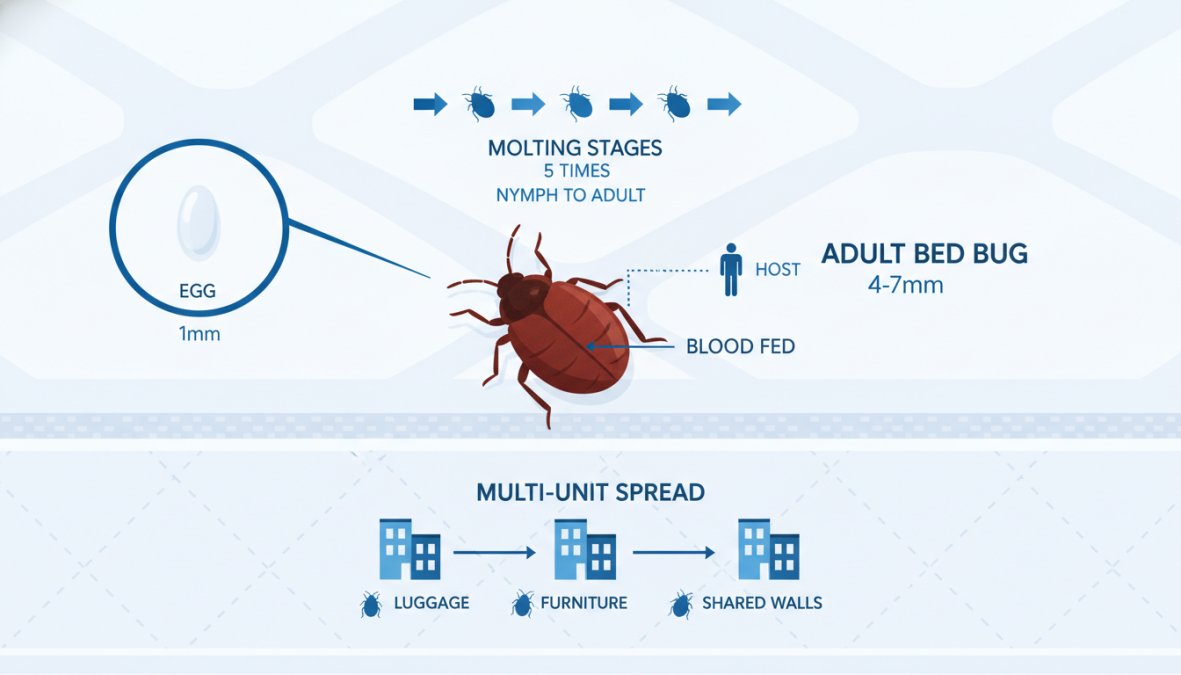
Multi-unit housing creates a specific problem single-family treatments don’t face: cross-contamination. Bed bugs travel through wall voids, electrical conduit, plumbing chases, and shared laundry facilities. A confirmed infestation in unit 3B is almost certainly a potential infestation in 2B, 4B, and 3A. Treating one unit without inspecting adjacent units is one of the most common and costly mistakes landlords make.
According to the EPA’s bed bug guidance for multi-family housing, bed bugs are among the most difficult urban pests to control precisely because of their ability to spread laterally through building infrastructure.
Never treat a single unit in isolation without inspecting adjacent units. Bed bugs displaced by treatment will move through wall voids to neighboring apartments, and the infestation will return within weeks.
How to Identify Bed Bugs: Eggs, Nymphs, and Adults
Accurate identification is the foundation of any effective treatment plan. Misidentification leads to the wrong treatment, wasted money, and a worse infestation months later.
- Eggs: Pearlescent white, 1mm, found in clusters in cracks, seams, and joints
- Nymphs: Translucent to yellow-brown, five developmental stages, each requiring a blood meal to molt
- Adult bed bugs: Reddish-brown, 4-5mm, flat when unfed and swollen after feeding
Bed bugs feed primarily between 2 a.m. and 5 a.m. and retreat to harborage during daylight. Common hiding places include mattress seams, box spring joints, bed frame crevices, baseboards, electrical outlet covers, and behind loose wallpaper.
Signs of an Infestation: Fecal Stains, Itchy Welts, and Sweetish Odor
The clearest early indicator is fecal staining, small dark brown or black spots on mattress seams, bed frames, and wall junctions near sleeping areas. These stains are digested blood and will smear when wiped with a damp cloth.
Tenants may report itchy welts in linear or clustered patterns on exposed skin. A heavy infestation often produces a sweetish odor, sometimes described as coriander or overripe raspberries. That smell without explanation is a red flag requiring immediate professional inspection.
Landlord Responsibilities for Bed Bugs in Rental Properties
Landlord responsibility for bed bugs is not discretionary. Most states impose a legal duty to maintain habitable conditions, and a confirmed infestation typically constitutes a housing code violation. Failing to act quickly exposes landlords to rent withholding, repair-and-deduct remedies, and civil liability.
Core obligations generally include: prompt inspection upon notification, engagement of a licensed Pest Management Professional (PMP), written communication to affected tenants, and treatment of all affected and adjacent units.
What Massachusetts Housing Code Requires
Massachusetts housing code places extermination responsibility on landlords when infestations affect two or more units, or when the infestation is not attributable to the tenant’s own actions. Under the Massachusetts State Sanitary Code (105 CMR 410), landlords must maintain rental units free from insect infestation and arrange for extermination at their own expense.
Landlords who receive written notice and fail to respond within a reasonable timeframe can face enforcement action from local boards of health. Given bed bugs’ rapid reproduction rate, that timeframe is interpreted strictly.
Tenant Rights and Financial Assistance Options
Tenants in Massachusetts have the right to report bed bug infestations to their local board of health without fear of retaliation. If a landlord fails to act, tenants can pursue rent escrow or repair-and-deduct remedies under state law. Financial assistance for low-income tenants is available through some municipal housing authorities and nonprofit organizations. The burden of treatment cost should not fall on tenants when the infestation is not their fault.
Bed Bug Inspection Checklist for Landlords Before Treatment
A structured inspection checklist prevents missed hiding places and ensures treatment scope is accurate before any pesticide application or heat treatment begins.
Pre-Treatment Inspection Checklist:
- Inspect all mattress seams, box spring fabric, and bed frame joints in affected unit
- Check all upholstered furniture, including couch cushion seams and undersides
- Examine baseboards, electrical outlet covers, and wall switch plates
- Inspect behind wall-mounted artwork, mirrors, and headboards
- Check drawer joints, nightstand interiors, and closet baseboards
- Inspect adjacent units (above, below, and on both sides of confirmed unit)
- Review shared laundry areas and common spaces
- Document all findings with photographs and written notes
- Provide written notification to all affected tenants with treatment timeline
- Confirm tenant preparation requirements in writing before scheduling treatment
This checklist should be completed by a licensed PMP, not building maintenance staff. Untrained visual inspections miss a significant percentage of infestations, particularly in early stages when populations are concentrated in deep crack-and-crevice hiding places.
Canine bed bug detection services can identify infestations that visual inspections miss. For large multi-unit buildings, a canine inspection before treatment scoping can save significantly on unnecessary unit treatments.
Effective Bed Bug Treatment for Rental Units: Heat vs. Chemical Control
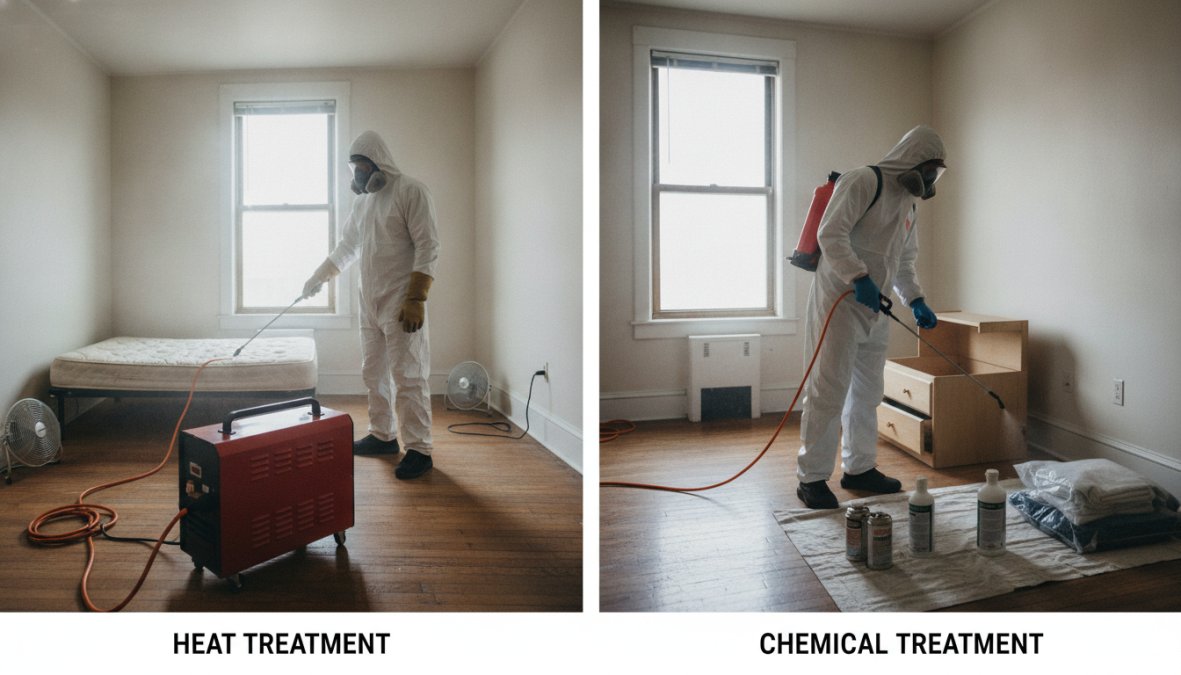
Effective bed bug treatment for rental units falls into two primary categories: heat treatment and chemical control. Each has distinct advantages, limitations, and apartment-specific logistics.
Heat Treatment: Apartment-Specific Logistics
Heat treatment kills bed bugs at all life stages, including eggs, by raising room temperatures above 120°F. This is its primary advantage: eggs are notoriously resistant to many pesticides, but heat eliminates them reliably.
Tenants must vacate for 6-8 hours. Heat-sensitive items, certain electronics, aerosol cans, medications, candles, vinyl records, must be removed beforehand. In multi-unit buildings, heat treatment requires careful management of shared walls to prevent bed bugs from evacuating into adjacent spaces ahead of the heat front. Some PMPs combine heat with perimeter chemical treatment to prevent this escape behavior.
Chemical Control: Crack-and-Crevice Application and Pyrethroid Resistance
Chemical control remains the most commonly used approach due to lower cost and easier logistics. Effective programs rely on crack-and-crevice application targeting specific hiding places rather than broadcasting pesticide across open surfaces.
The critical issue today is pyrethroid resistance. Many urban bed bug populations have developed significant resistance to pyrethroid-class insecticides, and a PMP applying only pyrethroid products to a resistant population will see treatment failure. Effective programs now combine multiple active ingredient classes, including neonicotinoids and insect growth regulators, which is why hiring a licensed PMP matters.
Integrated Pest Management (IPM): The Professional Standard
Integrated Pest Management (IPM) combines chemical and non-chemical methods, emphasizes prevention, and uses pesticide application as one tool among many. For bed bugs in rental units, IPM is the recognized professional standard recommended by university extension programs and the National Pest Management Association.
An IPM program for multi-unit housing typically includes:
- Thorough inspection and infestation mapping across all potentially affected units
- Tenant education on preparation requirements and post-treatment protocols
- Non-chemical controls (mattress encasements, clutter reduction, vacuuming)
- Targeted pesticide application using multiple active ingredient classes
- Follow-up inspections at 2 weeks and 4 weeks post-treatment
- Monitoring devices placed in treated and adjacent units for 90 days
IPM consistently outperforms single-method treatments in multi-unit housing because it addresses the structural and behavioral factors that allow infestations to persist and spread.
Bed Bug Extermination Cost for Apartments: What to Expect
Bed bug extermination cost varies based on treatment method, unit size, infestation severity, and number of units requiring treatment. Heat treatment generally costs more per unit but often requires fewer follow-up visits. Chemical IPM programs may have lower initial cost but should include scheduled follow-up inspections in the base price.
Landlords should be cautious of unusually low quotes. Bed bug treatment is labor-intensive, requires specialized equipment, and demands licensed professional application. A quote that significantly undercuts market rates typically reflects a simplified protocol that won’t achieve full elimination.
| Treatment Type | Typical Scope | Relative Cost | Best For |
|---|---|---|---|
| Heat Treatment | Single unit | Higher upfront | Severe infestations, chemical resistance |
| Chemical IPM | Single or multi-unit | Moderate, multi-visit | Early to moderate infestations |
| Combined Heat + Chemical | Multi-unit | Highest | Large buildings, confirmed resistance |
| Non-chemical only | Supplemental | Low | Prevention and monitoring only |
For multi-unit buildings, many PMPs offer per-building pricing more cost-effective than treating units individually. Zoifia Pest Control provides transparent quotes for both single-unit and multi-unit programs, with no long-term contracts required.
Bed Bug Lease Addendum Template and Landlord Communication
A bed bug lease addendum template is most useful before an infestation occurs, not after. A well-drafted addendum clarifies tenant reporting obligations, establishes cooperation requirements for treatment preparation, and documents the landlord’s commitment to prompt response.
Sample Bed Bug Lease Addendum Language:
Bed Bug Addendum
Tenant agrees to promptly notify Landlord in writing upon observing any signs of bed bug activity, including but not limited to: live or dead insects, fecal staining, shed skins, or bites consistent with bed bug feeding.
Landlord agrees to arrange for inspection by a licensed Pest Management Professional within [5] business days of written notification. If an infestation is confirmed, Landlord will arrange for treatment at Landlord’s expense, provided the infestation is not attributable to Tenant’s actions or belongings.
Tenant agrees to cooperate fully with preparation requirements provided by the pest control professional, including but not limited to: laundering and bagging linens, clearing clutter from treated areas, and vacating the unit for the duration of treatment.
Failure to cooperate with treatment preparation may result in treatment rescheduling at Tenant’s expense.
When notifying tenants of a confirmed infestation, written communication should include: the affected unit(s), scheduled treatment date, specific preparation instructions, the name and license number of the treating PMP, and a contact for questions. Clear communication reduces tenant anxiety and improves preparation compliance, which directly affects treatment success.
A bed bug lease addendum does not shift legal liability away from landlords. It creates a documented cooperation framework that protects both parties and improves treatment outcomes by setting clear expectations before an infestation occurs.
Choosing Effective Bed Bug Treatment for Rental Units: Post-Treatment Monitoring
Post-treatment monitoring is where most landlord programs fail. An infestation that appears resolved can rebound from surviving eggs, re-introduction from adjacent units, or incomplete treatment of hiding places.
Non-Chemical Controls: Mattress Encasements, Vacuuming, and Clutter Reduction
Non-chemical controls are an essential IPM component in both treatment preparation and post-treatment monitoring.
Mattress encasements trap any surviving bed bugs inside the mattress and box spring and prevent new bed bugs from establishing harborage. Encasements should be installed on all beds in treated units and left in place for a minimum of 18 months.
Vacuuming before treatment removes live insects, shed skins, and fecal material that can interfere with pesticide contact. Vacuum bags should be sealed in plastic and discarded immediately, not emptied into a building trash can.
Clutter reduction is the single most impactful non-chemical intervention a tenant can make. Clutter creates hundreds of additional hiding places that make complete pesticide application nearly impossible. Tenants should receive specific, written guidance on clutter reduction as part of their preparation instructions.
How to Monitor for Re-Infestation After Treatment
Post-treatment monitoring should be systematic, not reactive. Waiting for a tenant to report new bites is not a monitoring program.
Effective post-treatment monitoring includes:
- Active monitoring devices: Place interceptor traps (climb-up style) under all bed legs in treated and adjacent units. Check every 2 weeks for the first 60 days.
- Scheduled follow-up inspections: A licensed PMP should conduct visual inspections at 14 days and 30 days post-treatment. Any live activity triggers immediate re-treatment.
- 90-day monitoring window: Most re-infestations become apparent within 90 days. Zoifia Pest Control’s 90-day guarantee aligns with this window, providing licensed follow-up if activity is detected after treatment.
- Tenant reporting protocol: Tenants should have a direct contact and clear instructions for reporting suspected activity. Fast response prevents a small resurgence from becoming a full reinfestation.
According to guidance from the University of Minnesota Extension on bed bug monitoring, interceptor traps are among the most reliable tools for detecting low-level bed bug activity that visual inspections miss. A 90-day monitoring commitment is the only way to confirm an infestation has been fully resolved rather than temporarily suppressed.
Bed bugs in rental units compound quickly when the response is slow, incomplete, or poorly coordinated. Zoifia Pest Control specializes in bed bug programs for multi-unit residential properties in the Metro Boston area, offering licensed and insured treatment backed by a 90-day guarantee with no long-term contracts required. Get a quote from Zoifia Pest Control and get a clear treatment plan, transparent pricing, and the follow-up monitoring that turns a one-time treatment into a confirmed resolution.
Frequently Asked Questions
Are landlords responsible for bed bug treatment in rental units?
In most states, including Massachusetts, landlords are legally required to maintain rental units free of pest infestations under housing code. If bed bugs are present at move-in or spread due to building conditions, the landlord is typically responsible for hiring a licensed Pest Management Professional. However, if a tenant's behavior, such as bringing in infested furniture, caused the infestation, responsibility may shift. Always document the infestation in writing and report it promptly to protect your rights.
What is the most effective way to get rid of bed bugs in an apartment?
Effective bed bug treatment for rental units typically combines heat treatment and chemical control under an Integrated Pest Management (IPM) approach. Heat treatment raises room temperatures high enough to kill all life stages, eggs, nymphs, and adult bed bugs, without pesticide residue. Chemical control using crack-and-crevice application targets hiding places heat may miss. Non-chemical steps like mattress encasements, vacuuming, and clutter reduction support both methods. A licensed Pest Management Professional should conduct a thorough inspection before recommending a treatment plan.
How do you prevent bed bugs from spreading between rental units?
In multi-unit housing, cross-contamination between units is a serious risk. Landlords should treat adjacent units as part of any infestation response, even if no bugs have been confirmed there. Tenants can reduce spread by avoiding moving infested furniture, sealing cracks between walls, and using mattress encasements. Prompt reporting is critical, the longer an infestation goes untreated, the more units it can reach through shared walls, electrical conduits, and plumbing chases.
Can a landlord charge a tenant for bed bug extermination?
A landlord may charge a tenant for bed bug extermination cost if the tenant is proven to have caused the infestation, for example, by bringing in infested second-hand furniture. This is often addressed in a bed bug lease addendum template, which outlines each party's responsibilities. Without a clear addendum and documented proof of tenant fault, landlords in most jurisdictions cannot legally pass extermination costs to tenants. Consult local housing authority guidelines or a tenant rights organization if you face an unexpected charge.
What are the first steps to take when a tenant reports bed bugs?
When a tenant reports bed bugs, landlords should act quickly. First, document the report in writing and schedule a professional inspection within 24-48 hours using a bed bug inspection checklist for landlords. Identify the scope of the infestation and check adjacent units for signs of spread. Notify all affected tenants, arrange treatment with a licensed Pest Management Professional, and provide written preparation instructions. Early action limits liability, reduces extermination costs, and prevents the infestation from spreading across the building.
This article was written using GrandRanker
