
Table of Contents
- Why Avoiding Long Term Pest Service Contracts Is Worth Your Attention
- What Every Pest Control Service Agreement Should Include
- On-Demand Pest Control vs Subscription: Which Model Fits Your Situation
- One-Time Pest Control Service: When It Is the Smarter Choice
- Hidden Fees and Fine Print to Watch for in Residential Pest Management Contracts
- Pest Control Contract Cancellation Fees: Your Rights and Exit Options
- How to Negotiate Pest Control Services Before You Sign Anything
- Avoiding Long Term Pest Service Contracts With a No-Obligation Provider
Last Updated: June 13, 2026
Avoiding long term pest service contracts is one of the smartest consumer decisions you can make before letting any exterminator through your door. At Zoifia Pest Control, we see the fallout regularly: homeowners locked into annual agreements they can’t exit, paying for quarterly visits they don’t need, and fighting early termination fees just to switch providers. This guide breaks down exactly how those traps work, what your rights are, and how to get professional-grade pest management without surrendering your financial flexibility.
Here’s what most guides get wrong: they frame contracts as a necessary evil. They’re not. A well-run pest control company doesn’t need a 12-month commitment to deliver results. The contract requirement says more about the company’s business model than it does about your pest problem.
Why Avoiding Long Term Pest Service Contracts Is Worth Your Attention
Most homeowners sign pest control agreements without reading them. The contracts are long, the sales pitch is urgent, and the initial discount makes the math look favorable. But the structure of these agreements often works against the customer from the moment the ink dries.
A pest control service agreement is a legally binding document defining treatment scope, service frequency, billing cycles, and cancellation policy. The problem isn’t the agreement itself; it’s what gets buried inside it. Pest control companies benefit from recurring revenue; customers benefit from paying only when they have a problem. Fixed-term contracts resolve that tension entirely in the company’s favor.
The ‘Initial Discount’ Trap: How Loss Leader Pricing Locks You In
The initial service discount is a classic loss leader strategy. A technician quotes a first treatment at steep reduction, sometimes 50% off, and the real cost is distributed across mandatory recurring treatments that follow. By the time you realize the quarterly visits aren’t solving anything new, you’re already three months into a 12-month contract with an early termination fee at the exit. Door-to-door sales teams are often trained specifically to lead with the discounted initial service and downplay the ongoing commitment.
Never sign a pest control agreement on the same day a technician knocks on your door. Door-to-door sales pressure is a recognized tactic. Take 24 hours, read the full document, and compare the total annual cost, not just the first visit price.
Golden Handcuffs: Early Termination Fees and Billing Cycles Explained
Early termination fees typically equal the remaining contract balance or a flat penalty, sometimes both. A homeowner who cancels an annual agreement after six months can face charges equivalent to three or four service visits they’ll never receive. Automatic renewal clauses, often buried in fine print, can roll you into a second year without active consent. According to the FTC guidelines on negative option billing and automatic renewals, companies must clearly disclose auto-renewal terms before a consumer agrees, yet many pest control contracts bury the renewal clause in paragraph eight of a dense agreement.
What Every Pest Control Service Agreement Should Include
A legitimate service agreement protects both parties. Before signing, verify the document addresses each of the following areas clearly.
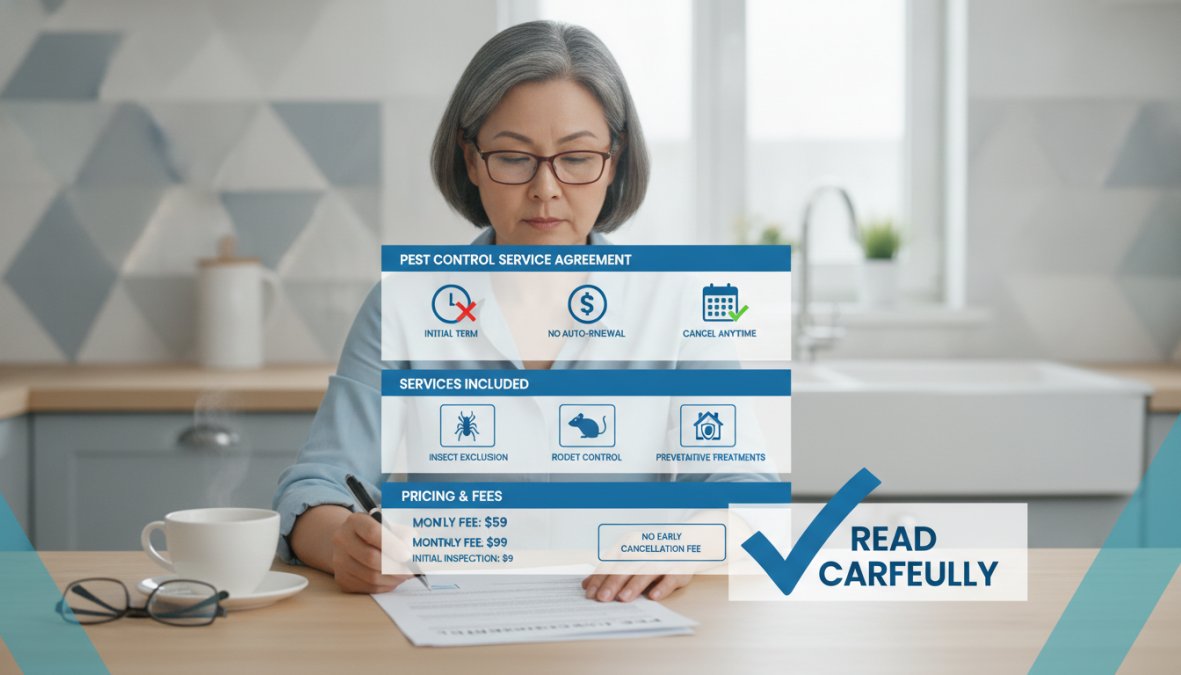
Treatment Scope, Service Frequency, and Pest Identification
The treatment scope defines which pests the company will treat, which areas of your property they’ll cover, and which methods they’ll use. Vague language is a red flag, "general pest control" without a specific pest list means the company can argue your infestation falls outside the agreement. Service frequency should be stated explicitly; a contract mandating four annual visits regardless of pest activity is billing you for compliance, not results. Pest identification clauses matter because a contract covering "ants" without specifying carpenter ants versus pavement ants gives the provider room to perform the cheaper treatment and claim compliance.
Liability Limitation, Service Guarantee, and Cancellation Policy
Every agreement includes a liability limitation clause, read it carefully, as some cap liability at the cost of a single service visit. The service guarantee is where you should focus negotiation energy: a strong guarantee commits to re-treatment at no additional cost if pests return within a defined window. The cancellation policy must state the notice period required, the method of cancellation, and the exact fee structure for early exit. If any of these three elements are missing or vague, get written clarification before signing.
Request a “plain language” summary of the cancellation policy in writing before you sign. A company that refuses to summarize its own terms in plain English is telling you something important about how they handle disputes.
On-Demand Pest Control vs Subscription: Which Model Fits Your Situation
The choice comes down to one question: does your property have chronic pest pressure, or do you deal with isolated incidents?
| Factor | On-Demand Service | Subscription/Contract |
|---|---|---|
| Best for | Isolated infestations | Chronic, recurring pest pressure |
| Cost structure | Per-service fee | Monthly or quarterly billing |
| Flexibility | Full | Limited by contract terms |
| Commitment | None | 6-24 months typical |
| Cancellation | N/A | Early termination fees apply |
| Service guarantee | Varies by provider | Often included |
A subscription makes sense when your property has documented, recurring pest pressure year after year, properties near water, dense vegetation, or older construction often qualify. On-demand service is the smarter choice for everyone else: you call when you have a problem, pay for the treatment, and you’re done. The honest answer most companies won’t give you: the majority of residential properties do not need quarterly treatments.
One-Time Pest Control Service: When It Is the Smarter Choice
One-time pest control service is right when the infestation is specific, contained, and unlikely to recur without a structural change in your property, a seasonal ant surge, a single rodent entry point, or a bed bug situation brought in from travel. The argument against one-time service is that pests always come back. Sometimes that’s true; often it’s not. The honest version: pests sometimes come back, and when they do, you can call again.
Calculating the Break-Even Point Between One-Time and Contract Pricing
Break-Even Formula:
- Annual contract cost = (Monthly fee x 12) + initial service fee
- One-time service cost = per-visit rate x estimated annual visits
- If Annual contract cost > (One-time cost x 1.2), the contract is not cost-effective
Many homeowners discover through this calculation that they’d need to schedule four or more separate visits annually before a contract becomes financially justified. For most properties, that threshold is never reached.
Run the break-even math before any sales conversation. A company that pushes back on you doing this math is not a company you want managing your pest problem.
Hidden Fees and Fine Print to Watch for in Residential Pest Management Contracts
The line items that cost homeowners the most money are rarely discussed during the sales pitch. According to the Consumer Financial Protection Bureau’s guidance on subscription billing practices, undisclosed fees in service agreements are among the most common consumer complaints across home services categories.
Specific clauses to audit before signing:
- Fuel surcharges: Added per visit, not disclosed upfront, and non-negotiable once you’re under contract
- Re-treatment fees: Some agreements charge for follow-up visits even when the initial treatment fails, arguing the return visit is a "new" service call
- Product upgrade charges: Technicians may recommend premium treatments during a visit not covered under your base agreement
- Price escalation clauses: Annual increases of 5-10% built into multi-year agreements
- Exclusion lists: Specific pest species or infestation types explicitly excluded from coverage, buried in an appendix
Watch also for contracts that define "service completion" as a technician visiting the property regardless of whether any treatment was applied or effective, this distinction matters enormously if you ever dispute a charge.
Pest Control Contract Cancellation Fees: Your Rights and Exit Options
Pest control cancellation fees are legally enforceable in most states, but they are not always calculated correctly and are sometimes waived when challenged. First, ask whether the company has delivered every scheduled service visit as promised. If they’ve missed visits, applied the wrong treatment, or failed to address the pest problem despite multiple attempts, you have grounds to argue material breach of contract.
State-Specific Consumer Rights and Door-to-Door Sales Protections
The FTC’s Cooling-Off Rule, as documented by the FTC’s official Cooling-Off Rule guidance, gives consumers the right to cancel contracts signed at their home within three business days with no penalty. Many states extend this window, California provides five days for home solicitation contracts. If your contract was signed during a door-to-door sales visit and required disclosures are missing, the contract may be unenforceable. State attorney general offices handle complaints against pest control companies specifically; filing costs nothing and often prompts companies to waive termination fees rather than face regulatory scrutiny.
A Step-by-Step Script for Canceling an Existing Contract
- Gather documentation first. Collect your original service agreement, all billing statements, and any written communication about service visits.
- Send written notice. Email or certified mail is preferable to phone calls, written notice creates a paper trail.
- State your intent clearly: "I am providing formal written notice of my intent to cancel my service agreement effective [date], per the cancellation policy outlined in Section [X] of my contract."
- Reference any service failures: "The company has failed to address [specific pest issue] despite [number] scheduled treatments, which constitutes a failure to deliver contracted services."
- Request written confirmation: "Please confirm receipt of this cancellation notice and provide a final billing statement within 10 business days."
- Dispute incorrect fees in writing: If charged a termination fee you believe is incorrect, dispute it in writing within 30 days and reference your state’s consumer protection statutes.
Never cancel by phone alone. Verbal cancellations are routinely disputed by companies claiming they have no record of the conversation.
How to Negotiate Pest Control Services Before You Sign Anything
Negotiation is expected in pest control, even if companies don’t advertise it. The sales structure of most pest control companies includes margin built into both price and contract terms, so there’s room to move before you commit.
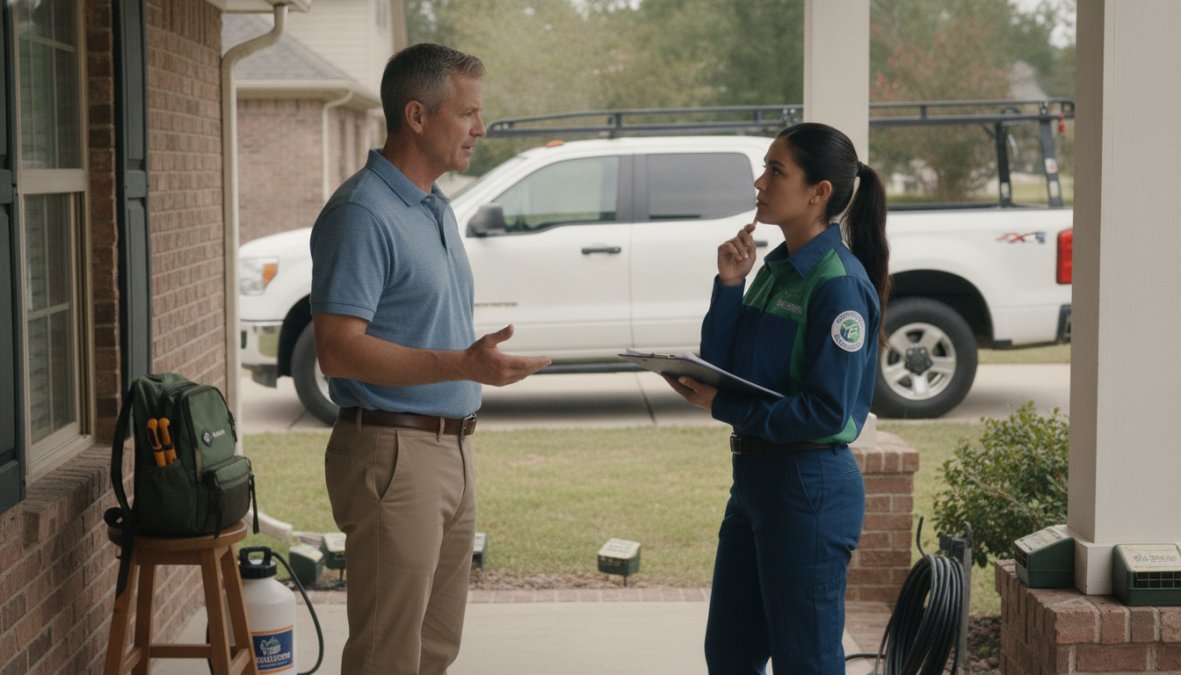
The most effective negotiating positions:
- Ask for month-to-month terms. Many companies offer month-to-month agreements with no early termination fee. The price per visit is slightly higher, but the flexibility is worth it.
- Request a shorter initial commitment. If a company insists on a contract, negotiate the term from 12 months to 6, this halves your exposure to termination fees.
- Get the service guarantee in writing. Verbal guarantees are worthless. Require that re-treatment terms be written into the agreement with specific conditions.
- Ask what triggers a cancellation fee waiver. Many companies have internal policies allowing fee waivers for customers who complain formally.
A Legal Template for No-Contract Service Agreements
If a company is willing to work without a standard contract, use this template as a starting point:
Pest Control Service Agreement (No Fixed Term)
Provider: [Company Name], licensed and insured under [State] License #[XXXXX]
Customer: [Your Name], [Property Address]
Effective Date: [Date]
Services: Provider agrees to perform [specific treatment type] targeting [specific pest species] at the above property. Treatment will include [interior/exterior/perimeter] application of [product category, e.g., EPA-registered residual insecticide].
Service Guarantee: Provider will return for one (1) re-treatment at no additional charge if [specified pest] activity is observed within [30/60/90] days of initial treatment, provided customer contacts provider within that window.
Payment: Customer agrees to pay [amount] upon completion of each service visit. No recurring billing or automatic charges will apply without written consent.
Cancellation: Either party may cancel this agreement with [24/48] hours notice. No cancellation fees apply.
Liability: Provider’s liability is limited to the cost of the service visit in which any issue arose.
Signatures: [Provider] / [Customer] / [Date]
A company that refuses to sign something this straightforward has a reason for that refusal. Find out what it is before proceeding.
Avoiding Long Term Pest Service Contracts With a No-Obligation Provider
The clearest path to avoiding long term pest service contracts is choosing a provider that doesn’t require them. Companies that compete on service quality rather than contractual lock-in have a structural incentive to do the job right the first time.
Zoifia Pest Control operates on exactly this model. Serving the Metro Boston area, the company is licensed and insured, covers ants, roaches, rodents, bed bugs, and other common household pests, and backs every treatment with a 90-day guarantee, no fixed-term contract required. That guarantee replaces the contract as the accountability mechanism, which is how it should work.
For homeowners evaluating providers, the National Pest Management Association’s consumer guide to hiring pest control recommends verifying licensing, insurance, and guarantee terms before any service begins. These three criteria filter out the majority of problematic providers before a single document is signed. Pest infestations are real problems requiring real expertise, but that expertise doesn’t require a 12-month financial commitment to deliver. The best providers know this. The ones who insist otherwise are protecting their revenue model, not your home.
Frequently Asked Questions
Can you get pest control without a contract?
Yes, you can absolutely get professional pest control without a long-term contract. Many providers, including Zoifia Pest Control, offer one-time treatments and on-demand services backed by a service guarantee rather than a binding agreement. When avoiding long term pest service contracts, look for companies that offer a 90-day guarantee on individual treatments, this gives you accountability without locking you into recurring billing cycles or early termination fees.
Is a one-time pest control service cheaper than signing a contract?
It depends on the infestation. A one-time pest control service typically costs more upfront per visit than a discounted contract rate, but you avoid early termination fees, automatic renewal clauses, and paying for treatments you don't need. For isolated problems like a single ant or roach infestation, one-time service almost always wins on total cost. Use the break-even calculation: multiply the contract's monthly fee by its term and compare it to the one-time service price.
How do I cancel a pest control contract early without paying a large fee?
Start by reviewing your pest control contract cancellation fee clause, many contracts cap fees at one or two months of service. In most U.S. states, door-to-door sales contracts include a three-day right of rescission, allowing cancellation with no penalty. Beyond that window, send a written cancellation letter via certified mail, cite any missed service appointments or unresolved pest issues as grounds, and request a prorated refund. Escalating to your state's consumer protection office often accelerates resolution.
What are the hidden fees I should watch for in a pest control service agreement?
Common hidden fees in a pest control service agreement include automatic renewal clauses that extend your fixed-term contract without notice, fees for additional pest identification beyond the original treatment scope, charges for emergency or same-day routing techs, and administrative fees added to billing cycles. Always ask for the full fee schedule in writing before signing, and confirm whether the service guarantee covers re-treatments at no extra cost or triggers a new service charge.
What should I ask when negotiating pest control services?
When learning how to negotiate pest control services, ask these key questions: Is this a month-to-month or fixed-term contract? What are the early termination fees? Does the service guarantee include free re-treatments? Can the treatment scope and service frequency be adjusted without penalty? Request that any verbal promises about recurring treatments or pricing be written into the pest control service agreement before you sign. Getting everything in writing is the single most effective negotiation move.
What is the difference between on-demand pest control and a subscription plan?
On-demand pest control means you call for service only when you have a problem, no recurring billing, no contractual obligations, and full control over service frequency. A subscription model involves automated scheduling of recurring treatments, often at a discounted rate, in exchange for a fixed-term contract or ongoing billing. On-demand suits homeowners with occasional or isolated pest issues, while a subscription model may benefit properties with chronic pest pressure, provided you understand the cancellation policy before committing.
Pest problems don’t follow a billing schedule, and your service agreement shouldn’t pretend they do. Zoifia Pest Control offers licensed, insured pest management for Metro Boston homeowners with no long-term contract required and a 90-day guarantee that puts accountability where it belongs. Get a quote from Zoifia Pest Control and get the pest problem handled without the paperwork that outlasts it.
This article was written using GrandRanker
