Table of Contents
- Why Essential Oils Work Against Kitchen Ants
- Top 7 Essential Oils That Repel Ants
- How to Get Rid of Ants in Kitchen Naturally: A Step-by-Step Method
- DIY Natural Ant Repellent Spray: 3 Simple Recipes
- Safety First: Protecting Pets, Kids, and Surfaces
- When to Call Professional Pest Control for Ants
- Final Verdict: Do Essential Oils Really Work?
- Frequently Asked Questions
Last Updated: September 6, 2026
Ants in the kitchen are among the most persistent household pests, and many homeowners are now turning to natural essential oils to repel kitchen ants rather than reaching for chemical sprays. These botanical extracts offer a non-toxic first line of defense, but they only work if you understand how to use them correctly. At Zoifia Pest Control, we handle ant infestations across the Metro Boston area daily, and this guide explains which oils actually deter ants, how to apply them safely, and when a DIY approach simply isn’t enough. Below, we’ll show you exactly how to deploy these natural deterrents, but first, here’s what most guides get wrong: they treat essential oils as a one-time fix rather than a maintenance routine.
Why Essential Oils Work Against Kitchen Ants
Essential oils disrupt ant communication and navigation by masking the chemical signals ants rely on to function as a colony. Ants leave pheromone trails between their nest and food sources; strong aromatic compounds in oils like peppermint and tea tree overwhelm these scent markers, causing worker ants to lose their path and stop recruiting others.
The effectiveness of this approach depends on the volatile organic compounds present in each oil. These compounds evaporate quickly, which is why the scent is potent at first but fades fast. This explains why a single application rarely solves an ant problem permanently; reapplication every few days is necessary to maintain the barrier. The National Pesticide Information Center guidance on natural repellents notes that botanical products can be useful, but their residual activity is typically shorter than synthetic alternatives.
Top 7 Essential Oils That Repel Ants
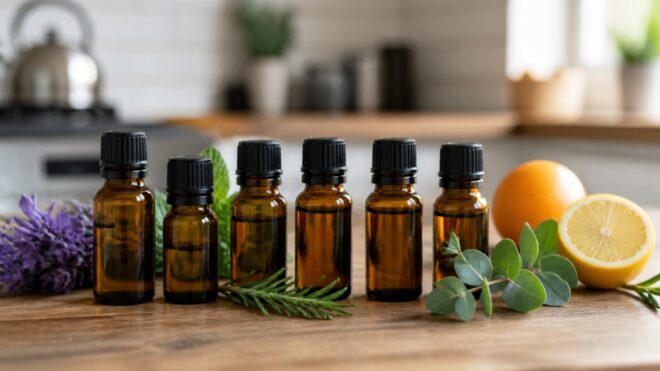
The most effective essential oils for ant control are peppermint, tea tree, citrus, eucalyptus, cedarwood, clove, and citronella. Each works through slightly different aromatic properties, but all share the ability to disrupt the scent trails that lead ants to your food.
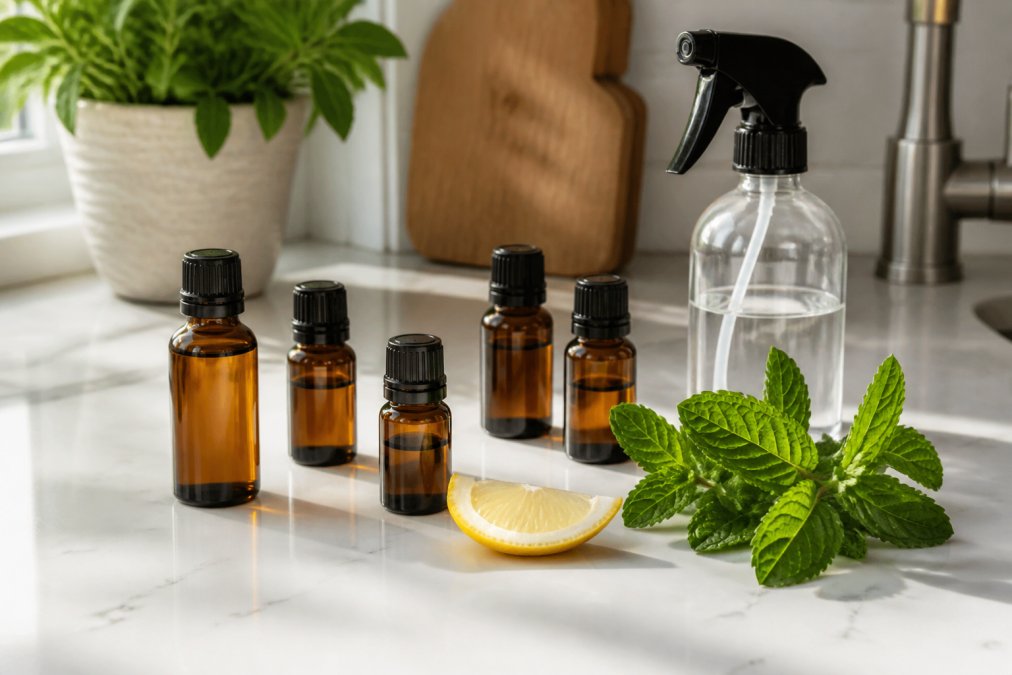
- Peppermint oil: The menthol content is a strong deterrent and doubles as a surface cleaner. Use at a 2% dilution (about 12 drops per cup of water). It is safe on sealed granite, tile, and stainless steel, but test on painted drywall first, as menthol can soften some latex paints.
- Tea tree oil: Known for its antimicrobial properties, it also confuses ant olfactory receptors. Use at a 1% dilution (6 drops per cup) because it is more caustic than other oils. Do not use tea tree oil in homes with cats, even trace amounts can be toxic. It is safe on ceramic tile but can etch untreated wood and some plastics.
- Citrus oil (lemon or orange): Contains limonene, which degrades ant exoskeletons on contact. Use at a 2% dilution. Limonene is a solvent, so never apply citrus oil to granite, marble, or sealed wood, it will strip sealants and cause clouding. Stick to baseboards, window sills, and exterior door thresholds.
- Eucalyptus oil: A sharp, medicinal scent that masks food odors. Use at a 2% dilution. It is one of the safest oils for finished wood surfaces, but it evaporates fastest, so plan to reapply every 24 hours rather than every 48.
- Cedarwood oil: Repels ants while also acting as a natural insecticide. Use at a 2% dilution. Cedarwood is gentle on most surfaces, including varnished wood, but it leaves a slight oily residue, wipe with a dry cloth after 30 minutes to prevent dust buildup.
- Clove oil: Potent and long-lasting, often used in commercial botanical sprays. Use at a 1% dilution (6 drops per cup), clove is the most likely of these oils to cause skin irritation and surface damage. It is safe on tile and glass but will dull unsealed grout over time.
- Citronella oil: Commonly associated with mosquitoes, but equally disruptive to ants. Use at a 2% dilution. It is safe on most hard surfaces but has a strong, lingering scent that some find unpleasant indoors; reserve it for entry points near doors and windows.
A common mistake is using these oils at full strength. Pure essential oils can damage countertops and flooring, so dilution with a carrier liquid is non-negotiable for kitchen use. Before applying any oil blend to a new surface, test a dime-sized drop on an inconspicuous area, wait 24 hours, and check for discoloration, clouding, or softening. This 24-hour patch test is the single best way to avoid costly damage to granite, marble, butcher block, or laminate, a step that most online guides omit entirely.
How to Get Rid of Ants in Kitchen Naturally: A Step-by-Step Method
Getting rid of ants in the kitchen naturally requires more than just spraying a scent; you must remove the colony’s reasons for entering your home. The key is understanding why ants keep coming back: they follow pheromone trails. When a scout ant finds food, it lays down a chemical trail of pheromones from the food source back to the nest. Other workers follow that trail, reinforcing it with each trip. Essential oils work not by killing ants on contact but by masking or overwhelming those pheromone signals, so the trail becomes unreadable and workers stop recruiting. This is why cleaning must come before spraying.
- Identify and seal ant entry points. Look for cracks around baseboards, windows, and pipes. Caulk these gaps to physically block access. Pay special attention to gaps under the sink where plumbing enters the wall, this is the most common entry point for kitchen ants in single-family homes.
- Eliminate food and water sources. Wipe down counters, sweep floors, and store pantry items in airtight containers. Ants forage for protein and sugar, so even crumbs matter. Empty the dish rack and wipe the sink dry at night, ants need moisture as much as food.
- Wipe away pheromone trails with soapy water. This step is non-negotiable. A 1:10 solution of dish soap to water breaks down the pheromone molecules that guide ants. If you skip this step and spray essential oils directly onto an active trail, the ants may simply reroute around the scent barrier because the original trail is still readable. Use a sponge or paper towel to wipe visible ant paths, then rinse the surface with plain water to remove soap residue.
- Apply your essential oil barrier. Focus on entry points and the perimeter of the kitchen, not just where you see ants. Spray a 2- to 3-inch band along baseboards, window sills, door thresholds, and the edges of cabinets. Do not spray directly on countertops where food is prepared, apply to the underside of cabinet edges or the back of baseboards instead.
- Monitor and reapply on a fixed schedule. Essential oil vapors dissipate quickly, most lose effectiveness within 24 to 48 hours. For the first week, reapply every 24 hours. After ant activity drops, you can extend to every 48 hours. Once you have gone two full weeks without sightings, reduce to a weekly maintenance spray. Mark a calendar reminder; a missed application is usually why natural ant control fails.
This method addresses the root cause rather than just killing the workers you see. If you skip the sealing and cleaning steps, the oils only provide a temporary reprieve. And if you are reapplying daily for more than a week with no reduction in ant numbers, the colony is likely nesting inside a wall void, at that point, surface treatments cannot reach the queen, and professional intervention is the faster path.
DIY Natural Ant Repellent Spray: 3 Simple Recipes
A DIY natural ant repellent spray is straightforward to make, but the recipe must include an emulsifier to properly mix oil and water. Without it, the oil sits on top of the water and never coats the surface evenly.
Recipe 1: All-Purpose Peppermint Spray
- 10-15 drops peppermint oil
- 1 cup distilled water
- 1 teaspoon liquid soap (emulsifier)
Recipe 2: Citrus Strength Spray
- 15 drops citrus oil (lemon or orange)
- 1 cup distilled water
- 1 teaspoon liquid soap
Recipe 3: Cedarwood & Clove Blend
- 8 drops cedarwood oil
- 8 drops clove oil
- 1 cup distilled water
- 1 teaspoon liquid soap
Combine all ingredients in a spray bottle and shake well before each use. Spray directly on baseboards, window sills, and behind appliances. The liquid soap serves a dual purpose: it emulsifies the oil and helps the solution stick to vertical surfaces longer.
Never spray essential oil mixtures on untreated wood, marble, or certain plastics without testing first. The oils can etch finishes or cause discoloration. Test a small, hidden area and wait 24 hours before widespread application.
Safety First: Protecting Pets, Kids, and Surfaces
Essential oils are natural, but “natural” does not automatically mean safe for every household member. Cats lack the liver enzymes to metabolize many essential oil compounds, making tea tree and citrus oils particularly toxic to them (aspca.org). Dogs are more tolerant but can still experience skin irritation or digestive upset if they ingest concentrated oils. The American Society for the Prevention of Cruelty to Animals (ASPCA) poison control resources provides detailed lists of which oils pose risks to specific pets.
For households with children, treat essential oil bottles like any other cleaning product: store them out of reach and never leave diluted sprays accessible. Regarding surfaces, always adhere to the dilution ratios mentioned earlier. A concentration above 2% (roughly 15 drops per cup of water) increases the risk of damaging finished wood and painted surfaces without improving ant repellency.
The frequency of application matters more than the concentration of the oil. A light barrier reapplied every 48 hours outperforms a heavy soak applied once a week, because the scent needs to stay fresh to keep disrupting pheromone trails.
When to Call Professional Pest Control for Ants
DIY methods using essential oils work best for small, foraging ant problems caught early. You should consider professional pest control for ants when you see large numbers of winged ants, notice ants emerging from wall voids, or find that your natural barriers are being overwhelmed within hours.
These signs indicate an established colony nesting inside the structure, which surface treatments cannot reach. Professional treatments target the nest itself. For homeowners facing this situation, licensed pest management is the most reliable path to elimination. Zoifia Pest Control provides fast, licensed, and insured ant removal backed by a 90-day guarantee, ensuring the problem is resolved without the need for long-term contracts. Our technicians can identify the ant species, locate the nest, and apply treatments that are safe for your family and pets.
Essential oils are an effective maintenance tool, not a cure for established infestations. If ants return within hours of cleaning and spraying, the colony is nesting indoors and requires professional intervention.
Final Verdict: Do Essential Oils Really Work?
Yes, natural essential oils to repel kitchen ants work, but with clear limitations. They are an excellent choice for prevention, for treating minor ant trails, and for homeowners who want to avoid synthetic chemicals near food preparation areas. Their effectiveness depends entirely on consistent reapplication and pairing them with proper sanitation and entry-point sealing.
Where they fail is against entrenched colonies. If you have tried essential oils, sealing cracks, and removing food sources for a week without a reduction in ant numbers, the nest is likely inside your walls or foundation. In that case, a professional solution is the faster and more cost-effective route. Zoifia Pest Control specializes in eliminating ants and other household pests with a 90-day guarantee and no contract necessary, so you can get your kitchen back without the guesswork. Get a quote today and let our licensed team handle the rest.
Frequently Asked Questions
Which is better, vinegar or peppermint oil to keep ants away?
Both work, but they function differently. Vinegar disrupts the pheromone trails ants follow, wiping out the scent path temporarily. Peppermint oil does the same but leaves a stronger, longer-lasting aromatic barrier that ants avoid. For best results, use both: clean surfaces with vinegar first to erase trails, then apply a peppermint oil spray along entry points. Peppermint oil also leaves a more pleasant scent than vinegar in a kitchen.
Are essential oils safe to use around food preparation areas?
Yes, when used correctly. Always dilute essential oils with water and a small amount of liquid soap; never apply them undiluted on counters. Wipe down surfaces before preparing food, and keep sprays away from open food, dishes, and utensils. Some oils, like citrus oils, can degrade certain countertop sealants, so test on a small, hidden area first. Store your DIY spray out of reach of children and pets.
How often should you reapply essential oil sprays for ants?
Reapply daily for the first week to break the ants’ scent trails and establish a strong barrier. After that, switch to every 2-3 days for maintenance. Essential oils evaporate quickly, especially in warm kitchens, so a once-a-week schedule usually isn’t enough. You’ll know it’s time to reapply when you see ants testing the treated areas again. Consistent reapplication is the key difference between a temporary fix and a working natural repellent.
What is the strongest natural ant repellent?
Peppermint oil is the most effective essential oil for repelling ants due to its high menthol content, which overwhelms their scent receptors and masks pheromone trails. Clove oil is a close second and also works as a contact killer. For a stronger blend, combine peppermint and tea tree oil. Remember that natural repellents deter ants rather than eliminate the colony, so if you see a steady stream of ants for over a week, you likely need professional treatment.
