Table of Contents
- Is Professional Pest Control Worth the Money? The Honest Answer
- Signs You Need Professional Pest Control (Not Just a Can of Spray)
- Average Cost of Pest Control Services in the Boston Metro Area
- DIY Pest Control vs. Professional: A Real Cost-Benefit Analysis
- Is Quarterly Pest Control Necessary for Boston Homeowners?
- Pest Prevention for Historic Boston Brownstones and Urban Properties
- What to Look for When Hiring a Pest Control Company
- Is Professional Pest Control Worth It? Our Final Verdict
Last Updated: May 31, 2026
Pest infestations cost U.S. homeowners billions in property damage and remediation every year, yet the question of whether is professional pest control worth the money still trips up most people before they pick up the phone. At Zoifia Pest Control, we hear this hesitation constantly from Boston-area homeowners who’ve already burned through three cans of spray and a box of traps. The honest answer is nuanced, but it leans heavily in one direction. Below, we’ll walk through the real cost-benefit analysis, Boston’s seasonal pest patterns, and the specific situations where DIY solutions make things measurably worse.
Is Professional Pest Control Worth the Money? The Honest Answer
Professional pest control is worth the money in most cases where a confirmed infestation exists, where pests pose structural or health risks, or where repeat DIY attempts have failed. The core reason is access: licensed technicians use formulations, application equipment, and treatment protocols unavailable to the general public, targeting pests at their source rather than at the surface.
Here’s what most guides get wrong on this topic. They frame the question as a simple price comparison: the cost of a can of spray versus the cost of a service visit. That framing ignores the compounding effect of an unresolved infestation. A minor rodent problem left untreated for one season can mean gnawed wiring, contaminated insulation, and multiple entry points that require professional remediation regardless. The question isn’t just what you pay today. It’s what you avoid paying later.
For Boston homeowners specifically, the urban environment adds layers of complexity. Dense housing, shared walls, and the city’s aging building stock create conditions where pests migrate between units and re-enter treated spaces quickly. A single treatment without a follow-up plan rarely holds. That’s the part nobody tells you upfront.
Professional pest control delivers the most value when it combines an accurate diagnosis, targeted treatment, and a prevention plan. [A service that only treats what’s visible without addressing entry points and harborage areas is unlikely to hold long-term](/best-pest-control-company-in-boston-ma/).
Signs You Need Professional Pest Control (Not Just a Can of Spray)
Most pest problems start small and get misread. A few ants near the kitchen sink seem manageable. A mouse dropping behind the stove looks like an isolated incident. The signs you need professional pest control are usually present earlier than people recognize them.
Watch for these indicators that a store-bought solution won’t cut it:
- Pest activity during daylight hours (rodents and cockroaches are nocturnal; daytime sightings suggest a large population)
- Structural damage: gnaw marks on baseboards, frayed wiring, or damaged insulation
- Multiple species present simultaneously, which suggests a systemic harborage issue
- Recurring infestations despite repeated DIY treatment
- Evidence in multiple rooms or on multiple floors
- Bed bug signs: rust-colored stains on mattress seams, shed skins, or bites in linear patterns
Pests That Almost Always Require a Licensed Technician
Certain pest infestations are genuinely beyond the reach of consumer-grade products. Termite control is the clearest example: subterranean termites build colonies deep in soil and wood, and effective treatment requires either liquid termiticide application around the foundation or bait station networks that take months to disrupt the colony. Neither is available over the counter.
Bed bug treatment is equally demanding. These insects hide in wall voids, electrical outlets, and furniture joints. Heat treatment or targeted chemical application by licensed technicians is the only approach with a reliable success rate. Rodent removal in an established infestation requires trapping combined with exclusion work, sealing every entry point larger than a quarter inch. Without exclusion, new rodents replace the ones you’ve caught within weeks.
Stinging pests, including yellow jackets and hornets nesting inside wall cavities, present a direct safety risk. Attempting removal without proper equipment and protective gear is genuinely dangerous.
When DIY Is Acceptable, And When It Makes Things Worse
DIY pest control is acceptable for low-level, early-stage problems with a single pest species. A handful of ants following a trail to a food source can often be resolved with bait gel and by eliminating the food source. Occasional spiders in a basement are manageable with residual sprays along the perimeter.
Where DIY makes things worse: applying repellent sprays to cockroach or bed bug populations. Repellents scatter these insects deeper into wall voids and adjacent units, making a contained problem much harder to treat professionally afterward. This is the most common mistake we see, and it adds both time and cost to eventual professional treatment.
Average Cost of Pest Control Services in the Boston Metro Area
Pest control pricing in the Boston metro area is shaped by factors that don’t apply in most other markets: the density of the urban environment, the age of the housing stock, and the complexity of treating attached and multi-unit properties. Understanding what drives cost variation helps you evaluate quotes accurately and avoid paying for services that don’t match your actual situation.
What Drives Cost in the Boston Market
Boston’s pest control market has several cost drivers that push pricing above national averages for comparable services:
Building age and construction type. Brownstones, triple-deckers, and pre-war brick buildings require more thorough inspection and more complex exclusion work than newer construction. Entry points are more numerous, wall voids are larger, and shared structural elements between attached units mean a single treatment often needs to account for migration from adjacent spaces.
Urban pest pressure. Boston’s rodent population is well-documented, and the density of the city means re-infestation pressure is higher than in suburban or rural markets. Effective treatment in dense urban neighborhoods typically requires more robust exclusion work and more frequent monitoring to hold results.
Treatment method. Chemical application, heat treatment, bait systems, and exclusion work carry different labor and material costs. A bed bug heat treatment, for example, requires specialized equipment and a full-day technician commitment. A general pest maintenance visit is a fraction of that investment.
Property size and access complexity. A single-family home in Jamaica Plain and a four-unit brownstone in the South End are categorically different treatment scopes, even for the same pest.
Service Types and General Cost Structure
While specific pricing varies by company and property, the general structure of pest control services in the Boston market follows a consistent pattern:
| Service Type | Typical Scope | Cost Driver | Best For |
|---|---|---|---|
| One-Time General Treatment | Single pest, single visit | Pest type, property size | Isolated, confirmed infestation |
| Quarterly Protection Plan | Multiple pests, 4 visits/year | Property size, pest pressure | Year-round prevention, recurring issues |
| Rodent Exclusion Service | Inspection + sealing + trapping | Number of entry points, access complexity | Active rodent infestation in older buildings |
| Bed Bug Treatment | Heat or targeted chemical, multi-visit | Treatment method, unit size | Confirmed bed bug infestation |
| Termite Treatment | Liquid barrier or bait system | Linear footage, soil access, method | Confirmed or suspected termite activity |
| Commercial Service | Customized frequency and scope | Property type, regulatory requirements | Restaurants, multi-unit residential, offices |
When comparing quotes from multiple companies, make sure you’re comparing the same scope. A lower quote that covers a single treatment with no follow-up is not equivalent to a slightly higher quote that includes a re-treatment guarantee and a follow-up inspection. The guarantee is part of the value.
One-Time Treatments vs. Ongoing Protection Plans
One-time treatments address a specific, identified pest problem. They work well for isolated incidents where the root cause is clear and the property has no structural vulnerabilities that invite re-entry. The limitation is straightforward: one-time treatments don’t prevent the next infestation, and they carry no guarantee if the problem returns.
Ongoing protection plans provide scheduled visits throughout the year, typically quarterly, with treatments timed to seasonal pest activity. For Boston homeowners, this timing matters: the four distinct pest pressure windows in New England, winter rodent entry, spring ant and termite emergence, summer stinging pest and cockroach peaks, and fall re-entry, mean that a quarterly schedule aligned to those windows catches problems at the moment of highest risk rather than after they’re established.
Most ongoing plans also include re-treatment guarantees between scheduled visits. This is the feature most homeowners undervalue when comparing plan costs to one-time treatment costs. If pests return between quarterly visits, a plan with a guarantee means the company returns at no additional charge. Without that guarantee, a second infestation is a second full-price service call.
For most Boston homeowners dealing with recurring pest pressure, which describes the majority of properties in dense urban neighborhoods and older buildings, the math on an annual protection plan versus two or three reactive one-time treatments typically favors the plan over a 12-month period.
What a Quote Should Include
A professional pest control quote should never be given over the phone without an inspection for anything beyond a simple, clearly defined general pest service. A quote that arrives without an inspection is a quote based on assumptions, not on the actual condition of your property.
A complete quote should specify:
- The pest species or pest types being addressed
- The treatment method and products to be used
- The number of visits included
- What the re-treatment guarantee covers and for how long
- Whether exclusion work (sealing entry points) is included or quoted separately
- Any preparation requirements for the homeowner before treatment
If a company cannot answer all of these questions before you sign anything, that’s a meaningful signal about the quality of service you’ll receive. According to the National Pest Management Association’s consumer guidance, homeowners should always request a written inspection report and treatment plan before authorizing any pest control service.
DIY Pest Control vs. Professional: A Real Cost-Benefit Analysis
The DIY pest control vs. professional debate usually focuses on the upfront cost of a service call versus a hardware store purchase. That’s the wrong comparison. The right comparison is total cost over 12 months, accounting for product purchases, time spent, probability of full resolution, and the damage that accumulates while a partial solution fails.
To make this concrete, consider three of the most common pest scenarios Boston homeowners face and how the two paths actually play out.
Scenario 1: Mice in a First-Floor Apartment or Condo Unit
The DIY path: A homeowner buys snap traps, bait stations, and steel wool from a hardware store. Initial spend is modest. Trapping catches a few mice in the first two weeks. Activity seems to slow. Then it returns. A second round of products is purchased. The cycle repeats through winter because the entry point, a gap around a pipe chase in the basement, was never identified or sealed. By spring, the homeowner has spent multiple rounds on products, invested several weekends on monitoring and disposal, and still has an active problem. Meanwhile, mice have been nesting in wall insulation, which now requires remediation.
The professional path: A licensed technician performs an inspection, identifies the pipe chase gap and two secondary entry points along the foundation, installs tamper-resistant bait stations in the activity zones, and seals the primary entry point as part of an exclusion service. A follow-up visit confirms the infestation is resolved. The problem is closed in four to six weeks.
The DIY path feels cheaper at each individual purchase. It is not cheaper when you add up every product bought over a four-month period, the time cost of repeated monitoring, and the downstream cost of insulation remediation that a faster resolution would have prevented.
Scenario 2: Cockroach Activity in a Kitchen
The DIY path: The most common first response is a can of residual spray applied along baseboards and under appliances. This is also the most expensive DIY mistake in this category. Cockroaches exposed to repellent sprays scatter into wall voids, behind appliances, and, in multi-unit buildings, into adjacent units. A contained population becomes a dispersed one. When a professional is eventually called, the scope of treatment is now larger, the infestation is harder to locate, and the cost is higher than it would have been at first contact.
The professional path: A licensed technician applies gel bait in harborage zones rather than repellent spray. Cockroaches consume the bait and carry it back to the harborage, achieving population-level suppression rather than surface scattering. Monitoring stations confirm activity levels. A follow-up visit assesses results and applies additional bait if needed. The infestation is resolved without dispersing the population.
Using repellent sprays on cockroach or bed bug populations before calling a professional is the single most expensive DIY mistake. It scatters the infestation into wall voids and neighboring spaces, significantly increasing the scope and cost of professional treatment afterward. If you’ve already done this, tell your technician immediately, it changes the treatment approach.
Scenario 3: Carpenter Ants in a Wooden Deck or Window Frame
The DIY path: Carpenter ants foraging on a deck surface are treated with perimeter spray. The visible ants are killed. The satellite colony inside the deck framing or window frame continues to excavate. The homeowner doesn’t realize carpenter ants don’t eat wood, they excavate it for nesting, so eliminating foragers at the surface doesn’t address the structural damage happening inside the wood. By the time the deck boards or window sill show visible deterioration, the colony has been active for one or more seasons.
The professional path: A technician identifies whether the ants on the surface are foragers from a parent colony (likely in a nearby tree or wood pile) or from a satellite colony already established in the structure. Treatment targets the correct source. If a satellite colony is confirmed inside the structure, targeted void treatment is applied directly to the nesting site. The structural damage is stopped at its actual source.
The Real Cost-Benefit Framework
When evaluating DIY vs. professional pest control, apply these four questions before buying anything:
- Have I correctly identified the pest species? Misidentification means the product you buy is formulated for the wrong target. Many consumer-grade products are species-specific.
- Do I know where the infestation is originating? Treating where you see pests rather than where they’re nesting is the core reason DIY fails on persistent problems.
- Is this pest type within the reach of consumer-grade products? Termites, bed bugs, and established rodent infestations are not. The products that work on these pests require a license to purchase and apply.
- What is the cost of the problem continuing for another 30, 60, or 90 days? For pests that cause structural damage or health risks, the damage accumulation cost of a slow DIY process often exceeds the cost of professional treatment.
When DIY Is the Right Call
DIY pest control is genuinely appropriate in a narrow set of circumstances: a low-level, early-stage problem with a single pest species, no evidence of structural access or harborage, and a clear, identifiable attractant that can be eliminated. A small ant trail following a food source to an unsealed container is a reasonable DIY target. Bait gel applied at the trail entry point, combined with removing the food source, resolves many of these cases without professional intervention.
The honest rule of thumb: if you’ve applied a consumer product correctly and the problem persists or returns within two weeks, the infestation is beyond the surface-level stage and professional diagnosis is the more cost-effective next step.
Hidden Costs of Going the DIY Route
The hidden costs of DIY pest control fall into three categories most people don’t calculate upfront.
Time cost. Effective DIY treatment requires research, multiple product applications, monitoring, and repeat treatments. A rodent problem handled correctly takes weeks of consistent effort. Most homeowners underestimate this by a significant margin.
Misdiagnosis cost. Consumer-grade products are formulated for the pests on the label, applied as directed. Misidentifying the pest species or the infestation source means those products accomplish nothing. Many homeowners discover the actual problem only after professional inspection, at which point they’ve already spent money on ineffective products.
Damage accumulation cost. Every week an infestation continues, structural and sanitary damage compounds. Termites, rodents, and moisture-seeking pests don’t pause while you work through product options. The cost of the damage that accumulates during a prolonged DIY attempt is rarely factored into the initial decision to skip professional service.
The DIY vs. professional decision is not a price comparison, it’s a probability-weighted cost analysis. For any infestation where the pest type, source location, or entry point is unclear, professional diagnosis is almost always the lower-cost path over a 12-month horizon.
Is Quarterly Pest Control Necessary for Boston Homeowners?
Quarterly pest control is necessary for most Boston homeowners, particularly those in older properties, urban neighborhoods, or areas with known rodent pressure. The reason is seasonal: pest activity in New England follows a predictable cycle, and quarterly visits align treatment timing with the moments when pest populations are most active and most likely to enter structures.
Boston’s Seasonal Pest Calendar: What to Expect Month by Month
Boston’s climate creates distinct pest pressure windows that property owners should plan around.
Winter (December – February): Rodents are the primary concern. Mice and rats seek warmth and move aggressively into structures through foundation gaps, utility penetrations, and deteriorated weatherstripping. Cockroach activity in heated spaces also increases.
Spring (March – May): Ant colonies emerge and begin foraging. Carpenter ants, which excavate wood for nesting, become active in April and May. Stinging pest queens begin establishing new nests. Termite swarmers appear on warm days, often mistaken for flying ants.
Summer (June – August): Stinging pests, mosquitoes, and cockroaches peak. Bed bug transmission increases with travel. Wildlife pressure from raccoons and squirrels seeking attic nesting sites continues.
Fall (September – November): Rodents begin their second major entry push as temperatures drop. Spiders move indoors. Cluster flies and stink bugs seek overwintering sites in wall voids and attics.
A quarterly service schedule, timed to each of these transition windows, addresses the specific pest challenges of each season rather than reacting to infestations after they’re established. According to the National Pest Management Association’s pest prevention resources, preventative maintenance is consistently more effective and less costly than reactive treatment.
Pest Prevention for Historic Boston Brownstones and Urban Properties
Boston’s historic brownstones present pest challenges that newer construction simply doesn’t have. The brick and mortar construction, balloon-frame interiors, and century-old foundations create a structural environment where pest entry and harborage are almost inevitable without active prevention.
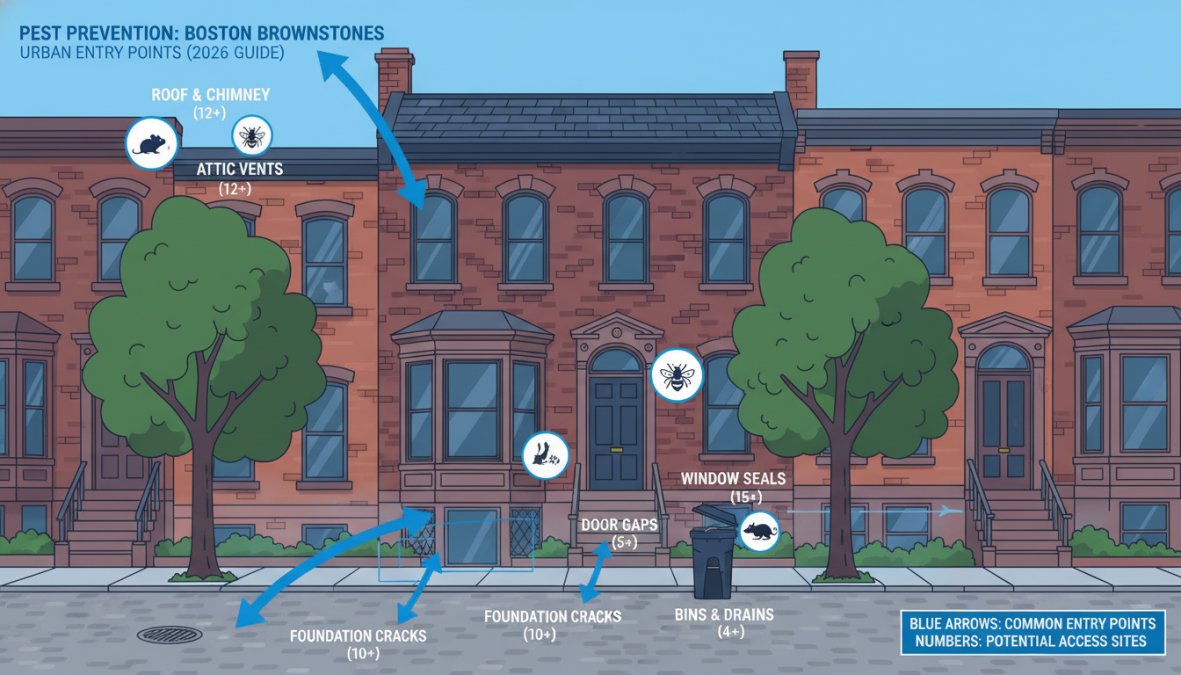
The most common entry points in brownstone properties include mortar gaps between brick courses at the foundation, deteriorated window and door frames, utility conduit penetrations that weren’t sealed at installation, and shared wall voids between attached units. A pest entering one unit in a brownstone row has a direct path to every adjacent unit through these shared spaces.
Effective pest prevention for these properties goes beyond treatment. It requires an inspection protocol that maps actual entry points and harborage areas specific to the building’s construction. Sealing work, often called exclusion, is as important as any chemical application. Without it, treated areas are simply re-colonized from adjacent spaces.
For brownstone owners dealing with recurring rodent problems, start with a professional exclusion inspection before scheduling any treatment. Identifying and sealing entry points first means treatment results hold. Skipping exclusion and going straight to trapping is the reason most brownstone rodent problems keep coming back.
Urban properties in Boston also face elevated cockroach and bed bug pressure due to population density and the frequency of resident turnover in rental properties. Integrated pest management approaches, which combine inspection, exclusion, targeted treatment, and monitoring, are the standard of care for urban residential properties. As documented in EPA guidance on integrated pest management, IPM reduces pesticide use while achieving better long-term pest suppression than reactive spray-only approaches.
What to Look for When Hiring a Pest Control Company
Hiring a pest control company is a decision that affects your health, your property, and your wallet. The criteria matter more than most people realize when they’re in the middle of an active infestation and just want the problem solved.
Start with licensing. Massachusetts requires pest control operators to hold a state-issued license, and any technician entering your home should be covered under that license. Confirm this before scheduling service.
Ask specifically about their guarantee. A company that offers no re-treatment guarantee is telling you something important about their confidence in the outcome. A 90-day guarantee, like the one Zoifia Pest Control provides, means the company is accountable for results, not just for showing up.
Contract terms matter too. Many pest control companies lock customers into annual contracts with automatic renewal clauses. If a company won’t offer service without a long-term contract, that’s worth noting. Flexible service arrangements, where you can schedule treatment based on actual need rather than a mandatory subscription, are a better fit for most homeowners.
Other evaluation criteria:
- Does the company perform a thorough inspection before quoting? A quote given over the phone without inspection is a red flag.
- Do they explain the treatment plan in terms you can understand?
- Are they licensed and insured? Ask for documentation.
- Do they use eco-friendly solutions where appropriate, particularly for homes with children or pets?
Understanding Integrated Pest Management (IPM) and Why It Matters
Integrated Pest Management (IPM) is a science-driven approach to pest control that combines biological, physical, and chemical methods to suppress pest populations with the lowest possible risk to people and the environment.
IPM is the current best practice standard for both residential and commercial pest control. Rather than applying pesticides on a fixed schedule regardless of pest pressure, IPM practitioners inspect first, identify the pest and its population level, address harborage and entry points, and apply targeted treatments only when monitoring data justifies it. The result is more effective long-term suppression and reduced chemical exposure for occupants.
For Boston homeowners asking whether is professional pest control worth the money, the answer depends partly on whether the company they hire actually practices IPM or simply sprays on a schedule. A company using tailored treatments based on inspection data will consistently outperform one applying the same product to every property regardless of the pest challenge. Ask any prospective provider how they adjust their approach based on inspection findings. The answer tells you a great deal about the quality of service you’ll receive.
According to University of California’s IPM program resources, properties managed under IPM protocols show significantly lower rates of recurring infestation compared to those treated with calendar-based spray programs alone.
Is Professional Pest Control Worth It? Our Final Verdict
Professional pest control is worth the money for any confirmed infestation, any pest type that requires licensed-only products or equipment, and any property with structural vulnerabilities that invite recurring entry. The calculus shifts only for truly minor, early-stage problems with a single pest species and no evidence of structural access.
For Boston properties specifically, the combination of aging building stock, urban density, and a four-season climate with distinct pest pressure windows makes year-round professional management the practical choice for most homeowners and property managers. The cost of reactive treatment after an established infestation is consistently higher than the cost of preventative maintenance that catches problems early.
The right professional pest control company brings three things a can of spray never will: accurate diagnosis, licensed-grade treatment options, and a guarantee that the problem stays solved.
Frequently Asked Questions
How much does professional pest control cost on average?
The average cost of pest control services varies depending on the type of pest, property size, and treatment method. In the Boston metro area, a one-time residential treatment typically ranges from around $150 to $400, while ongoing quarterly plans can be more cost-effective over time. Severe infestations involving termites, bed bugs, or rodents often cost more due to the complexity of treatment. Always request a free inspection before committing to a service.
Is it cheaper to do your own pest control?
DIY pest control vs. professional treatment may seem cheaper upfront, store-bought products often cost $20-$80, but the real cost comparison is more nuanced. DIY methods frequently address symptoms rather than the root infestation, leading to recurring problems and repeated purchases. When you factor in time, product costs, and the risk of the infestation worsening, professional pest control is often the more cost-effective choice, especially for pests like bed bugs, termites, or rodents.
Is quarterly pest control necessary, or is it overkill?
Whether quarterly pest control is necessary depends on your property type, location, and pest history. In the Boston metro area, seasonal shifts drive distinct pest activity, rodents in fall and winter, ants and stinging pests in spring and summer. For homeowners, especially those in older brownstones or wooded neighborhoods, a quarterly preventative maintenance plan helps intercept infestations before they start. For lower-risk properties, bi-annual service may suffice. A licensed technician can assess your specific situation.
What pests almost always require professional intervention?
Certain pest infestations are rarely resolved effectively with DIY methods. Bed bug treatment, termite control, and rodent removal are among the most difficult to handle without professional equipment and expertise. Stinging pests like wasps or hornets also pose safety risks during removal. Wildlife trapping requires licensing in Massachusetts. If you're dealing with any of these, professional pest control is not just worth the money, it's often the only reliable option for achieving a pest-free environment.
What are the benefits of hiring professional pest control over DIY?
Professional pest control offers several advantages over DIY approaches: licensed technicians can accurately identify pest species and infestation severity, apply targeted treatments that are safer and more effective, and provide service guarantees that give you recourse if the problem persists. Companies using Integrated Pest Management (IPM) also focus on long-term prevention, not just elimination. For Boston homeowners dealing with urban pest challenges in older properties, professional expertise delivers measurably better outcomes.
Boston’s pest challenges are real, and they don’t resolve themselves. Zoifia Pest Control serves the Metro Boston area with licensed and insured technicians, no long-term contracts required, and a 90-day guarantee on every service. Get a quote from Zoifia Pest Control and have a confirmed pest-free environment without the cycle of repeated DIY attempts that cost more in the long run.
This article was written using GrandRanker
