
Table of Contents
- How to Choose a Local Pest Exterminator: Start With the Right Criteria
- How to Verify a Pest Control License and Insurance
- Check Reputation, Customer Reviews, and Better Business Bureau Ratings
- Questions to Ask Pest Control Companies Before You Hire
- Understanding Your Pest Control Cost Estimate
- Signs of a Bad Pest Control Company to Avoid
- Eco-Friendly Certifications, Technology-Driven Inspections, and What Else to Look For When Choosing a Local Pest Exterminator
- Conclusion: Make a Confident, Informed Choice
Last Updated: June 1, 2026
Knowing how to choose a local pest exterminator is the difference between solving your problem once and paying for the same treatment repeatedly. At Zoifia Pest Control, we see this pattern constantly: homeowners hire the first company they find, skip the vetting process, and end up with an infestation that was never fully addressed. This guide walks you through every step of the selection process, from verifying credentials to reading the fine print on service contracts. Below, we’ll show you exactly what separates a qualified pest management professional from one who will cost you more time and money than the pests themselves.
Most guides on this topic focus on price. That’s the wrong starting point. The right starting point is your specific pest problem, because not every exterminator is equipped to handle every infestation type.
How to Choose a Local Pest Exterminator: Start With the Right Criteria
The most common mistake homeowners make is treating pest control as a commodity. It isn’t. A company that excels at rodent control may have little experience with bed bug treatment or wood-destroying insects. Before you call anyone, you need a clear picture of what you’re dealing with.
Assess Your Specific Pest Problem First
Identifying your pest type before contacting companies gives you immediate use in the conversation. Ants in your kitchen require a different approach than termites in your foundation or bed bugs in your bedroom. Each pest has distinct biology, behavior, and treatment protocols.
Ask yourself:
- Where are you seeing activity, and is it isolated or widespread?
- Have you noticed structural damage (wood damage, gnaw marks, droppings)?
- Is the infestation recent or has it been building over weeks or months?
The answers shape which extermination methods are appropriate and whether you need a one-time treatment or an ongoing service contract. A company that gives you a quote without asking these questions first is a red flag.
Understand the Difference Between One-Time Treatment and Ongoing Service
One-time treatments address a specific, contained infestation. Ongoing service plans, often called pest management programs, involve scheduled visits to prevent reinfestation through preventive measures and regular monitoring.
For active, severe infestations, a single treatment rarely solves the problem entirely. Most professional exterminators will recommend follow-up visits as part of a complete protocol. The key question is whether those follow-up visits are included in the initial price or billed separately. Get this in writing before you agree to anything.
Ask the company specifically whether their quote covers re-treatment if the pest problem persists after the first visit. Reputable companies will have a clear answer. Vague responses about “additional charges” are a warning sign.
How to Verify a Pest Control License and Insurance
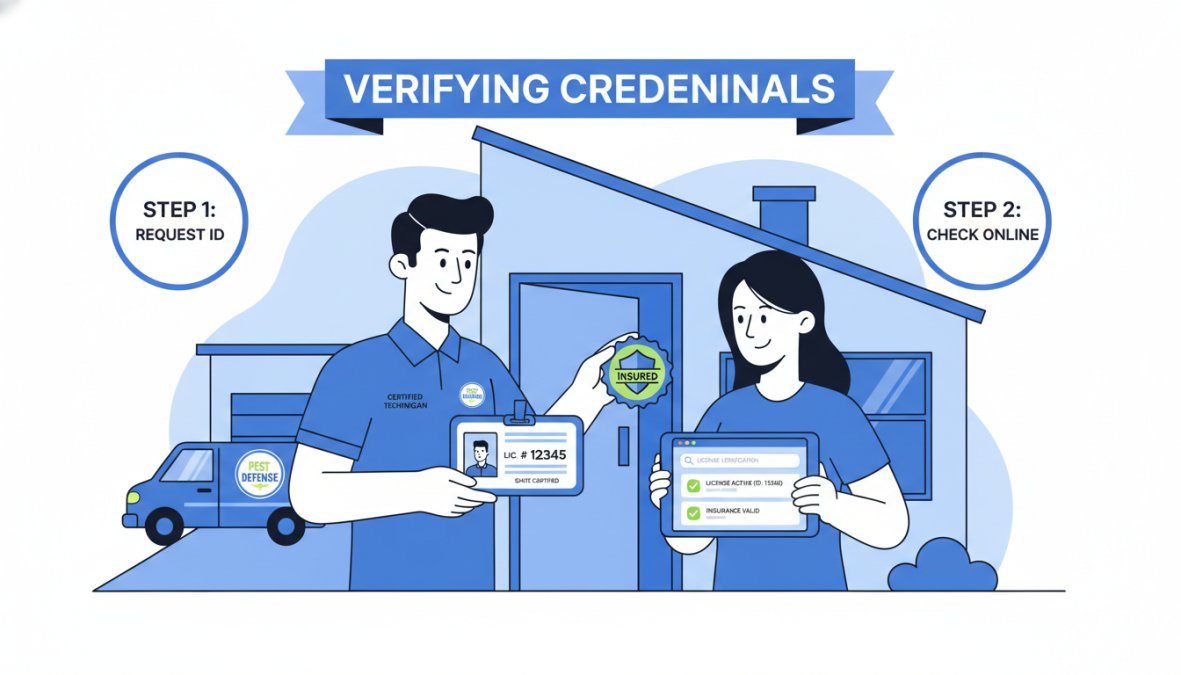
Every pest control company operating legally in your state must hold a valid pesticide applicator license issued by the relevant state regulatory authority. Licensing confirms that technicians have passed examinations on pesticide application, safety standards, and EPA guidelines. It is not optional, and you should never hire an unlicensed exterminator regardless of price.
Verification is straightforward. According to EPA’s pesticide applicator licensing guidance, each state maintains its own licensing database. Search your state’s department of agriculture website and enter the company’s name or license number to confirm active status.
Why Bonded and Insured Matters for Your Property
A company being bonded and insured protects you from two distinct risks. Insurance covers property damage or personal injury that occurs during service. Bonding protects you if a technician steals from your home or causes financial harm.
Ask for a certificate of insurance before the first visit. A legitimate company will provide this without hesitation. If they push back or say you can "trust them," that tells you everything you need to know.
Check Reputation, Customer Reviews, and Better Business Bureau Ratings
Customer reviews are the fastest credibility signal available to you, but raw star ratings are a poor proxy for actual service quality. The pest control industry has a documented pattern of short-term positive reviews that don’t reflect long-term outcomes, a homeowner who leaves a five-star review two days after treatment has no idea yet whether the infestation was resolved. Your goal is to find evidence of durable results, not first-impression satisfaction.
How to Read Reviews for Long-Term Outcome Evidence
When scanning reviews on Google, Yelp, or the Better Business Bureau, filter your reading by these specific signals:
- Reviews mentioning a second or third visit: Positive reviews that reference follow-up visits indicate the company actually honored its guarantee. This is more valuable than a glowing one-visit review.
- Reviews from 6-12 months ago: Recent reviews tell you about current operations. Reviews from six months or more ago tell you whether the treatment held. Search for phrases like "still pest-free" or "came back after a few months."
- Negative reviews and company responses: According to Better Business Bureau’s guide to hiring contractors, how a company responds to complaints is as diagnostic as the complaints themselves. A company that publicly acknowledges a failure and describes how they corrected it is demonstrating accountability. A company that disputes every negative review or goes silent is not.
- Complaint categories, not complaint counts: One company with twelve complaints, all resolved and all about scheduling delays, is a different risk profile than a company with four complaints about technicians applying the wrong pesticide or refusing to re-treat.
Cross-Reference at Least Three Independent Sources
No single review platform is reliable in isolation. Google Reviews can be gamed. Yelp’s algorithm suppresses reviews it deems suspicious, which sometimes removes legitimate ones. The BBB rating reflects complaint resolution history, not service quality. Use all three together:
| Source | What It Tells You | What It Misses |
|---|---|---|
| Google Reviews | Volume of customer experience, recent sentiment | Susceptible to review manipulation |
| Yelp | Filtered reviews may reflect longer-term customers | Algorithm can suppress valid reviews |
| BBB Complaint History | Formal dispute resolution track record | Doesn’t capture customers who never filed formally |
| State Licensing Board | Disciplinary actions, license suspensions | Not a review platform, requires active search |
| Nextdoor / Local Facebook Groups | Hyperlocal, neighbor-verified recommendations | Anecdotal, no verification of outcomes |
The state licensing board column is one most homeowners skip entirely. Every state department of agriculture that issues pesticide applicator licenses also maintains a record of disciplinary actions. A company with a license suspension or formal violation on record is a disqualifying finding, regardless of their Google rating.
How to Spot Fake or Incentivized Reviews
The pest control industry, like home services broadly, has a subset of companies that solicit reviews immediately after service, sometimes offering discounts in exchange. Warning signs of an inflated review profile include:
- A cluster of five-star reviews posted within a short window (visible by sorting by "newest" on Google)
- Reviews that use identical or near-identical phrasing
- Reviewers with no other review history on the platform
- An overall rating that is dramatically higher than the median for similar companies in your area
None of these signals is definitive on its own, but a pattern of two or more should prompt you to weight that company’s reviews less heavily and rely more on the BBB complaint record and licensing board history.
Avoid companies with no online presence at all. Legitimate pest management professionals accumulate reviews over time. A company with zero reviews and no Better Business Bureau listing may be operating without proper licensing or insurance. Equally, treat a company with a suspiciously perfect rating and no negative reviews with the same caution, no service business with significant volume has a genuinely flawless record.
Ask for References for Complex or High-Cost Jobs
For infestations that require significant investment, termite treatment, whole-home bed bug remediation, or multi-visit rodent exclusion programs, it is entirely reasonable to ask the company for two or three customer references you can contact directly. Reputable companies will have satisfied customers willing to speak with prospective clients. A company that cannot or will not provide references for a job of that scope is a meaningful red flag.
When you speak with references, ask specifically: Did the pest problem stay resolved? Did the company return when called? Were there any charges beyond the original estimate? Those three questions surface the issues that reviews rarely capture in enough detail.
Questions to Ask Pest Control Companies Before You Hire
The right questions to ask pest control companies reveal competence, transparency, and professionalism faster than any marketing material. Before committing, get direct answers to these:
- What specific treatment do you recommend for my pest type, and why?
- What active ingredients will you use, and are they safe for children and pets?
- Are your technicians certified pest management professionals (PMPs)?
- Does your quote include follow-up visits if the treatment doesn’t work?
- What is your service guarantee, and what are its exact terms?
- Do you offer a written service contract, and what are the exit clauses?
- How long have you been operating in this area?
A company that answers these clearly and specifically is worth your time. One that deflects, gives vague answers, or rushes you toward signing is not.
Technician Training, Certifications, and IPM Approach
Technician training is where the quality gap between companies becomes most visible. Certified pest management professionals hold credentials from recognized industry bodies and are required to complete continuing education to maintain their status. This matters because pest biology, pesticide regulations, and treatment technology all evolve.
Integrated pest management (IPM) is the current gold standard in the industry. IPM is a science-based approach that combines targeted solutions, sanitation recommendations, habitat modification, and chemical treatment only when necessary, prioritizing long-term prevention over repeated pesticide application. As documented in EPA’s integrated pest management principles, IPM reduces pesticide exposure while achieving more durable results.
Ask directly: "Do your technicians follow integrated pest management principles?" If they don’t know what IPM means, that tells you about their training level.
Post-Treatment Follow-Up Protocols and Service Guarantees
Post-treatment follow-up protocols are one of the most overlooked factors when homeowners evaluate pest control companies. Here’s the part most guides skip entirely: the quality of a treatment is often only visible 2-4 weeks later, once the pest population has had time to respond. A company with no follow-up protocol is essentially asking you to trust that the first visit worked without any verification.
Good follow-up protocols include a scheduled inspection visit within 2-4 weeks, clear criteria for what constitutes a successful treatment, and a defined re-treatment process if activity persists. Zoifia Pest Control backs every service with a 90-day guarantee, meaning if pests return within that window, they return to treat at no additional charge.
A service guarantee is only as valuable as its terms. Always ask what the guarantee covers, how long it lasts, and what the re-treatment process looks like before you sign anything.
Understanding Your Pest Control Cost Estimate
A pest control cost estimate should be itemized, not a single lump sum. You need to see what you’re paying for: the initial inspection, the treatment itself, any follow-up visits, and the cost of any ongoing service plan if one is recommended. A company that hands you a single number without breaking it down is making it impossible for you to compare their offer against a competitor’s, which may be intentional.
Many companies offer free estimates. Take advantage of at least two or three before deciding. The inspection itself is informative, because a thorough inspector will examine entry points, evidence of activity, and conditions that make your property conducive to infestation. A less experienced technician may walk the perimeter, quote a flat rate, and leave. The quality of the inspection is a preview of the quality of the treatment.
Comparing Quotes: What to Watch For Beyond the Price
The lowest quote is rarely the best value. A low price often reflects one of three things: a less experienced technician, a less thorough treatment scope, or hidden charges that appear after the first visit. When comparing quotes
Signs of a Bad Pest Control Company to Avoid
Recognizing signs of a bad pest control company early saves you money, time, and the frustration of a recurring infestation. The following patterns are consistent across negative customer experiences:
- Pressure to sign a contract on the first call, before any inspection
- Inability to name the specific pesticides they plan to use
- No proof of licensing or insurance when asked
- Quotes given over the phone without a site visit
- Technicians who arrive without branded uniforms or company identification
- No written service agreement or guarantee
- Dismissing your questions about follow-up or re-treatment

The pressure tactic is particularly common. A company that tells you the price is only valid "today" or that you need to decide immediately is using urgency to prevent you from doing proper due diligence. Walk away.
Eco-Friendly Certifications, Technology-Driven Inspections, and What Else to Look For When Choosing a Local Pest Exterminator
Beyond the basics, two areas separate modern, professional pest control companies from outdated operators: environmental certifications and inspection technology. These aren’t marketing buzzwords. They reflect real differences in treatment approach and outcome quality.
Environmental and Eco-Friendly Pest Management Options
Eco-friendly pest management is not a compromise on effectiveness. It’s a more sophisticated approach that targets pests specifically while minimizing impact on non-target species, household occupants, and the broader environment.
Companies with legitimate environmental credentials will reference specific certifications or compliance with EPA Safer Choice guidelines. They’ll discuss low-toxicity product formulations, targeted application methods, and sanitation-based prevention strategies. If a company’s entire pitch is "we spray everything," that’s not integrated pest management. That’s a dated, blanket-application approach that creates resistance over time and puts unnecessary chemicals in your home.
Ask specifically: "Do you offer any eco-friendly or low-impact treatment options for my pest type?" The answer reveals a lot about their training and philosophy.
Technology-Driven Inspection Tools That Signal a Modern PMP
Technology-driven inspection is one of the clearest signals that a pest management professional is operating at a professional level. Modern exterminators use tools like thermal imaging cameras to detect heat signatures from rodent activity inside walls, moisture meters to identify conditions conducive to termite infestation, and digital monitoring systems that track activity between service visits.
According to National Pest Management Association’s industry resources, the adoption of digital monitoring and data-driven service protocols is growing across the professional pest control industry. Companies that use these tools can show you evidence of activity, track treatment effectiveness over time, and make more precise decisions about where and how to treat.
A company that still relies entirely on visual inspection and a spray tank is not necessarily bad. But one that integrates technology into its process is giving you a more accurate picture of your infestation and a more targeted treatment.
Frequently Asked Questions
What questions should I ask a pest control company before hiring?
When choosing a local pest exterminator, ask about their licensing and insurance, the specific extermination methods they use, whether they follow integrated pest management (IPM) principles, what their post-treatment follow-up protocol looks like, and whether they offer a service guarantee. Also ask if they use EPA-approved pesticides and whether their technicians receive ongoing training. These questions help you gauge professionalism and ensure the company is a good fit for your specific infestation.
How do I know if a pest control company is reputable?
Start by checking their licensing status with your state's pesticide regulatory authority and verifying they are bonded and insured. Look up their Better Business Bureau rating and read customer reviews on Google and Yelp. A reputable pest management professional will be transparent about their methods, provide a written pest control cost estimate, and not pressure you into long-term contracts. Word-of-mouth referrals from neighbors or local community groups are also a strong trust signal.
What should I look for in a pest control contract?
Review the service frequency, exactly which pests are covered, and what happens if the infestation returns. Most importantly, look for contractual exit clauses, you should be able to cancel without heavy penalties if you're unsatisfied. Be cautious of companies that lock you into year-long agreements without a satisfaction guarantee. A trustworthy exterminator will offer flexible terms, such as a 90-day guarantee or no-contract service options, so you're not trapped if results fall short.
Are there eco-friendly pest control options available?
Yes. Many pest management professionals now offer treatments aligned with integrated pest management (IPM) principles, which prioritize targeted solutions, sanitation, and preventive measures over heavy pesticide application. Look for companies that hold GreenPro or similar eco-friendly certifications, or that explicitly mention EPA-guideline-compliant, low-toxicity products. When asking questions to pest control companies, specifically request information about their environmental approach and whether they offer green alternatives for rodent control, bed bug treatment, or other common infestations.
Is it worth paying for professional pest control?
For most active infestations, especially bed bugs, termites, or rodents, professional pest control is worth the investment. A licensed pest management professional has access to commercial-grade extermination methods and the training to identify the root cause of an infestation, not just the visible symptoms. DIY solutions often address surface-level activity without eliminating the source. A professional service with a satisfaction guarantee also gives you recourse if the problem persists, making it a more reliable long-term solution.
Choosing the right pest control company is genuinely difficult when every company claims to be licensed, experienced, and affordable. Zoifia Pest Control makes the decision straightforward: licensed and insured service for residential and commercial properties in the Metro Boston area, backed by a 90-day guarantee and no long-term contract requirement. Get a quote from Zoifia Pest Control and have a qualified technician assess your property without the pressure of a locked-in commitment.
This article was written using GrandRanker
