Table of Contents
- How to Get Rid of Ants in Kitchen: Identify the Species First
- Follow the Scent Trails: How to Find Where Ants Are Coming From
- Natural Home Remedies to Get Rid of Ants in the Kitchen
- Best Ant Bait for Kitchen: Borax-Based and Commercial Options
- Safe Ant Killers for Homes with Pets and Children
- How to Prevent Ants in Kitchen: Sealing Entry Points and Sanitation
- How Long Does It Take to Get Rid of Ants in Your Kitchen?
- When to Call a Professional Exterminator for a Kitchen Ant Infestation
- Conclusion
Last Updated: May 18, 2026
Ants in your kitchen are not just a nuisance. They are a sign that your home has something they want, and they have found a way inside to get it. Knowing how to get rid of ants in kitchen spaces effectively starts with understanding what you are actually dealing with. This guide from Zoifia Pest Control covers every step of the process, from identifying the species invading your countertops to sealing the entry points they use to get in. Below, we will show you exactly how to eliminate an active infestation, protect your household, and keep ants from coming back.
Here is what most guides get wrong: they jump straight to home remedies without addressing the root cause. Spraying vinegar on a trail kills the visible ants, but the colony behind the wall keeps sending more. The real fix is a layered approach that targets the foraging workers, the scent trails they leave, and ultimately the queen ant driving the whole operation.
How to Get Rid of Ants in Kitchen: Identify the Species First
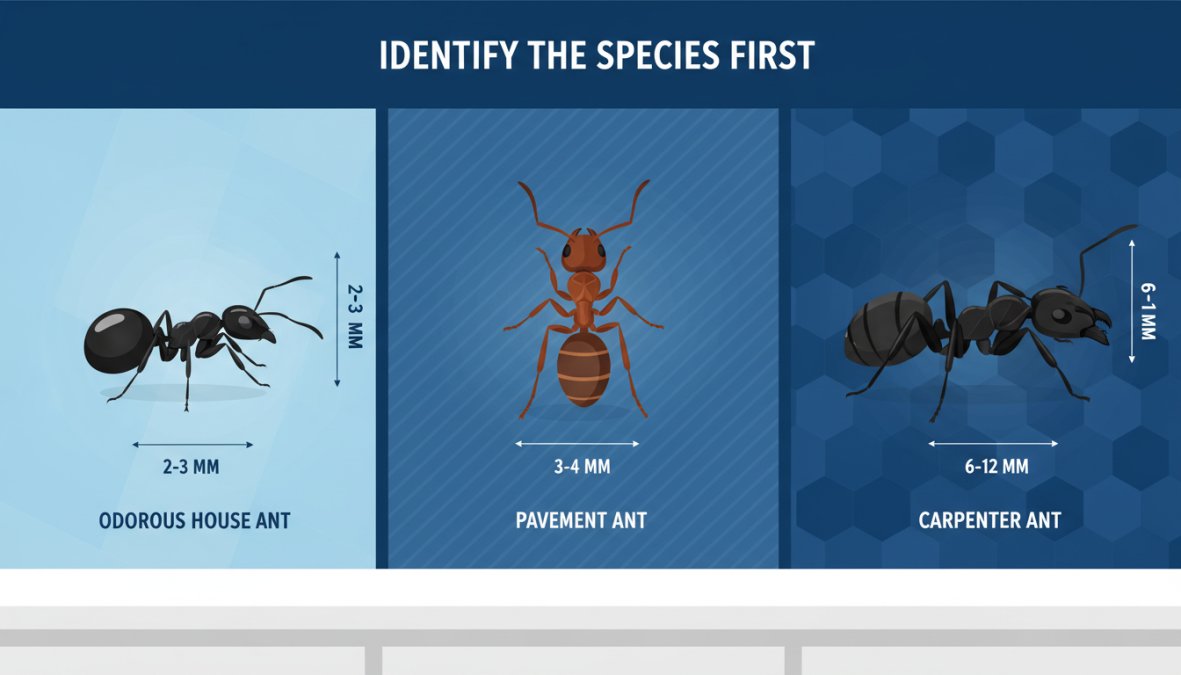
Identifying the ant species is the single most important step before reaching for any treatment. Different species respond to different baits, nest in different locations, and carry different levels of risk to your home’s structure.
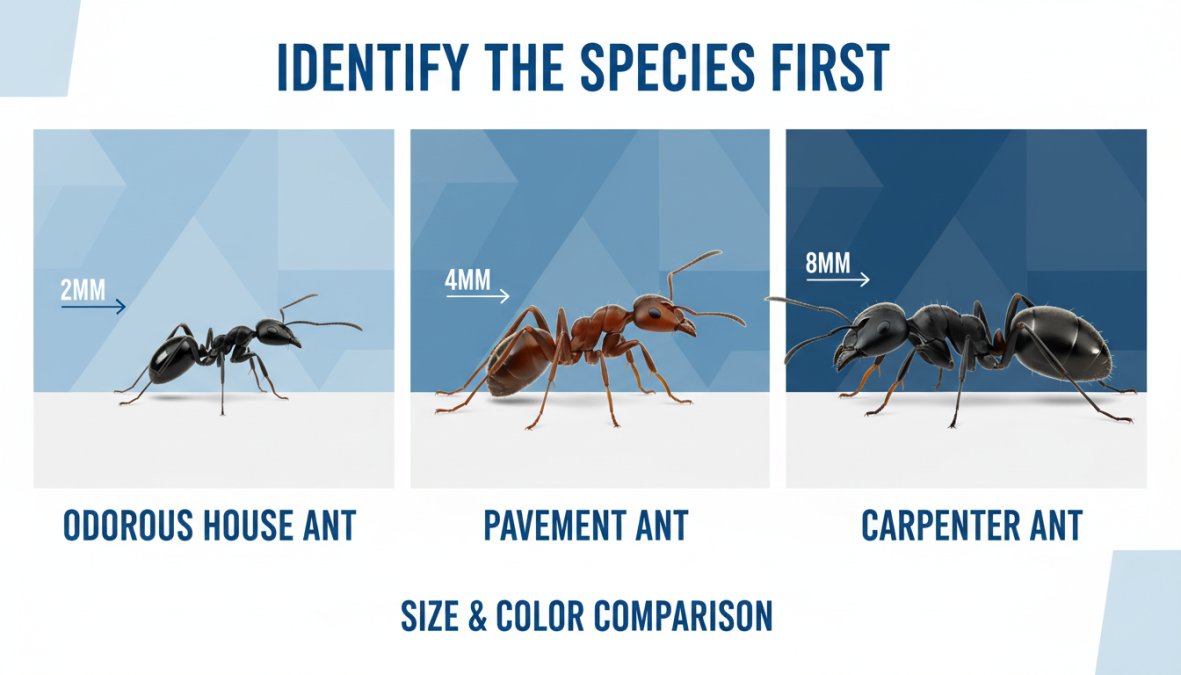
Odorous House Ants vs. Pavement Ants vs. Carpenter Ants: A Visual ID Guide
The three most common kitchen invaders in the Metro Boston area each have distinct characteristics:
| Species | Size | Color | Key Identifier | Risk Level |
|---|---|---|---|---|
| Odorous house ants | 1/16 – 1/8 inch | Dark brown/black | Rotten coconut smell when crushed | Low structural risk |
| Pavement ants | 1/16 – 1/8 inch | Brown to black | Parallel grooves on head and thorax | Low structural risk |
| Carpenter ants | 1/4 – 1/2 inch | Black or red-black | Large size, smooth thorax | High structural risk |
Odorous house ants are the most frequent kitchen invaders. They earned their name from the distinctive rotten coconut odor they emit when crushed. They nest in wall voids, under floors, and near moisture sources.
Pavement ants typically nest under slabs and along foundations, foraging indoors for any available food source. They are slower to spread through a structure but can establish large colonies.
Carpenter ants are the ones to take seriously. Unlike the others, carpenter ants do not eat wood. They excavate it to build galleries, which means a large infestation signals potential structural damage. According to University of Minnesota Extension entomology resources, carpenter ant colonies can contain thousands of workers and take years to develop to a damaging size.
Seasonal Ant Behavior: Why Infestations Spike in Spring and Summer
Ant activity follows a predictable seasonal pattern. Colonies overwinter in a dormant or semi-dormant state, then explode in population as temperatures rise above 50 degrees Fahrenheit. Spring triggers two things simultaneously: queens begin laying eggs at an accelerated rate, and foraging workers fan out aggressively searching for food and moisture to support colony growth.
Summer brings peak ant pressure. Dry spells push ants indoors searching for water, which is why kitchen sinks and dishwashers become hotspots. Fall sees a second, smaller surge as colonies build food reserves before winter. Understanding this cycle matters because spring is the optimal time to deploy preventive baiting before populations peak.
Follow the Scent Trails: How to Find Where Ants Are Coming From
Most people treat the ants they can see. The smarter move is to follow the trail they leave behind.
Ants communicate through pheromone-based scent trails. A scout ant finds food, returns to the colony, and lays a chemical path that recruits other workers. This is why you see ants moving in lines rather than randomly. Disrupting the visible trail without eliminating the source accomplishes nothing permanent.
How to trace an ant trail to its origin:
- Resist the urge to spray or kill the visible ants immediately. Observe the trail direction first.
- Follow the trail backward, away from the food source and toward the wall, baseboard, or window frame where ants are entering.
- Look for gaps around pipe penetrations, utility lines, window frames, and where cabinets meet walls.
- Check under the sink, behind the refrigerator, and along the baseboard near the dishwasher.
- Once you locate the entry point, mark it. You will seal it after treatment is complete.
A common mistake is treating only the kitchen surface when the nest is located outside the house entirely, with ants commuting in through a single crack. Tracing the trail to its source saves you from treating the wrong location repeatedly.
Place a small piece of food (a drop of honey or a cracker crumb) near where you suspect ant activity and watch it for 20-30 minutes. The trail that forms will lead you directly to the entry point with minimal guesswork.
Natural Home Remedies to Get Rid of Ants in the Kitchen
Natural remedies work best as repellents and supplementary deterrents, not as standalone solutions for an established infestation. That distinction matters more than most guides admit. If you have a colony of thousands behind your walls, white vinegar will not eliminate it. What it will do is disrupt active scent trails and create a temporary barrier while other treatments do the heavy lifting. Understanding why each remedy works, and where it stops working, is what separates a useful natural approach from a frustrating one.
How Each Remedy Works at the Biological Level
Most guides tell you what to apply. Very few explain the mechanism, which is the only way to know when a remedy is actually working versus when you are wasting time.
White vinegar disrupts pheromone trails through acetic acid. Ant navigation depends on detecting chemical gradients laid by scout ants. Acetic acid degrades those pheromone molecules on contact and temporarily masks the scent signature of the trail. The effect is real but short-lived: the acetic acid evaporates within hours, and the colony can re-establish a trail over the same path once the disruption clears. Mix equal parts white vinegar and water in a spray bottle. Apply directly to visible trails, entry points, and surfaces where ants travel. Reapply every 6-8 hours during active infestation, not just once a day. The limitation is not the remedy itself, it is the reapplication frequency most people skip.
Cayenne pepper and black pepper work through a different mechanism: capsaicin and piperine compounds interfere with ant chemoreception, essentially overwhelming the sensory organs ants use to detect food and navigate. Ants will not cross a fresh line of cayenne pepper. Apply it along baseboards, around cabinet bases, and directly at confirmed entry points. The honest limitation: pepper barriers wash away, get displaced by foot traffic, and lose potency as the volatile compounds dissipate. In a dry, undisturbed location (inside a cabinet corner, behind the refrigerator), a pepper barrier can hold for several days. On a kitchen floor with regular foot traffic, it needs daily reapplication.
Cinnamon works similarly to pepper, the cinnamaldehyde compound disrupts ant olfactory function. Ground cinnamon applied at entry points creates a barrier, but cinnamon sticks placed in cabinets have minimal effect because the volatile compounds do not disperse widely enough at room temperature. Use ground cinnamon, not sticks, and apply it directly at the gap or crack where ants are entering.
Peppermint and tea tree essential oils function as contact repellents. Mix 10-15 drops of peppermint essential oil per cup of water and spray along entry points, windowsills, and baseboards. The menthol in peppermint oil is particularly effective against odorous house ants. Tea tree oil is broader-spectrum but should be used cautiously in homes with cats, tea tree oil is toxic to felines even at low concentrations. Reapplication every 2-3 days is necessary as the volatile compounds evaporate.
Never use tea tree oil spray on surfaces cats walk on or in areas where cats groom. Even diluted concentrations can cause neurological symptoms in cats. For cat-owning households, peppermint oil or plain white vinegar are the safer alternatives.
Which Remedies Work for Which Ant Species
This is the angle almost no competitor covers, and it matters significantly for results:
- Odorous house ants respond well to vinegar trail disruption because they rely heavily on pheromone trails to coordinate foraging. Disrupting the trail buys time while bait treatments work. Peppermint oil is also notably effective as a repellent for this species.
- Pavement ants are less trail-dependent and more opportunistic in their foraging. Vinegar and essential oil repellents have limited effect on pavement ants moving along baseboards. Physical barriers (cayenne, cinnamon at entry points) are more useful for this species.
- Carpenter ants are largely unaffected by surface repellents. They forage individually rather than in tight pheromone trails, and their colony is typically located in wood rather than near the kitchen surface. Natural repellents applied to countertops will not address a carpenter ant problem. If you are seeing large black ants that do not respond to any surface treatment, move directly to professional inspection.
Baking Soda and Sugar: DIY Bait That Targets the Queen
This is where natural remedies get genuinely useful rather than just temporarily disruptive. A mixture of equal parts baking soda and powdered sugar functions as a DIY bait rather than a repellent. The mechanism: sugar attracts foraging workers, who carry the mixture back to the colony. Once ingested, baking soda reacts with the acidic compounds in ant digestive systems, disrupting normal function. The key difference from repellents is that workers carry this material back to the nest, meaning it has the potential to affect the broader colony including the queen.
DIY baking soda bait:
- Mix equal parts baking soda and powdered sugar
- Place in shallow containers (bottle caps or jar lids) near active trails
- Replace every 2-3 days
- Allow 1-2 weeks before evaluating results
The honest limitation: baking soda bait is less reliable than borax-based bait because the concentration and delivery mechanism are harder to control. It works best as a supplementary measure or in situations where borax is not available. For a serious infestation, move to the borax bait section below.
When Natural Remedies Are Not Enough: Clear Failure Signals
Natural remedies have failed, and you should stop using them as your primary strategy, when any of the following are true:
- Ant activity has not decreased after 7-10 days of consistent application
- You are seeing ants emerge from inside wall voids rather than from a visible exterior entry point
- The species is carpenter ants (natural repellents are ineffective against established carpenter ant colonies)
- You are finding new trails in different locations after disrupting the original trail, indicating the colony is large enough to reroute around barriers
At that point, natural remedies should be demoted to a supporting role, disrupting trails and deterring new entry points, while borax-based bait becomes the primary treatment.
Natural remedies are most effective in the first 48-72 hours of a new, small infestation, or as a maintenance layer after a primary treatment has reduced colony size. Using them as a standalone solution against an established colony delays effective treatment and gives the colony more time to expand.
Best Ant Bait for Kitchen: Borax-Based and Commercial Options
The best ant bait for kitchen use is a slow-acting borax-based formulation that workers carry back to the colony before it takes effect. This is not a controversial position. According to National Pesticide Information Center borax fact sheet, borax disrupts ant digestive systems and is effective against many common species when used correctly in bait formulations.
Why slow-acting matters: Fast-acting baits kill foraging workers before they return to the nest. The colony simply sends more workers. Slow-acting borax baits allow time for the material to reach the queen and the broader colony population.
DIY borax bait recipe:
- Mix 1 tablespoon of borax with 3 tablespoons of powdered sugar
- Add enough water to create a syrup consistency
- Place in shallow containers (bottle caps work well) near active trails
- Replace every 3-4 days or when the bait is consumed
Commercial options worth noting include gel baits and station-style baits available at hardware stores. Gel baits are particularly effective for odorous house ants because they mimic the liquid food sources these ants prefer. Station-style baits work well for pavement ants foraging along baseboards.
A common mistake is placing too much bait at once. A small amount placed precisely on an active trail outperforms a large amount placed randomly. Ants need to find it easily, and overcrowding a bait site can actually deter them.
Safe Ant Killers for Homes with Pets and Children
Safe ant killers for homes with pets and children require a different decision framework than standard pest control. The priority shifts from maximum efficacy to efficacy within tight safety constraints.
Pet-Safe Protocols: What to Avoid and What to Use
Synthetic pesticides containing pyrethroids (bifenthrin, cypermethrin, permethrin) are highly toxic to cats specifically. Cats groom themselves and can ingest residue from treated surfaces. Dogs are more tolerant but should still be kept away from treated areas until dry.
What to use instead:
- Diatomaceous earth (food-grade) is a non-toxic option. It damages ant exoskeletons through physical abrasion rather than chemical toxicity. Apply a thin line along baseboards and entry points. Keep pets away during application as the dust can irritate respiratory systems, but it is safe once settled.
- Borax-based bait stations in enclosed containers prevent pets from accessing the bait directly while allowing ants to enter.
- Essential oil repellents are generally safe for dogs but should be used cautiously around cats, as many essential oils are toxic to felines.
The thing nobody tells you about pet-safe ant control: the safest approach is also the most targeted. Bait stations placed precisely on active trails, inside enclosed containers, carry almost zero risk to pets and children while still delivering borax to the colony.
Child-Safe Precautions When Using Ant Baits and Traps
Children are at risk primarily through direct ingestion of bait products. The following precautions apply regardless of the product’s toxicity rating:
- Place all bait stations behind appliances, inside cabinet hinges, or under the refrigerator where children cannot reach
- Never apply spray treatments to countertops or food preparation surfaces
- Store all pest control products in locked cabinets
- If using borax-based DIY baits, use enclosed containers rather than open bottle caps in households with toddlers
The safest ant control strategy for families with pets and young children combines enclosed bait stations placed on active trails with physical barriers (caulk, diatomaceous earth) at entry points. This approach minimizes chemical exposure while maintaining effectiveness.
How to Prevent Ants in Kitchen: Sealing Entry Points and Sanitation
Prevention is the only strategy that produces lasting results. Killing an active colony without addressing entry points and food sources guarantees re-infestation within weeks.
Using Caulk and Steel Wool to Block Entry Points
Caulk and steel wool are the two most effective materials for blocking ant entry points, and they serve different purposes.
Caulk seals gaps along baseboards, around pipe penetrations, window frames, and where countertops meet walls. Use a silicone-based caulk for areas near moisture (under the sink, around the dishwasher) and a paintable latex caulk for baseboards and wall gaps. Caulk is permanent and creates a barrier that eliminates the entry point entirely.
Steel wool fills larger gaps where caulk alone would be insufficient, such as around utility pipe penetrations through walls. Ants cannot chew through steel wool. Pack it tightly into the gap before caulking over it for a complete seal.
Entry points to prioritize:
- Where plumbing pipes enter through walls or floors
- Gaps between window frames and exterior walls
- Cracks in the foundation visible from the basement or crawl space
- Where utility lines (electrical, cable) enter the structure
- Gaps around door frames, especially exterior doors
Kitchen Sanitation Habits That Eliminate the Food Source
Ants are opportunistic foragers. Remove their food source and you remove their reason to be there.
The most effective sanitation habits are not complicated, but they require consistency:
- Wipe down countertops after every meal preparation, not just at the end of the day
- Store sugar, flour, honey, and other dry goods in sealed containers rather than original packaging
- Empty trash cans daily during active infestation periods
- Clean under and behind appliances monthly, as crumb accumulation in these areas goes unnoticed
- Fix leaking faucets and pipes immediately. Moisture is as attractive to ants as food, especially during dry summer months
- Rinse recyclables before placing them in indoor bins
According to EPA integrated pest management guidance for schools and homes, sanitation combined with physical exclusion (sealing entry points) is the most effective long-term strategy for preventing ant infestation without relying on chemical treatments.
How Long Does It Take to Get Rid of Ants in Your Kitchen?
Getting rid of ants in your kitchen takes anywhere from a few days to several weeks, depending on the species, colony size, treatment method, and, critically, the time of year you are treating. Most guides give a single generic timeline. The reality is that a small odorous house ant colony discovered in early spring responds very differently to treatment than a mature carpenter ant colony found in late summer. Understanding the variables that drive timeline is what prevents you from abandoning an effective treatment too early, or continuing an ineffective one too long.
Treatment Timelines by Method
Repellents only (vinegar, essential oils, pepper barriers):
Visible trail activity reduces within 24-48 hours as ants reroute. This is not elimination, it is displacement. The colony remains intact and will re-establish foraging routes within days to weeks, often through a different entry point. Repellents alone do not produce a lasting result against an established colony. If repellents are your only strategy, expect to see ants return within 1-3 weeks.
DIY borax bait (homemade or commercial gel bait):
Worker activity typically increases in the first 3-5 days after bait placement. This is a positive sign, not a failure. More workers finding the bait means more bait material being carried back to the colony. Colony decline begins as the borax accumulates in the nest population, typically starting around days 7-10. Visible foraging activity should drop noticeably by week 2. Full elimination of a small to medium colony (a few hundred to a few thousand workers) generally takes 3-6 weeks with consistent bait maintenance. Larger colonies can take 6-8 weeks.
Commercial bait stations (enclosed gel or granular):
Timeline is similar to DIY borax bait. The advantage of commercial stations is consistent bait concentration and enclosed delivery that reduces the risk of bait drying out or being disturbed. Most manufacturers indicate significant colony reduction within 2-4 weeks for common household species.
Professional treatment:
Professional methods vary, direct nest injection, perimeter barrier treatment, and targeted bait placement are the most common approaches. Many infestations show significant reduction within 1-2 weeks following professional treatment, with full elimination following the complete treatment protocol. A reputable exterminator will schedule a follow-up inspection, typically at 2-4 weeks, to assess colony response and apply additional treatment if needed.
How Timelines Differ by Ant Species
This is the variable most guides ignore entirely, and it is the one that most often explains why a treatment that "should be working" appears not to be.
Odorous house ants have smaller colonies (typically a few thousand workers) and respond relatively quickly to borax bait. Expect visible improvement within 1-2 weeks and full resolution within 4-6 weeks with consistent treatment. One complicating factor: odorous house ant colonies can have multiple queens, which means eliminating one reproductive center does not necessarily collapse the colony. If activity rebounds after an initial decline, a satellite colony with a separate queen may be present.
Pavement ants form large colonies that can contain tens of thousands of workers, but their foraging behavior is more predictable and their nests are typically located outside the structure (under slabs, along foundations). Treatment timelines are similar to odorous house ants, 3-6 weeks for borax bait, but the outdoor nest location means indoor activity may continue longer as the bait works its way through a larger worker population.
Carpenter ants operate on a fundamentally different timeline. Carpenter ant colonies develop slowly, a mature colony capable of causing structural damage typically takes 3-6 years to establish. Treatment timelines are correspondingly longer. A professional treatment targeting a carpenter ant nest directly may show results within 2-4 weeks, but confirming full elimination requires monitoring over a full season. Because carpenter ant swarmers (winged reproductives) emerge in spring, the absence of swarmers the following spring is one of the most reliable indicators that a colony has been successfully eliminated.
How Season Affects Your Treatment Timeline
Ant colonies are not equally responsive to treatment year-round. This is a content gap most competitors miss entirely.
Spring (March-May): Colonies are emerging from winter dormancy and queens are laying eggs at peak rates. Foraging workers are actively seeking food and moisture. This is the highest-activity period and also the optimal window for bait treatment, workers are hungry, foraging aggressively, and will find and carry bait efficiently. Bait placed in spring reaches a colony that is actively growing, maximizing the impact of the borax on a large, active worker population.
Summer (June-August): Peak ant pressure, particularly during dry spells when ants move indoors seeking moisture. Bait remains effective, but high ambient temperatures can cause gel baits to dry out faster, requiring more frequent replacement. Liquid or gel baits in enclosed stations hold up better in summer heat than open bait placements.
Fall (September-October): A secondary surge in activity as colonies build food reserves before winter. This is a commonly missed treatment window, many homeowners assume the problem is resolving as summer ends, when in fact fall activity represents a final opportunity to deploy bait before colonies become dormant and harder to reach.
Winter (November-February): Colonies in cold climates enter a semi-dormant state. Foraging activity drops sharply. Bait placed in winter is found and carried back to the colony much more slowly, extending treatment timelines significantly. If you are treating in winter, expect timelines to run 2-3 times longer than the same treatment applied in spring or fall.
Reading the Signals: Is Your Treatment Working or Failing?
The most common mistake homeowners make is misreading the early phase of a successful bait treatment as failure, then spraying and disrupting the process.
Signs your treatment is working:
- Increased ant activity around bait stations in the first 3-7 days
- Ants visibly carrying bait material (you may see them transporting small particles)
- Gradual, steady decline in trail activity after the initial surge
- Trails becoming less defined and more scattered as colony coordination breaks down
Signs your treatment is failing:
- No change in activity after 10-14 days of consistent bait placement
- Ants ignoring bait entirely (may indicate wrong bait type for the species, or bait has dried out)
- Activity declining near bait but increasing in new locations, suggesting the colony is large enough to reroute
- Bait being consumed rapidly but activity not declining (may indicate a very large colony requiring professional-scale treatment)
If ants are ignoring your bait after 48 hours, try switching the bait matrix. Odorous house ants prefer liquid or gel-based sweet baits. Pavement ants will take sweet baits but also respond well to protein-based baits (a small amount of peanut butter mixed with borax). Matching the bait to the species’ current food preference, which shifts between sweet and protein depending on colony nutritional needs, dramatically improves uptake.
The decision point: If you have been treating consistently for more than 4-6 weeks without a clear downward trend in activity, the treatment approach needs to change. Either the colony is larger than DIY bait can address, the nest is located in a position that foraging workers are not reliably connecting to the bait, or the species requires a different treatment method. At that point, professional inspection is the more efficient path forward than continuing to adjust a DIY approach.
When to Call a Professional Exterminator for a Kitchen Ant Infestation
Certain situations make professional pest control the clear choice over continued DIY attempts.
Call an exterminator when:
- You have been treating actively for more than 4-6 weeks without significant reduction in activity
- You have identified or suspect carpenter ants, which require locating and treating the nest directly
- Ant trails are emerging from inside walls rather than from obvious exterior entry points
- You have found multiple entry points that are difficult to seal without structural knowledge
- The infestation has spread beyond the kitchen to multiple rooms
Zoifia Pest Control handles exactly these situations. The team is licensed and insured, serves the Metro Boston area, and backs every treatment with a 90-day guarantee. There are no long-term contracts required, which means you pay for results, not a subscription.
Signs of Structural Damage from Carpenter Ants
Carpenter ants are the one species where a kitchen ant problem can become a structural problem. The key distinction: carpenter ants excavate wood to nest in it, preferring wood that has been softened by moisture damage.
Signs of carpenter ant structural damage:
- Small piles of coarse sawdust (called frass) near baseboards, window frames, or door frames
- Hollow sound when tapping on wood beams or structural members
- Soft or spongy wood in areas that should be solid, particularly near plumbing
- Winged ants (swarmers) emerging from walls or ceilings in spring, indicating a mature colony
Frass is the most reliable indicator. Unlike termite frass, which is pellet-shaped, carpenter ant frass looks like coarse wood shavings mixed with insect body parts. Finding it inside your home means the nest is already established within the structure.
According to Penn State Extension carpenter ant identification and management guide, carpenter ant damage is often discovered during renovation projects when walls are opened, revealing galleries that have been expanding for years undetected. Early identification is the only reliable way to limit structural impact.
If you find frass or suspect carpenter ant activity in structural wood, professional inspection is not optional. The colony needs to be located and treated directly, and any moisture damage enabling the infestation needs to be repaired simultaneously.
A persistent ant infestation rarely resolves on its own, and the longer a colony establishes itself in your kitchen, the harder it becomes to eliminate without professional intervention. Zoifia Pest Control provides fast, reliable service across the Metro Boston area, with licensed and insured technicians who identify the species, locate the source, and treat the infestation with a 90-day guarantee backing the work. No long-term contracts, no guesswork. Get a quote from Zoifia Pest Control and get your kitchen back.
Frequently Asked Questions
What is the fastest way to get rid of ants in the kitchen?
The fastest way to get rid of ants in your kitchen is to combine two actions immediately: wipe down surfaces with white vinegar to disrupt scent trails, then place a borax-based ant bait near the trail. The vinegar stops foraging ants in their tracks, while the bait carries poison back to the ant colony and kills the queen. For severe infestations, a licensed pest control professional can deliver faster, longer-lasting results.
Why do I keep getting ants in my kitchen even after cleaning?
Even a clean kitchen can attract ants if entry points remain unsealed. Odorous house ants and pavement ants can squeeze through hairline cracks in caulk, gaps around pipes, or worn door sweeps. They follow pheromone scent trails left by earlier foraging ants, so simply removing visible ants does not stop the colony. You must seal entry points with caulk or steel wool and eliminate the scent trail with vinegar to break the cycle.
Is the best ant bait for the kitchen safe to use around pets and children?
Most gel and station-style ant baits use borax or similar slow-acting ingredients at low concentrations, which are generally low-risk for adults. However, pets and small children can be attracted to sweet bait formulas. Always place bait stations inside child-resistant stations, tuck them behind appliances or inside cabinets, and keep them out of reach. Avoid synthetic pesticide sprays near food prep areas and choose non-toxic or pet-labeled products when possible.
How long does it take to get rid of ants in the kitchen completely?
With consistent use of ant baits and proper sanitation, most homeowners see a significant reduction in ant activity within 3 to 7 days. Full elimination of the ant colony, including the queen, typically takes 1 to 3 weeks depending on the species and infestation size. Carpenter ant infestations or large colonies may take longer and often require professional pest control treatment to fully resolve the problem.
Are there natural home remedies that actually kill ants in the kitchen?
Some natural remedies disrupt ants rather than kill them outright. White vinegar and cayenne pepper act as repellents by masking scent trails. Essential oils like peppermint can deter foraging. A DIY mixture of baking soda and powdered sugar can kill individual ants, while a borax and sugar water solution acts as a slow-acting bait that reaches the queen. Natural remedies work best for minor infestations combined with strong sanitation and entry-point sealing.
When should I call a professional exterminator for ants?
Call a professional exterminator if you have tried baits and natural remedies for two or more weeks without a clear reduction in ant activity, if you suspect carpenter ants (which can cause structural damage), or if you find multiple ant colonies. A licensed pest control service can identify the exact species, locate hidden nests, and apply targeted treatments safely. Zoifia Pest Control offers a 90-day guarantee with no long-term contract required.
This article was written using GrandRanker
