Table of Contents
- How to Identify Carpenter Ant Damage in Boston Homes
- Common Signs of Carpenter Ant Infestation
- Carpenter Ant Frass Identification
- Carpenter Ant vs Termite Damage
- Where Carpenter Ants Hide in Boston Homes
- How to Get Rid of Carpenter Ants in Boston
- Common Mistakes to Avoid When Assessing Damage
- Conclusion
Identify Carpenter Ant Damage in Boston Homes
Last Updated: July 5, 2026
Carpenter ants cause an estimated $5 billion in property damage annually across North America, with Boston’s older homes particularly vulnerable due to their wood-frame construction and moisture-prone foundations. Understanding how to identify carpenter ant damage is critical for early intervention, the longer an infestation persists, the more structural compromise occurs. At Zoifia Pest Control, we’ve documented hundreds of cases where homeowners caught infestations within weeks rather than months, preventing costly repairs.
What Makes Boston Homes Vulnerable
Boston’s architectural heritage creates ideal conditions for carpenter ants. Most homes built before 1980 feature wood siding, wooden window frames, and uninsulated crawl spaces, prime carpenter ant territory. These structures often have compromised moisture barriers, especially in basements and around foundation penetrations where water seeps in during New England’s heavy spring thaw.
The region’s climate compounds the risk. Carpenter ants remain active year-round in heated homes, and Boston basements average 60-70% humidity, creating the damp wood conditions carpenter ants need to establish galleries. According to University of Massachusetts Extension pest management guidelines, the combination of older construction and seasonal moisture fluctuations makes the Metro Boston area a high-risk zone.
Carpenter ants don’t eat wood for nutrition, they excavate galleries to nest. This means infestations can remain invisible for months while damage accumulates inside walls. A single colony can contain 10,000 to 20,000 workers, and mature colonies often send out satellite nests into attics and wall voids.
Boston homes with additions or second stories built in the 1980s-2000s are especially vulnerable. These sections often have wood-to-soil contact at the foundation line, a direct highway for carpenter ant entry.
Why Early Detection Matters
Catching carpenter ant damage in the early stages saves thousands in structural repairs. A small colony discovered in spring can be eliminated before it matures and splits into satellite nests. Delayed detection often means the difference between a $500 treatment and a $5,000+ foundation repair.
Carpenter ants follow predictable patterns: they establish a primary nest in moist wood, usually basement areas or crawl spaces, then send foragers through walls at night. Within 3-6 months, a primary colony may spawn satellite colonies in attics, wall voids, or upper floors. Once satellites establish, the infestation becomes exponentially harder to eliminate.
The structural risk escalates quickly. Carpenter ants create smooth, clean galleries that weaken wood’s load-bearing capacity. A beam that appears solid on the outside can be 40-50% hollowed out inside. This hidden damage is why early identification, before galleries extend deep into framing, is essential.
If you spot carpenter ant activity in spring, do not wait until fall to treat. Spring activity indicates an overwintering colony that has survived the winter indoors, an urgent signal that the infestation is established and growing.
Common Signs of Carpenter Ant Infestation
Carpenter ants leave multiple clues if you know where to look. The most obvious sign is the presence of large black ants (½ to ⅝ inch long) moving along baseboards, window frames, or foundation walls, especially at dusk and night.
Sawdust-like debris near wood surfaces is a primary indicator. Unlike termite damage, carpenter ant galleries produce coarse, granular frass that often contains pieces of insulation or wood fibers. This material accumulates near exit holes or inside wall voids, sometimes visible in basement corners or under windowsills.
Listen for sounds inside walls during quiet evenings. Carpenter ants produce a faint rustling or crunching noise as they excavate and move through galleries. In severe infestations, this sound becomes noticeable, especially in walls adjacent to kitchens or bathrooms.
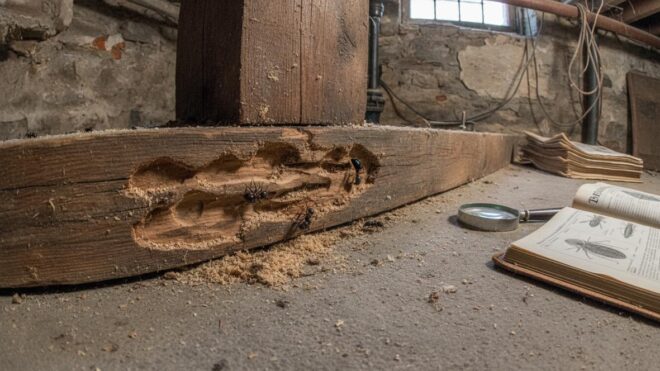
Wood damage patterns are distinctive. Carpenter ants create smooth, rounded galleries with clean walls, not the jagged, mud-filled tubes of termites. If you find damaged wood in a basement beam or sill plate, look for this gallery pattern. The wood around the galleries often remains solid, creating a honeycomb appearance when a section breaks open.
Carpenter Ant Frass Identification
Carpenter ant frass is the granular debris ejected from galleries as ants excavate wood. It’s one of the most reliable indicators of active infestation.
Carpenter ant frass appears as coarse, sawdust-like particles, typically tan to reddish-brown in color depending on the wood type being excavated. The texture is gritty and uniform, like fine sand mixed with wood shavings. Frass often contains visible wood fragments and pieces of insulation, which differentiates it from termite frass (which is fine, powdery, and uniform).
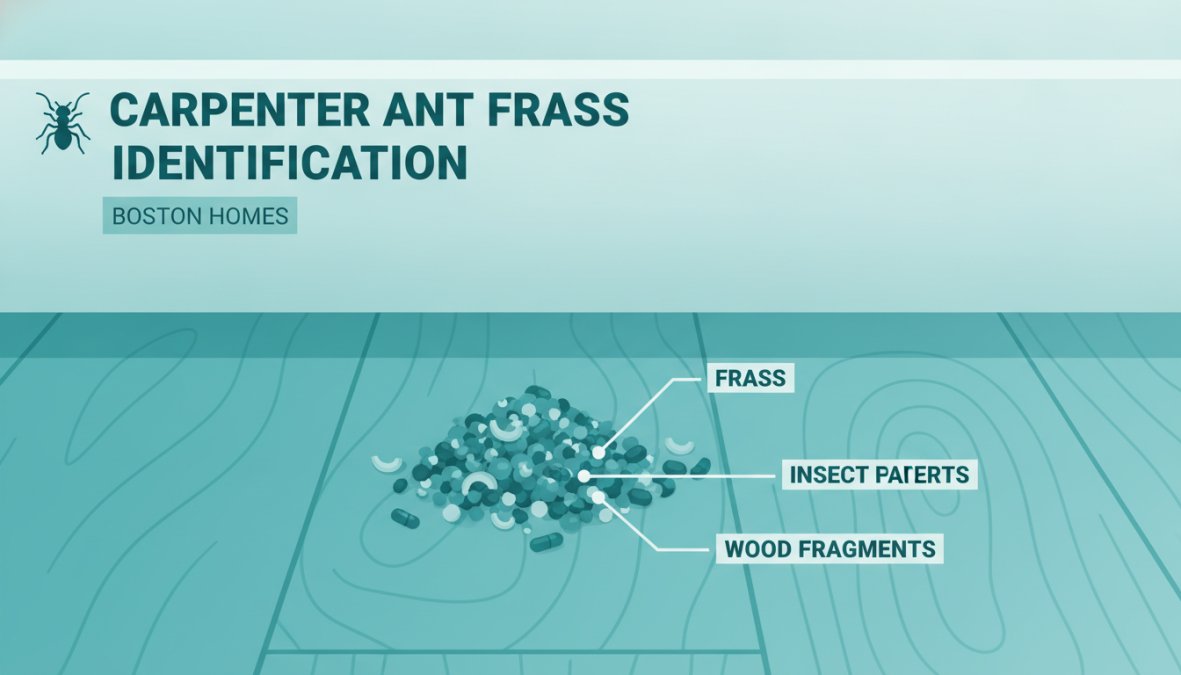
Location is critical for frass identification. Carpenter ants push frass out of exit holes, so you’ll find it accumulating directly below these openings. In basements, look along sill plates, rim joists, and foundation walls. In attics, check around roof penetrations and along the top plates of exterior walls. Bathrooms are common sites because moisture attracts colonies.
The key distinction: carpenter ant frass is ejected in small piles that grow over days or weeks. Sawdust from construction is random and doesn’t accumulate in organized piles. If you find granular material in a concentrated pile near wood, and that pile grows slightly larger each week, carpenter ants are almost certainly present.
Frass piles near wood surfaces are the single most reliable early detection signal. Check basement corners, windowsills, and attic corners monthly during warmer months. A pile that wasn’t there two weeks ago indicates active excavation.
Carpenter Ant vs Termite Damage
The structural signatures of carpenter ants and termites are fundamentally different, and misidentification delays treatment by months.
Carpenter ant damage creates smooth, clean galleries with intact wood walls. The excavated wood remains relatively solid and dry. If you break open an affected beam, you’ll see rounded tunnels with polished surfaces. The surrounding wood is usually unaffected, creating a honeycomb pattern. Carpenter ants avoid soil contact and prefer dry wood in wall voids and attics.
Termite damage produces galleries packed with mud and fecal material. Subterranean termites (the common Boston species) must maintain moisture in their tunnels, so they fill them with soil and saliva. If you break open termite-damaged wood, you’ll see mud-lined tunnels, not clean galleries. The wood becomes soft and crumbly, and damage often extends into soil-contact areas.
The behavioral differences matter for treatment. Carpenter ants forage at night and return to a central nest; termites work continuously and maintain constant soil contact. Carpenter ant infestations can be eliminated by treating the primary nest. Termite infestations require soil treatment and barrier creation because the colony lives in the ground.
Why misidentification delays treatment: If a homeowner assumes termite damage but the infestation is actually carpenter ants, the soil treatment won’t work. The colony inside the wall remains untouched. According to Connecticut Agricultural Experiment Station pest identification resources, visual inspection of gallery type and frass characteristics correctly identifies the pest in 95% of cases when performed carefully.
Where Carpenter Ants Hide in Boston Homes
Carpenter ants follow moisture and wood in predictable patterns. Understanding their preferred locations dramatically improves detection odds.
Basement and crawl space areas are the primary infestation site in nearly 80% of Boston cases. Carpenter ants establish colonies in sill plates, rim joists, and band boards. These areas are naturally damp due to moisture migration through foundations and poor drainage.
Bathroom and kitchen areas are secondary hotspots. Water leaks around tubs, showers, and sinks create localized moisture that attracts foragers. Carpenter ants often establish satellite colonies in wall voids behind these areas.
Roof penetrations and gutters attract carpenter ants in upper-story areas. Clogged gutters create standing water that saturates fascia boards and soffit. Boston’s heavy spring rains make gutter maintenance critical.
Window frames and sills are common entry points. Old windows with failed caulking allow water infiltration, softening the wood around the frame.
Seasonal nesting patterns show carpenter ants establishing primary colonies in cool, moist basement areas during winter and fall. As spring arrives and colonies mature, they send foragers throughout the structure and establish satellite nests in attics and wall voids. By summer, a single primary colony can have 3-5 active satellite colonies spread across the home.
In Boston homes, the most overlooked hiding spot is the space between the foundation wall and the sill plate. This gap, often 2-3 inches wide, is protected from cold and attracts moisture. Check this area with a flashlight during basement inspections.
How to Get Rid of Carpenter Ants in Boston
Eliminating carpenter ants requires a two-phase approach: identification and treatment.
DIY inspection and treatment limits are important to understand. Homeowners can successfully identify carpenter ant presence through frass detection and visual inspection. However, treatment is where DIY efforts typically fail. Over-the-counter sprays kill foraging ants but don’t reach the primary nest, which is often hidden deep in wall voids or foundation areas.
A realistic DIY approach includes:
- Conducting a thorough basement and attic inspection to locate frass piles and gallery damage
- Documenting the location and extent of damage with photos
- Eliminating moisture sources (fixing leaks, improving drainage, reducing humidity)
- Sealing entry points and wood-to-soil contact areas
- Calling a licensed professional to treat the nest
Moisture control alone will not eliminate an established colony, it only prevents future infestations.
When to call a licensed pest control professional is the critical decision point. If you’ve confirmed carpenter ant presence, professional treatment is necessary. Zoifia Pest Control specializes in carpenter ant elimination for Boston homes, using targeted treatments that reach primary and satellite nests. Our licensed team identifies nest locations using thermal imaging and acoustic detection, then applies treatments directly to the colony.
Professional treatment typically costs $300-$800 depending on infestation severity and home size. This investment prevents thousands in structural repairs. Zoifia Pest Control backs our carpenter ant treatments with a 90-day guarantee, meaning if ants return within 90 days, we retreat at no cost.
Common Mistakes to Avoid When Assessing Damage
The most costly mistake is confusing carpenter ant damage with other wood issues. Dry rot, water damage, and wood-boring beetle damage all create holes and cavities, but the treatment approaches are completely different.
Another critical error is assuming all wood damage is active. A home may contain old carpenter ant galleries from an infestation that ended years ago. Without evidence of active ants (fresh frass, live sightings, or rustling sounds), treating old damage is unnecessary.
Waiting for visible structural failure is dangerous. By the time wood becomes noticeably soft or beams sag, the infestation has progressed for years. Early detection through frass identification catches infestations when damage is still minor.
Ignoring basement moisture is perhaps the most common long-term mistake. Even without current pest activity, persistent moisture in basements guarantees future infestations. Boston homes with damp basements should implement moisture control (sump pumps, dehumidifiers, improved drainage).
Finally, treating only the visible area is ineffective. Carpenter ants establish primary colonies in hidden locations, usually basements or crawl spaces. Treating an attic satellite colony without eliminating the primary nest results in reinfestation. Comprehensive treatment requires identifying and treating the primary nest.
Carpenter ant damage in Boston homes progresses silently and expensively when left untreated. Early identification through frass detection and gallery inspection is the difference between a $500 treatment and a $5,000 repair. If you’ve confirmed carpenter ant presence in your home, professional elimination is the most reliable path forward. Zoifia Pest Control provides licensed, insured carpenter ant treatments backed by a 90-day guarantee, ensuring your Boston home remains protected. Get a quote today and stop carpenter ants before they compromise your home’s structure.
Frequently Asked Questions
What does carpenter ant damage look like in wood?
Carpenter ant damage appears as smooth, clean galleries or tunnels inside wood, often creating a honeycomb-like pattern. Unlike termites, carpenter ants don't eat the wood, they hollow it out to create nesting galleries. You'll see small, round exit holes (about 1/8 inch diameter) where ants emerge. The damaged wood may feel soft or weakened, and you might notice sawdust-like frass around the damaged area. In Boston homes, this damage commonly appears in window frames, door jambs, and structural beams.
How can you tell the difference between termite and carpenter ant damage?
Carpenter ant damage features smooth, clean tunnels with visible walls, while termite damage shows mud-lined galleries and a more chaotic pattern. Carpenter ants create distinct, round exit holes; termites leave irregular openings. Termites consume wood fibers, leaving a papery residue, whereas carpenter ant frass is coarse and granular. Termite damage typically affects wood grain patterns uniformly, while carpenter ant tunneling follows wood grain structure. If you find live insects, carpenter ants are large (1/4 to 1/2 inch) and segmented; termites are smaller and lighter-colored.
Are carpenter ants common in Boston homes?
Yes, carpenter ants are very common in the Boston area due to the region's older housing stock, high humidity, and abundant wood structures. Massachusetts' climate, with cold winters and damp springs, creates ideal conditions for carpenter ant colonies. Boston's colonial and Victorian homes, many with original wood framing and moisture issues, are particularly vulnerable. Spring through fall is peak activity season, though carpenter ants remain active year-round in heated homes. Early detection and professional pest management are essential in the metro Boston area.
What time of year are carpenter ants most active in Massachusetts?
Carpenter ants are most active from late spring through early fall (May through September) in Boston and Massachusetts. During warmer months, they forage more aggressively and expand nesting galleries. However, in heated homes, carpenter ant activity continues throughout winter, making year-round vigilance important. You may notice increased activity in spring when ants emerge from winter dormancy and begin establishing satellite colonies. Fall activity intensifies as ants prepare for winter by expanding food storage and nesting areas, making autumn an ideal time for professional inspection and treatment.
This article was written using GrandRanker
