Table of Contents
- Common Pests in Boston Homes: What Residents Are Up Against
- Boston’s Seasonal Pest Calendar: When Infestations Peak
- Pest Prevention for Historic Boston Brownstones
- Comprehensive Pest Control Services for Boston Residential Properties
- How to Prevent Rodents in Boston Apartments: Practical Steps
- Eco-Friendly Pest Control in Boston: IPM Explained for Residents
- Cost of Residential Pest Control in Boston: DIY vs. Professional
- Choosing the Right Pest Control Services for Boston Residential Properties
- Conclusion
Last Updated: May 30, 2026
Boston’s dense urban environment, aging housing stock, and harsh seasonal climate create conditions that make pest infestations more common and harder to control than in most American cities. Finding reliable pest control services for boston residential properties is not just a matter of comfort, it’s a matter of protecting your home’s structural integrity and your family’s health. This guide from Zoifia Pest Control covers everything Boston homeowners need to know, from the specific pests that target the city’s historic brownstones to the honest cost comparison between DIY and professional treatment. Below, we’ll show you exactly how to identify, prevent, and eliminate infestations the right way.
Here’s what most guides get wrong: they treat Boston like any other American city. It isn’t. The combination of century-old building stock, a subway system running beneath dense residential neighborhoods, and four distinct seasons creates a pest pressure cycle unlike anywhere else in the Northeast.
Common Pests in Boston Homes: What Residents Are Up Against
Boston residents face a broader pest challenge than most homeowners expect. The urban environment concentrates food sources, the aging housing stock provides countless entry points, and the climate swings from brutal winters to humid summers, conditions that drive pests indoors repeatedly throughout the year.
According to the Massachusetts Department of Agricultural Resources pest management guidance, urban residential properties face elevated pest pressure compared to suburban homes, largely because of proximity to commercial food waste and shared building infrastructure.
Rodents, Cockroaches, and Ants: The Year-Round Threats
Rodents, cockroaches, and ants are the three pests Boston residents encounter most consistently, regardless of season. Mice and rats exploit the city’s aging sewer infrastructure and basement-level apartments. A single mouse can squeeze through a gap the size of a dime, which means older buildings with settling foundations are particularly vulnerable.
German cockroaches thrive in apartment kitchens and bathrooms where warmth and moisture concentrate. They reproduce rapidly and develop resistance to over-the-counter treatments faster than most homeowners realize. Carpenter ants and pavement ants become a persistent nuisance in spring and summer, often nesting inside wall voids or beneath concrete slabs.
A common mistake is treating these pests reactively, only after a visible infestation has established. By the time you see one mouse in your kitchen, there are likely several more in the walls.
Bed Bugs, Termites, and Stinging Pests: Seasonal Surges
Bed bug infestations peak in late summer and fall in Boston, driven by increased travel and the turnover of rental units common in the city’s large student population. Termite activity surges in spring when swarmers emerge to establish new colonies. Stinging pests, yellow jackets, hornets, and wasps, become aggressive from mid-July through September, particularly in properties with mature landscaping or wood-framed eaves.
The pest infestation risk from termites is especially serious for Boston homeowners because damage accumulates silently for months before becoming visible. Bed bug treatment requires professional-grade approaches; consumer products rarely eliminate an established colony.
Boston’s Seasonal Pest Calendar: When Infestations Peak
Understanding when pest pressure peaks lets you get ahead of problems rather than chase them.
| Season | Primary Pests | Key Risk Factors |
|---|---|---|
| Winter (Dec-Feb) | Mice, rats, cockroaches | Rodents seek warmth; cockroaches thrive in heated buildings |
| Spring (Mar-May) | Termite swarmers, ants, carpenter ants | Moisture and warming temps trigger colony expansion |
| Summer (Jun-Aug) | Stinging pests, ants, bed bugs | Outdoor nesting, travel-related bed bug spread |
| Fall (Sep-Nov) | Mice, bed bugs, spiders | Rodents enter for winter; bed bug peak season |
The practical implication: year-round protection plans outperform single-treatment approaches in Boston’s climate. A treatment applied in April won’t address the mouse problem that begins in October. This is the part most pest control guides skip over, seasonal re-entry is the norm, not the exception, in New England residential properties.
Schedule a preventative inspection in late September, before rodents begin their winter entry push. Most licensed technicians can identify and seal entry points before an [infestation](/how-to-handle-roach-infestation-in-apartment/) establishes, which costs significantly less than a full rodent removal program.
Pest Prevention for Historic Boston Brownstones
Historic brownstones present pest control challenges that simply don’t exist in newer construction. This is where Boston’s pest problem gets genuinely complicated.
Brownstones built between the 1860s and 1920s feature rubble-stone foundations, brick-and-mortar construction with natural settling gaps, original wood framing, and basement units that sit partially below grade. Each of these characteristics creates structural vulnerabilities that modern pest exclusion techniques must adapt to.
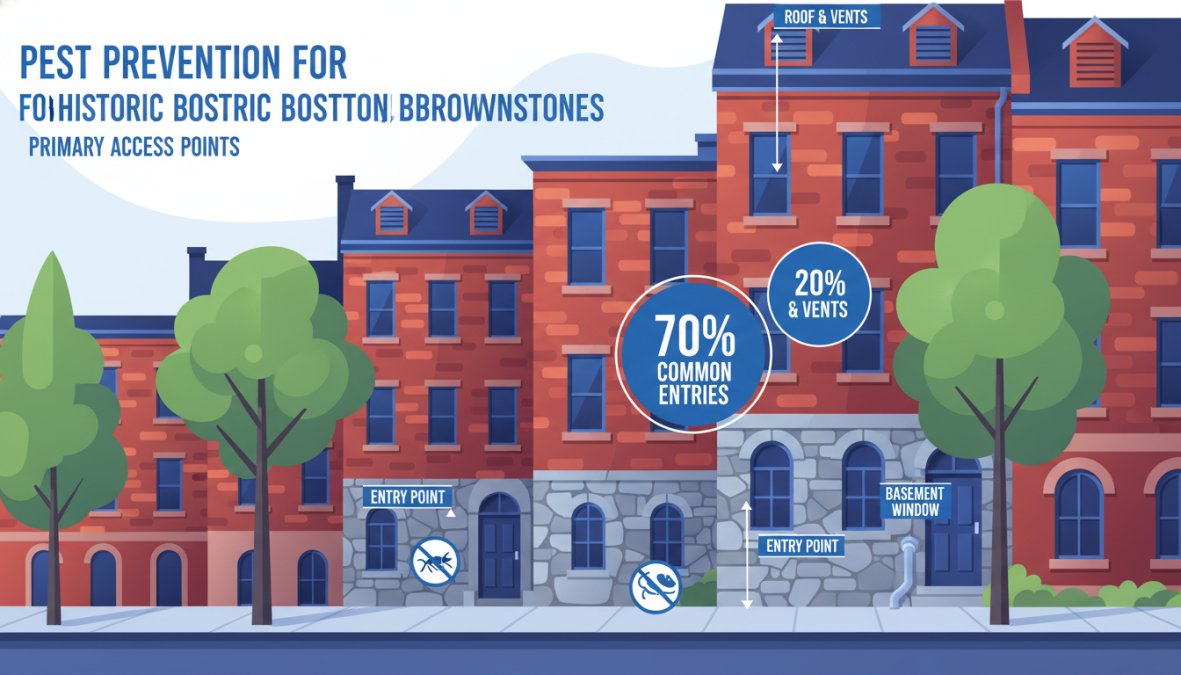
The most effective prevention strategy for brownstones focuses on four specific areas:
- Foundation gaps and mortar joints: Settling creates gaps in brick mortar that mice exploit. Copper mesh and appropriate sealants (not expanding foam alone) are the correct materials for these surfaces.
- Basement window frames: Original wood frames shrink and warp seasonally, creating recurring entry points that require ongoing attention rather than one-time sealing.
- Utility penetrations: Gas lines, water pipes, and electrical conduit that enter through original masonry often have gaps that were never properly sealed.
- Shared walls in row houses: Pests move laterally through shared wall cavities. Treating one unit in a brownstone without coordinating with adjacent units frequently produces incomplete results.
According to the National Pest Management Association’s guide to structural pest prevention, exclusion work on historic structures requires materials and methods specifically chosen for compatibility with older construction, a detail many general contractors overlook.
Never use expanding spray foam as the sole sealant in brownstone foundations. It degrades within a few years and doesn’t bond reliably to old brick. Rodents can chew through it. Use copper mesh packed into gaps first, then seal over it with an appropriate masonry caulk.
Comprehensive Pest Control Services for Boston Residential Properties
Professional pest control services for Boston residential properties cover a wide spectrum of treatment types, but the right service for your home depends on three factors competitors rarely discuss together: the pest species involved, the age and construction type of your building, and the Massachusetts regulatory framework that governs what licensed technicians can legally apply and where.
Understanding each service category, and the constraints specific to Boston’s housing stock, helps you make an informed decision rather than simply booking the lowest quote.
Rodent Removal and Exclusion
Rodent removal is a two-phase process, and the second phase, exclusion, is where the Boston context matters most. Elimination uses bait stations, snap traps, or a combination depending on infestation severity and whether children or pets are present. Exclusion involves physically sealing every identified entry point.
In Boston’s older housing stock, exclusion is significantly more complex than in new construction. Rubble-stone and brick foundations have irregular surfaces that standard foam sealants don’t bond to reliably. Shared wall cavities in row houses and triple-deckers mean a gap sealed in one unit may still allow rodent movement from an adjacent unit. Licensed technicians working on historic properties should be using copper mesh packed into gaps before any sealant is applied, this is a material standard, not a preference.
Massachusetts regulations also govern where rodenticide bait stations can be placed in multi-unit residential buildings, particularly in common areas. A provider who doesn’t reference these placement rules during their inspection quote is worth questioning.
Bed Bug Treatment and Termite Control
Bed bug treatment in Boston residential properties typically involves heat treatment, chemical treatment, or a combination. Heat treatment, raising the interior temperature of an infested space to a level lethal to all life stages of the insect, is highly effective and leaves no chemical residue, which makes it well-suited to homes with chemical sensitivities. It requires full vacating of the treated space and careful preparation of heat-sensitive items. Chemical treatment using residual insecticides is less disruptive to occupants’ schedules but typically requires two or more follow-up visits to address newly hatched eggs that survived the initial application.
For Boston’s large rental population, the practical complication is that Massachusetts law places specific obligations on landlords regarding bed bug disclosure and remediation in residential tenancies. Homeowners in owner-occupied multi-family buildings should be aware that treating only their unit while an adjacent rental unit remains infested will produce incomplete results, a pattern that drives repeat service calls and unnecessary expense.
Termite control in Boston primarily targets Eastern subterranean termites (Reticulitermes flavipes), the species responsible for the vast majority of structural termite damage in New England. Two main approaches are used: liquid termiticide applications to the soil around the foundation perimeter, and bait station systems installed at intervals around the property. For historic brownstones and properties with finished basement floors, bait systems are generally preferable because they don’t require drilling through original masonry or finished flooring to create a continuous chemical barrier. The trade-off is that bait systems work more slowly, they rely on foraging termites finding and consuming the bait and carrying it back to the colony, a process that takes weeks rather than days.
Wildlife Trapping and Stinging Pest Management
Wildlife trapping in Boston residential neighborhoods most commonly addresses gray squirrels, raccoons, skunks, and, in older buildings with accessible attic or soffit spaces, bats. Each species is governed by Massachusetts Division of Fisheries and Wildlife regulations that specify which trapping methods are permitted, whether relocation is allowed, and how captured animals must be handled. Bats are a particular case: all bat species in Massachusetts are protected under state law, and exclusion work on bat colonies must be timed to avoid trapping flightless juvenile bats inside a structure. Most licensed wildlife removal providers will not perform bat exclusion between June 1 and August 15 for this reason.
Stinging pest management, yellow jackets, bald-faced hornets, paper wasps, and European hornets, requires locating the nest before any treatment is attempted. In Boston residential properties, yellow jacket colonies frequently establish inside wall voids, beneath concrete stoops, or in the ground beneath landscaping, locations that aren’t visible from the exterior. Treating the entry point without reaching the colony interior is ineffective and can cause defensive swarming. Technicians should be able to describe their nest-location methodology before you agree to a treatment.
When requesting quotes for any of these services, ask the provider specifically how they handle re-infestation between treatment visits. The answer tells you more about their methodology than any marketing language on their website. A provider with a genuine re-treatment guarantee has a financial incentive to resolve the problem completely the first time.
How to Prevent Rodents in Boston Apartments: Practical Steps
Preventing rodents in Boston apartments is meaningfully different from rodent prevention advice written for single-family suburban homes, and most guides don’t acknowledge that distinction. Boston’s rental housing is dominated by triple-deckers, converted brownstones, and mid-century multi-unit buildings, each with structural characteristics that make standard prevention advice partially or entirely insufficient without adaptation.
This section addresses prevention by building type, covers the landlord-tenant obligations that affect what you can actually do as a renter, and identifies the specific failure points that cause prevention efforts to break down in Boston’s shared-wall housing stock.
Why Generic Prevention Advice Falls Short in Boston Multi-Unit Buildings
The standard rodent prevention checklist, seal gaps, store food properly, eliminate moisture, is correct but incomplete for Boston apartments. The core problem is that in a triple-decker or brownstone row house, your unit shares wall cavities, floor joists, utility chases, and often a common basement with one to five other households. A mouse doesn’t need to enter your unit from the exterior. It can enter through a gap in a shared interior wall from a neighboring unit that has an active infestation.
This means individual apartment-level prevention has a hard ceiling on its effectiveness. You can seal every gap in your unit’s exterior-facing walls and still have a rodent problem if the building’s common areas, basement, or adjacent units are not addressed simultaneously. This is the structural reality that most prevention guides skip over because it complicates the simple checklist format.
Prevention by Building Type
Triple-deckers: The most common multi-family form in Boston neighborhoods like Dorchester, Jamaica Plain, and Roxbury. Key vulnerability points are the basement utility room (often shared, rarely well-sealed), the stairwell walls that run the full height of the building, and the gap between the first-floor unit and the basement ceiling. Rodents entering the basement can access any floor through these vertical chases. Prevention at the unit level must be paired with basement-level exclusion to be effective.
Converted brownstones: Original rubble-stone foundations have natural voids that are difficult to seal completely. The gap between the original foundation and the first-floor framing, often a wood sill plate sitting directly on masonry, is a consistent entry point. Basement units that sit partially below grade are at highest risk. Window wells that collect leaf debris provide harborage directly adjacent to basement windows.
Mid-century brick apartment buildings: Generally better sealed than older stock, but utility penetrations, particularly where heating pipes and electrical conduit pass between floors, are frequently unsealed or sealed with materials that have degraded over decades. Laundry rooms and trash rooms in these buildings are high-activity areas that can sustain rodent populations that then spread to residential floors.
Practical Prevention Steps, Adapted for Boston Renters
-
Seal gaps at your unit’s interior boundaries, not just exterior walls. In a multi-unit building, the wall between your unit and the stairwell, the floor penetrations where pipes enter your kitchen or bathroom, and the gap beneath your unit’s entry door are as important as exterior-facing gaps. Use steel wool packed into gaps, covered with an appropriate caulk, not foam alone.
-
Store all food, including pet food, in hard-sided sealed containers. Cardboard boxes and paper bags are not rodent barriers. A mouse can chew through a standard plastic bag in seconds. Glass or heavy-gauge plastic containers with locking lids are the practical standard.
-
Eliminate moisture accumulation points. Leaking pipes beneath kitchen and bathroom sinks, condensation around cold-water pipes in warm months, and standing water in basement areas all support rodent activity. Rodents need water sources, and eliminating them reduces harborage value.
-
Know your rights and your landlord’s obligations under Massachusetts law. Under Massachusetts General Laws Chapter 111 and the State Sanitary Code (105 CMR 410.550), landlords are legally required to maintain residential rental units free from rodent infestation. If you report a rodent problem in writing and your landlord fails to take action within a reasonable timeframe, you have legal remedies including the right to withhold rent in escrow or arrange for repairs and deduct the cost. Documenting your report in writing, email or certified letter, is essential if you need to escalate.
-
Request building-wide inspection, not just unit-level treatment. When contacting your landlord about a rodent issue, specifically request that the pest control provider inspect and treat the basement, common areas, and any adjacent units with reported activity. A treatment limited to your unit alone will produce temporary results at best.
-
Schedule a preventative inspection in late August or early September. Rodents begin seeking winter harborage in early fall in New England. An inspection before that pressure begins allows a technician to identify and seal entry points before an infestation establishes, which costs significantly less than a full removal program after the fact.
If you are a renter and your landlord is unresponsive to a documented rodent complaint, you can file a complaint with the Boston Inspectional Services Department (ISD). ISD inspectors can issue violation notices to property owners for failure to maintain rodent-free conditions under the State Sanitary Code. This is a legitimate and commonly used pathway, you do not need an attorney to initiate a complaint.
The Coordination Problem in Shared Buildings
The single most common reason apartment-level rodent prevention fails in Boston is lack of coordination across units. If your building has six units and two of them have active infestations, the rodent population has a stable food and harborage base that will continuously repopulate the building regardless of what you do in your own unit.
The practical implication: if you’re experiencing recurring rodent activity despite consistent prevention efforts, the problem is almost certainly building-wide rather than unit-specific. Pushing for a building-wide treatment program, and citing the landlord’s legal obligation under the State Sanitary Code if necessary, is the correct next step, not purchasing more consumer-grade traps.
In Boston’s multi-unit housing stock, effective rodent prevention is a building-level problem that requires building-level solutions. Individual apartment prevention measures are necessary but not sufficient. Understanding your landlord’s legal obligations under Massachusetts law gives you the leverage to push for the coordinated, building-wide approach that actually resolves the problem.
Eco-Friendly Pest Control in Boston: IPM Explained for Residents
Integrated Pest Management (IPM) is a science-driven approach to pest control that prioritizes prevention, monitoring, and targeted treatment over routine pesticide application. Rather than applying chemicals on a fixed schedule, IPM practitioners assess actual pest pressure and use the least-invasive effective method available.
For Boston residential properties, IPM typically involves:
- Thorough inspection to identify pest species, population size, and entry points
- Habitat modification to remove conditions that support pest populations
- Targeted treatments using eco-friendly solutions applied only where pests are active
- Follow-up monitoring to verify treatment effectiveness and catch re-infestation early
The practical benefit for residents is reduced chemical exposure without sacrificing effectiveness. IPM-based treatments are particularly well-suited to homes with children, pets, or residents with chemical sensitivities.
Many providers serving the Boston metro area now offer IPM-based programs as their standard approach. The key distinction to look for is whether a company uses smart chemistry, selecting products based on the specific pest and situation, rather than applying broad-spectrum pesticides to every treatment area. According to the EPA’s guidance on Integrated Pest Management, IPM programs consistently reduce pesticide use while maintaining effective pest control outcomes in residential settings.
IPM is not a compromise between effectiveness and safety. For most common Boston residential pests, IPM-based approaches deliver equivalent or better long-term results compared to conventional pesticide programs, with fewer repeat treatments required.
Cost of Residential Pest Control in Boston: DIY vs. Professional
The DIY vs. professional debate comes down to a straightforward cost-benefit calculation once you factor in all the variables.
DIY pest control products are inexpensive upfront. Consumer-grade bait stations, traps, and sprays are widely available and can address minor, early-stage infestations. The limitations become apparent quickly: consumer products are lower concentration than professional-grade treatments, most don’t address the underlying entry points, and many pests (particularly cockroaches and bed bugs) have developed significant resistance to common OTC active ingredients.
Professional treatment costs more upfront but typically includes inspection, treatment, and follow-up visits. For established infestations, the professional route almost always costs less over a 12-month period because it resolves the problem rather than managing it.
| Scenario | DIY Approach | Professional Approach |
|---|---|---|
| Minor ant problem | Effective, low cost | Faster resolution, entry point identification |
| Mouse infestation | Partial control, ongoing cost | Full exclusion, one-time cost |
| Bed bug infestation | Rarely effective | Required for reliable elimination |
| Termite activity | Not recommended | Required; structural stakes too high |
| Cockroach infestation | Temporary suppression | Targeted gel baiting, long-term control |
The honest assessment: DIY makes sense for minor, early-stage insect problems in newer construction. For rodents, bed bugs, termites, or any infestation in a historic Boston property, professional treatment is the more cost-effective choice from the outset.
Choosing the Right Pest Control Services for Boston Residential Properties
Not all pest control services for boston residential properties deliver the same quality. The Boston metro area has dozens of providers, and the differences in licensing, methodology, and service terms matter more than most homeowners realize before they’ve had a bad experience.
What to Look for in a Licensed Exterminator
A qualified exterminator serving Boston residential properties should hold a Massachusetts Pesticide Applicator license, carry liability insurance, and be able to explain their treatment methodology in plain terms. Ask specifically whether they use IPM principles, what products they apply and why, and how they handle re-infestation between treatments.
Red flags include technicians who can’t name the specific products they’re using, companies that offer flat-rate treatments without conducting an inspection first, and providers who discourage questions about their methods. Licensed technicians operating as environmental stewards of the properties they treat will welcome these questions.
Service Guarantee, Free Inspection, and Year-Round Protection Plans
Service guarantees vary significantly between providers. The most meaningful guarantees cover re-treatment at no additional cost if pests return within a defined period. A 90-day guarantee is a reasonable standard for most common pest treatments.
Free inspections are a legitimate starting point for any service relationship, they allow the technician to assess the actual scope of the problem before quoting treatment costs. Be cautious of companies that quote prices without first inspecting the property.
Year-round protection plans make the most sense for Boston properties given the seasonal pest calendar. A single annual treatment leaves gaps in coverage during the fall rodent entry season and spring termite swarming period. Quarterly or bi-annual service visits, combined with guaranteed re-treatment between visits, provide meaningful year-round protection.
Zoifia Pest Control offers licensed and insured pest control services for boston residential properties across the Metro Boston area, with a 90-day guarantee and no long-term contracts required. The no-contract model is worth noting: it means the service has to earn your continued business rather than locking you in. For homeowners who’ve been burned by auto-renewing pest control contracts, that flexibility matters. As documented in the Better Business Bureau’s guidance on home service contracts, long-term service contracts in the home services industry are a common source of consumer complaints, so providers willing to operate without them demonstrate a different kind of confidence in their work.
Boston homeowners face a genuine challenge: a city built on aging infrastructure, with a climate that drives pests indoors every fall and a housing stock that makes exclusion work genuinely difficult. Zoifia Pest Control addresses this directly with fast response times, licensed and insured technicians, and a 90-day guarantee that backs every treatment. There are no long-term contracts, just effective pest management tailored to the specific conditions of your property. Get a quote from Zoifia Pest Control and put a reliable year-round protection plan in place before the next infestation season begins.
Frequently Asked Questions
What are the most common pests in Boston homes?
Boston homeowners most frequently deal with mice, rats, cockroaches, ants, bed bugs, and termites. The city's dense urban environment, aging housing stock, and cold winters push rodents indoors seeking warmth and food. Bed bugs are especially common in multi-unit buildings and apartments. Stinging pests like wasps and yellowjackets surge in late summer. Identifying the specific pest early is key to choosing the right pest control service for your Boston residential property.
How much does professional pest control cost in Boston?
The cost of residential pest control in Boston varies based on pest type, property size, and treatment method. A one-time treatment for a common pest like ants or cockroaches typically runs less than ongoing prevention programs. Bed bug treatment and termite control tend to cost more due to the complexity involved. Most licensed exterminators offer a free inspection or quote, which helps you understand the scope before committing. Zoifia Pest Control offers affordable, no-contract options backed by a 90-day guarantee.
Is pest control necessary for apartments in Boston?
Yes, pest control is strongly recommended for Boston apartments. Multi-unit buildings create shared walls, pipes, and utility runs that allow pests to move freely between units. A pest infestation in one apartment can quickly spread to neighbors. Proactive pest control services for Boston residential properties, including preventative maintenance and entry point sealing, are far more cost-effective than treating a full building-wide infestation. Tenants should also know that landlords in Massachusetts are legally responsible for maintaining pest-free living conditions.
Are eco-friendly pest control options available in Boston?
Yes, several Boston-area exterminators offer eco-friendly pest control using Integrated Pest Management (IPM) techniques. IPM focuses on identifying root causes of pest infestations, like entry points and food sources, and uses smart chemistry and targeted treatments to minimize pesticide exposure. Companies like F&W Pest Control and Beantown Pest Control emphasize green methods. Zoifia Pest Control also prioritizes solutions that protect your family and the environment while still delivering effective, reliable results for Boston residential properties.
What should I look for when hiring a pest control company in Boston?
When choosing pest control services for Boston residential properties, prioritize companies that are licensed and insured by the state of Massachusetts. Look for a clear service guarantee, such as a 90-day guarantee, and transparent pricing with no hidden long-term contracts. Ask whether the exterminator offers a free inspection, uses integrated pest management methods, and has experience with Boston's specific pest challenges, including historic brownstones and dense apartment buildings. Local knowledge and fast response times are strong indicators of a reliable provider.
This article was written using GrandRanker
