
Table of Contents
- Why Old Boston Homes Are a Hotspot for Bed Bug Infestations
- How to Recognize the Signs of Bed Bugs in Old Boston Homes
- Bed Bug Hiding Spots in Furniture and Old Building Structures
- Understanding the Bed Bug Life Cycle: Egg, Nymph, and Adult
- What a Professional Bed Bug Inspection in Boston Involves
- Preventing Bed Bugs in Multi-Unit Buildings: A Boston Tenant Checklist
- Common Mistakes Boston Renters Make When Dealing with Bed Bugs
- Conclusion
Last Updated: June 6, 2026
Recognizing the signs of bed bugs in old Boston homes is harder than most renters expect, and the consequences of missing them early are significant. At Zoifia Pest Control, we’ve inspected hundreds of properties across the Metro Boston area and seen firsthand how the city’s aging housing stock creates conditions that accelerate infestations. Below, we’ll show you exactly how to identify an infestation, where these blood-feeding parasites hide in historic buildings, and what your legal rights are as a Boston tenant.
Here’s what most guides get wrong: they treat bed bug detection as a simple mattress check. In older Boston buildings, the problem runs much deeper than that.
Why Old Boston Homes Are a Hotspot for Bed Bug Infestations
Bed bugs are opportunistic hitchhiking insects that thrive wherever people sleep in close proximity. Boston’s housing stock is among the oldest in the country, and that age creates structural advantages for infestations that newer construction simply doesn’t offer.
How Boston Housing Density and Historic Architecture Create Ideal Conditions
Boston’s multi-unit dwellings are densely packed, frequently subdivided, and built with materials that have been expanding and contracting for over a century. That means wall voids, gaps around pipes, cracks in plaster, and spaces behind original baseboards that pest control professionals rarely see in newer builds.
The city’s triple-deckers, row houses, and converted Victorian apartments share walls, plumbing chases, and electrical conduits. A bed bug infestation on one floor can migrate to adjacent units through these pathways without anyone opening a door. According to EPA guidance on bed bug biology and behavior, bed bugs can survive for months without feeding, which means a vacant unit offers no protection against cross-contamination.
Boston housing density also means high tenant turnover. Furnished apartments, short-term rentals, and student housing near universities cycle through occupants rapidly. Each new resident is a potential vector. Hitchhiking on luggage, secondhand furniture, and clothing is how infestations spread between buildings, not just between units.
The practical implication: if you live in a pre-1980 Boston building, your infestation risk is structurally elevated. That’s not alarmism. It’s architecture.
Never assume an infestation is contained to one unit in a multi-unit building. Bed bugs travel through shared wall voids and plumbing chases. Treating only the affected apartment without inspecting adjacent units is one of the most common reasons infestations return.
How to Recognize the Signs of Bed Bugs in Old Boston Homes
The clearest signs of bed bugs in old Boston homes fall into two categories: physical evidence left behind by the insects themselves, and symptoms on your body. Missing either category is how infestations go undetected for months.
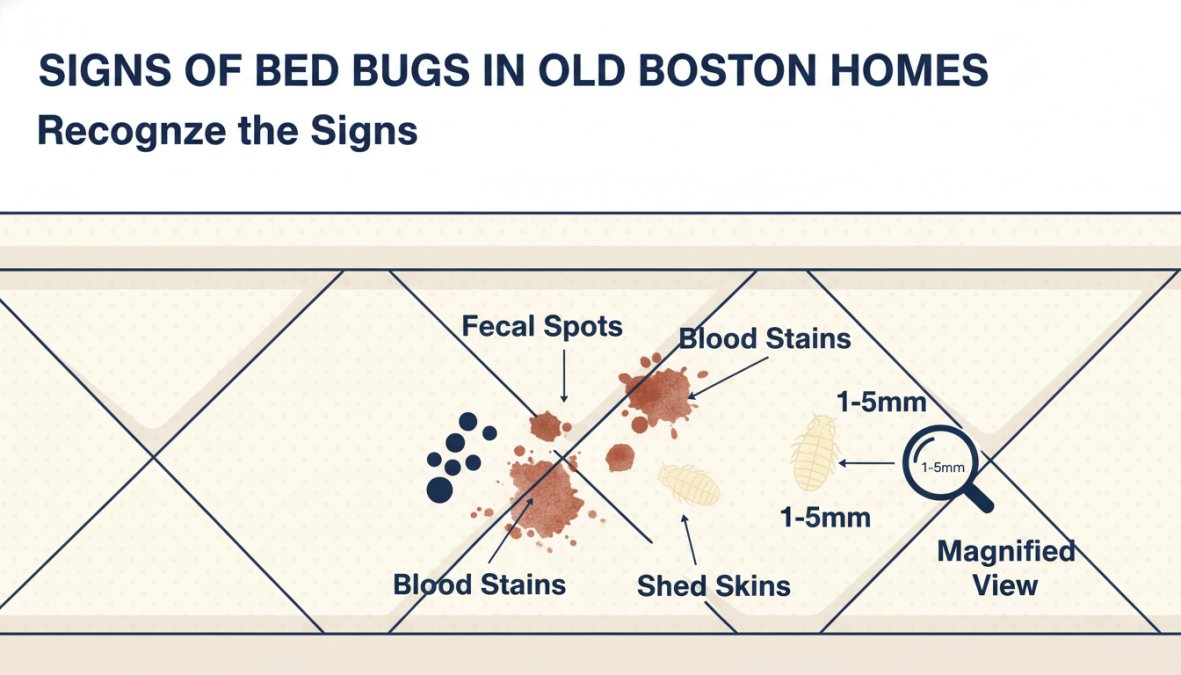
Physical Evidence: Rusty Stains, Fecal Spots, and Molted Skins
Physical evidence is the most reliable confirmation of an active infestation. Here’s what to look for, in order of how easy each is to spot:
- Rusty or reddish-brown stains on mattress seams, sheets, or pillowcases. These appear when a bed bug is crushed after feeding. The color comes from partially digested blood.
- Dark fecal spots about the size of a pen tip. These are digested blood deposits and appear as dark brown or black dots, often in clusters near harborage sites.
- Molted skins (shed exoskeletons) left behind as nymphs progress through their five developmental stages. These are translucent and hollow, ranging from 1mm to 4.5mm in size.
- Live or dead insects. Adult bed bugs are roughly the size and shape of an apple seed: flat, oval, and reddish-brown. Nymphs are smaller and paler.
- Eggs and eggshells. Eggs are tiny (about 1mm), pearl-white, and often found in tight crevices where females deposit them.
A mattress inspection should cover seams, tufts, and the underside. But in old Boston apartments, also check behind headboards, inside box spring folds, and along the wooden slats of bed frames. Old wood holds heat and provides excellent harborage.
Bed Bug Bites: Itchy Welts, Blisters, and Allergic Reactions
Bed bug bites are not a definitive diagnostic tool on their own, but they’re often the first signal that prompts an inspection. Bed bugs use stylets to pierce skin and locate a blood vessel, injecting protein enzymes that prevent clotting and cause the inflammatory response most people experience.
The typical presentation is itchy welts in a line or cluster, often on exposed skin: arms, neck, shoulders, and legs. Some people develop blisters or pustules. A subset of people have no visible reaction at all, which is why bites alone can’t confirm an infestation.
One important distinction: bed bug bites don’t appear immediately. The delayed reaction can take one to three days, meaning you may wake up without marks and still have been bitten. If you notice recurring itchy welts with no obvious cause, pair that observation with a physical inspection of your sleeping area.
Severe allergic reactions are uncommon but documented. As noted in CDC information on bed bugs and public health, bed bugs are not known to transmit disease, but secondary infections from scratching are a real concern, particularly in children.
Bed Bug Hiding Spots in Furniture and Old Building Structures
The biggest mistake renters make is limiting their search to the mattress. Bed bugs are not mattress insects specifically. They are harborage insects that prefer to stay within a few feet of their host’s sleeping location.
Wall Voids, Crevices, and Other Structural Sanctuaries
In old Boston buildings, bed bug hiding spots in furniture are only part of the problem. The structure itself provides sanctuary. Common harborage locations include:
- Mattress seams, box spring folds, and bed frame joints
- Behind loose wallpaper and peeling paint (common in pre-1978 buildings)
- Inside wall voids through gaps around electrical outlets and switch plates
- Along baseboards, especially where they’ve separated from the wall
- Inside upholstered furniture: sofas, chairs, and ottomans, particularly in seams and underneath cushions
- Behind picture frames and mirrors mounted on walls near beds
- Inside nightstands and dressers, especially in joints and drawer slides
- Under carpeting near walls and tack strips
The structural crevices in older plaster-and-lath walls hold bed bugs particularly well. Modern drywall construction leaves fewer gaps. A 100-year-old triple-decker in Dorchester or Jamaica Plain has gaps that no amount of caulking fully eliminates.
 technician in a uniform using a flashlight to inspect the wooden frame and crevices of an old upholstered couch in a dimly lit Boston apartment with exposed brick walls and aged plaster](https://cdn.grandranker.com/articles/signs-of-bed-bugs-in-old-boston-homes-a-2026-guide-content-2-1780710771.jpg)
When inspecting furniture, use a credit card or stiff piece of paper to drag along seams and joints. This dislodges fecal spots and molted skins that are otherwise invisible. Do this over a white sheet so evidence is easy to see.
Understanding the Bed Bug Life Cycle: Egg, Nymph, and Adult
A bed bug infestation grows faster than most people expect because the life cycle is short and the reproductive rate is high. Understanding the stages helps you gauge how long an infestation has been present.
Egg: A female lays one to five eggs per day, depositing them in crevices with a sticky substance that adheres them to surfaces. Eggs hatch in approximately six to ten days under warm conditions.
Nymph: Bed bugs pass through five nymph stages before reaching adulthood. Each stage requires at least one blood meal to molt. The entire nymph-to-adult progression takes approximately five weeks under optimal temperatures. Nymphs are pale and nearly translucent, making them easy to miss on light-colored fabric.
Adult: Adult bed bugs live for several months and can survive extended periods without feeding. In cooler, less-trafficked spaces (common in Boston’s older buildings during winter months), adults can remain dormant for longer periods, which is why infestations can appear to "disappear" and then return.
The presence of eggs and multiple nymph stages in the same inspection area indicates an established, actively reproducing infestation rather than a recent introduction. That distinction matters for treatment planning.
According to University of Minnesota Extension bed bug life cycle resource, the speed of reproduction means a small introduction can become a significant infestation within two to three months.
What a Professional Bed Bug Inspection in Boston Involves
A bed bug inspection in Boston conducted by a licensed professional is fundamentally different from a self-inspection. A trained technician knows where to look in old building structures and uses tools and methods that surface evidence invisible to the untrained eye.
Heat Treatment vs. Insecticide: Risks, Benefits, and What Boston Tenants Should Know
Professional inspections typically precede treatment decisions. Two primary options exist: heat treatment and insecticide application.
Heat treatment raises the temperature of the infested space to levels lethal to bed bugs at all life stages, including eggs. It’s the preferred method for old Boston buildings because it penetrates wall voids, furniture joints, and structural crevices where insecticides can’t reliably reach. Heat treatment leaves no chemical residue and eliminates the risk of insecticide resistance.
Insecticide treatment uses chemical applications to targeted harborage sites. The risks are real: insecticide resistance in bed bug populations is well-documented, and improper application in multi-unit dwellings can cause cross-contamination, pushing insects into adjacent units rather than eliminating them. In older buildings with poor sealing, this scatter effect is a serious concern.
The insecticide risks extend to occupant health as well. Tenants with respiratory conditions, children, and pets face elevated exposure risks in older apartments with limited ventilation.
For most situations in old Boston housing, heat treatment is the more effective and less disruptive option. Zoifia Pest Control provides licensed and insured bed bug treatment with a 90-day guarantee, giving Boston tenants a clear resolution path without long-term contracts.
Heat treatment is generally the superior choice for old Boston buildings because it reaches harborage sites that insecticides cannot penetrate, including wall voids, structural crevices, and the interior of upholstered furniture.
Preventing Bed Bugs in Multi-Unit Buildings: A Boston Tenant Checklist
Preventing bed bugs in multi-unit buildings requires consistent habits, not one-time actions. The following checklist is designed specifically for Boston apartment hunters and current renters in older buildings.
Boston Apartment Hunter Checklist
- Inspect the mattress seams and box spring before moving in
- Check behind the headboard and along baseboards for fecal spots or molted skins
- Ask the landlord for written disclosure of any prior bed bug treatment in the unit
- Examine the electrical outlets and switch plates nearest to sleeping areas
- Look for rusty stains on any upholstered furniture included with the apartment
- Confirm the building has a written pest management policy
- Check that baseboards and wall-floor junctions are properly sealed
For Current Residents
- Encase mattresses and box springs in bed bug-proof covers
- Reduce clutter near sleeping areas to eliminate harborage sites
- Inspect secondhand furniture thoroughly before bringing it inside
- After travel, inspect luggage before bringing it into the bedroom
- Report any suspected infestation to your landlord in writing immediately
Tenant vs. Landlord Legal Responsibilities in Boston
This is the part most guides skip entirely. Under Massachusetts law, landlords are legally responsible for maintaining rental units free from insect infestations. The Massachusetts State Sanitary Code requirements for rental housing classifies an active bed bug infestation as a condition requiring remediation by the property owner.
Practically, this means:
- Tenants must notify landlords in writing of a suspected infestation
- Landlords must respond within a reasonable timeframe and arrange professional extermination
- Tenants cannot be evicted in retaliation for reporting a pest problem
- If a landlord fails to act, tenants may have grounds to pursue rent withholding or repair-and-deduct remedies under state law
Document everything. Photograph evidence, send notices by certified mail, and keep copies of all communication. In multi-unit buildings where the infestation source may be disputed, this documentation becomes critical.
Common Mistakes Boston Renters Make When Dealing with Bed Bugs
The gap between recognizing an infestation and resolving it is where most renters lose significant time and money. These are the mistakes we see most often.
Waiting to report. Many tenants delay notifying their landlord because they’re uncertain about the infestation or worried about the disruption. Every week of delay is more eggs, more nymphs, and a harder treatment job.
DIY insecticide application. Over-the-counter sprays don’t penetrate the harborage sites where bed bugs actually live. Worse, they can scatter insects into adjacent wall voids, spreading the infestation to neighboring units. This is a particularly acute problem in Boston’s densely built older housing.
Discarding furniture prematurely. Moving an infested mattress or couch through the building spreads bed bugs to hallways, stairwells, and other units. If furniture must be removed, it should be wrapped in plastic first.
Treating only the bedroom. Bed bugs follow their host. If you sleep on the couch during an infestation, the infestation follows. Treatment must cover all areas where the occupant sleeps or rests regularly.
Assuming one treatment resolves the problem. A single treatment rarely eliminates all eggs. Professional follow-up inspections are standard practice, and any reputable pest control service should include them. Zoifia Pest Control’s 90-day guarantee exists precisely because responsible treatment means confirming the infestation is fully resolved, not just initially reduced.
Frequently Asked Questions
Are bed bugs common in old Boston apartments?
Yes, bed bugs are particularly common in older Boston apartments. Historic multi-unit dwellings offer an abundance of wall voids, cracked baseboards, aging wooden furniture joints, and dense pipe networks that serve as ideal hiding spots. Boston's high housing density also means bed bugs can hitchhike between units easily through shared walls and hallways, making infestations in older buildings harder to contain than in newer construction.
Do historic homes have more hiding spots for bed bugs?
Historic homes tend to have significantly more hiding spots than modern builds. Older construction features wider wall voids, deteriorating plaster, exposed pipe chases, and aged hardwood floors with deep crevices, all ideal sanctuaries for bed bugs. Decades of paint layers over baseboards and door frames create additional gaps. These structural characteristics make mattress inspection alone insufficient; a thorough professional inspection of the full structure is strongly recommended.
How can I tell if I have bed bugs in my mattress?
Start by stripping all bedding and examining the mattress seams, tufts, and tags under a bright flashlight. Look for rusty or dark reddish-brown stains (blood spots), small dark fecal spots about the size of a pen tip, tiny pale molted skins, and live or dead insects roughly the size of an apple seed. Also inspect the box spring and bed frame joints. If you find any of these signs of bed bugs, contact a licensed pest control professional promptly.
Should I hire a professional for bed bug inspection in Boston?
For Boston apartments, especially in older multi-unit buildings, professional inspection is strongly advised. DIY treatments carry real insecticide risks including cross-contamination of neighboring units and incomplete extermination, which allows surviving bed bugs to repopulate. A licensed pest control professional uses targeted methods such as heat treatment that penetrate wall voids and furniture crevices more effectively. Zoifia Pest Control offers fast, licensed bed bug inspection in Boston with a 90-day guarantee and no long-term contracts.
Can bed bugs travel between apartments in old Boston buildings?
Yes, bed bugs are skilled hitchhiking insects and can move between units through shared wall voids, electrical conduits, plumbing chases, and gaps under doors, all of which are far more prevalent in older Boston buildings. A bed bug infestation in one unit can spread to adjacent apartments within days if untreated. This is why preventing bed bugs in multi-unit buildings requires coordinated action between tenants and landlords, not just individual unit treatment.
Who is responsible for bed bug extermination in a Boston rental, tenant or landlord?
Under Massachusetts law, landlords are generally responsible for maintaining rental units free of pest infestations, including bed bugs, as part of the state sanitary code. However, if a tenant introduced the infestation through hitchhiking on luggage or used furniture, responsibility may shift. Tenants should document signs of bed bugs in writing and notify their landlord immediately. If the landlord fails to act, tenants may have legal remedies including rent withholding or repair-and-deduct options under Massachusetts law.
Bed bug infestations in old Boston housing don’t resolve on their own, and the structural complexity of historic buildings makes self-treatment unreliable. Zoifia Pest Control serves the Metro Boston area with licensed and insured bed bug treatment, fast response times, and a 90-day guarantee backed by no long-term contracts. Get a quote from Zoifia Pest Control and resolve your infestation with confidence.
This article was written using GrandRanker
