Table of Contents
- Identify Where Roaches Hide in Old Buildings
- Use Gel Baits and Sticky Traps to Get Rid of Roaches
- Best Roach Bait for Apartments and How to Apply It
- How to Seal Cracks in Old Apartments to Prevent Entry
- Fix Sanitation and Moisture Problems That Attract Roaches
- Landlord Responsibilities for Pest Control in Rental Units
- When to Call a Professional Exterminator
- Conclusion
Identify Where Roaches Hide in Old Buildings
Roaches thrive in older buildings because structural vulnerabilities create countless hiding spots that modern pest control often misses. Gaps between baseboards and walls expand as the building settles. Plumbing penetrations through floors and walls were rarely sealed properly decades ago. Electrical conduits offer protected pathways, and deteriorated grout creates harborage areas roaches exploit.
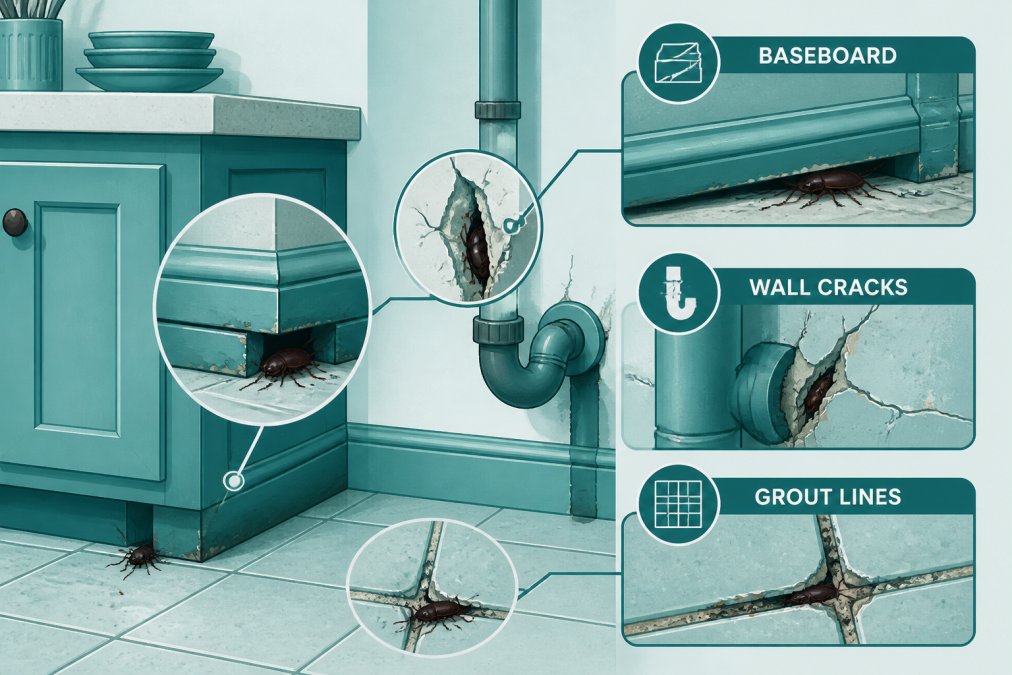
The most common hiding spots include:
- Under and behind kitchen cabinets, Roaches prefer areas within 6-12 inches of food and water sources. Older cabinets often have gaps underneath where they rest during the day.
- Around plumbing, Pipes under sinks, behind toilets, and along walls create the warm, moist environment roaches need.
- Wall voids and cavities, Hollow spaces inside walls allow roaches to move vertically between apartments.
- Cracks in walls and corners, Older plaster and drywall crack more easily, offering protection and access to food sources.
- Behind appliances, Refrigerators, stoves, and dishwashers accumulate grease and moisture in dark, undisturbed spaces.
- Baseboards and trim, Gaps widen with age, creating highways roaches use to move along room perimeters.
The key insight: roaches establish routes between harborage areas, moving along walls and pipes to reach food at night. Treating only obvious areas misses the pathways they use to survive. Successful treatment requires identifying these pathways first.
Use Gel Baits and Sticky Traps to Get Rid of Roaches
Gel baits and sticky traps form the foundation of effective roach elimination. They work through different mechanisms, and using both together breaks the infestation cycle.
Gel baits contain insecticide mixed with food attractants. Roaches consume the bait, return to harborage areas, and die. Critically, other roaches feed on the dead roach, ingesting poison themselves. This cascade effect reduces populations rapidly.
Sticky traps don’t kill roaches directly, they trap them on adhesive surfaces. Their real value is diagnostic. The number of roaches caught tells you where populations concentrate and whether treatment is working. Dozens of roaches after one week indicates severe infestation; zero roaches after two weeks suggests treatment is succeeding.
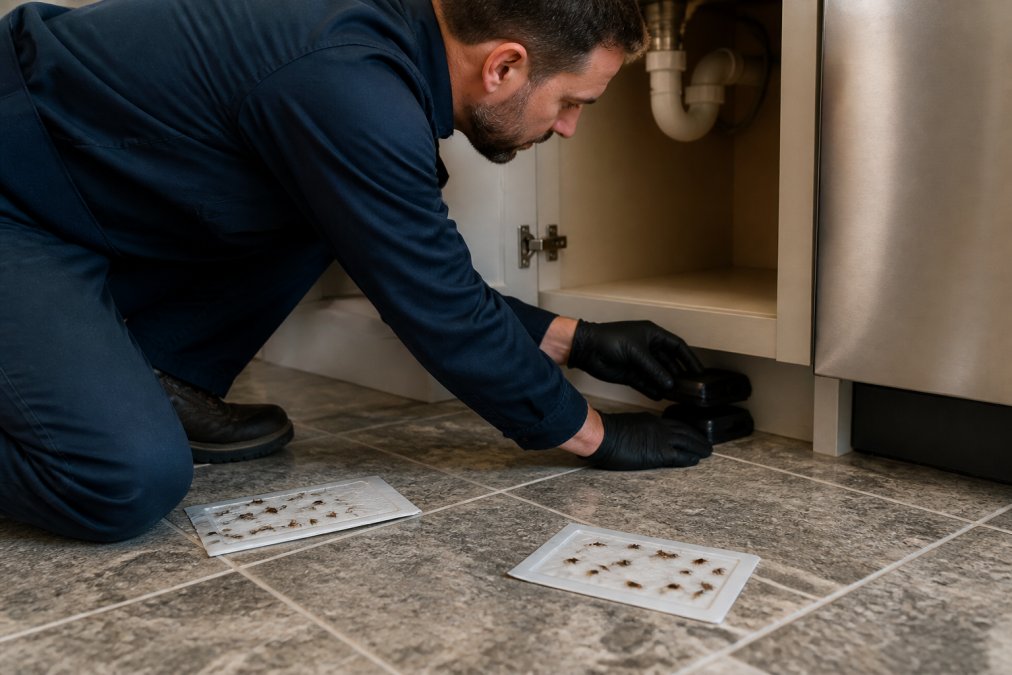
How to deploy gel baits effectively:
- Place bait stations in a grid pattern, spacing them 3-4 feet apart along walls and under cabinets
- Position baits close to suspected harborage areas but not directly in them
- Use small amounts (pea-sized dots) rather than large globs; roaches prefer small feeding opportunities
- Reapply bait every 7-10 days for the first month, then every 2-3 weeks as populations decline
- Keep baits away from areas where pets or children can access them
- Replace bait if it dries out or becomes contaminated
Sticky trap placement strategy:
Place traps along walls where roaches travel, particularly in corners and baseboards. Position them under sinks, behind refrigerators, and near water sources. Check traps every 2-3 days initially to monitor activity. Replace traps when they become full or lose adhesiveness.
Expect results in 3-5 days, with full elimination taking 2-3 weeks because roaches reproduce continuously. Patience and consistent application matter more than intensity.
Best Roach Bait for Apartments and How to Apply It
The most effective baits for apartment use contain fipronil or imidacloprid as the active ingredient. These chemicals disrupt the roach’s nervous system, causing death within hours. The bait matrix typically includes peanut oil, sugar, and other attractants roaches cannot resist.
Application technique matters as much as the product itself. Roaches are cautious feeders. A small, strategically placed amount of bait attracts more feeding than a large glob that looks suspicious.
Step-by-step application process:
- Identify high-activity areas first, Use sticky traps for 3-5 days to map roach concentration
- Apply bait in small dots, Use a caulking gun or applicator bottle to place pea-sized amounts
- Position baits 3-6 inches from walls, Roaches travel along edges; baits slightly away force them to approach from multiple angles
- Create a perimeter, Establish bait stations around the kitchen, under sinks, behind appliances, and in bathrooms
- Maintain consistent spacing, Space baits 3-4 feet apart to ensure roaches encounter them
- Avoid over-application, More bait doesn’t mean faster results; it wastes product and spoils faster
- Track consumption, Check baits every 3-4 days; quick consumption indicates active feeding
Reapplication schedule:
- Week 1-2: Apply fresh bait every 7 days
- Week 3-4: Apply every 10-14 days as populations decline
- Week 5+: Apply every 3 weeks until no roach activity for 30 consecutive days
Reapplication matters because roach populations continuously reproduce. Nymphs hatch from eggs laid by females. Ongoing bait application catches new roaches before they mature and reproduce.
How to Seal Cracks in Old Apartments to Prevent Entry
Sealing cracks stops new roaches from entering and gives existing roaches fewer places to hide. In old apartments, this is essential because the building itself is compromised.
The most critical areas are entry points from adjacent apartments and common areas. Roaches move between units through gaps around pipes, electrical conduits, and baseboards.
Priority sealing locations:
- Plumbing penetrations, Seal gaps around pipes with silicone caulk or foam sealant
- Electrical outlets and switches, Caulk around the perimeter where boxes meet walls
- Baseboards, Fill gaps wider than 1/8 inch where baseboards meet walls and floors
- Gaps under cabinet toe kicks, Seal or block the space under kitchen and bathroom cabinets
- Door frames, Use weatherstripping or caulk around entry and closet doors
- Gaps between tiles, Regrout or caulk deteriorated grout in tile areas
How to seal cracks properly:
- Clean out debris using a wire brush or vacuum
- For gaps wider than 1/2 inch, use foam sealant first to fill bulk space
- Apply silicone caulk over foam or directly into smaller cracks
- Smooth caulk with a wet finger to ensure complete filling
- Allow caulk to cure fully (24-48 hours) before exposing to water or traffic
Sealing only prevents new entry; it doesn’t eliminate roaches already inside. Use it as a complementary strategy alongside baiting and trapping.
Fix Sanitation and Moisture Problems That Attract Roaches
Roaches need food, water, and shelter to survive. Remove any one of these, and populations decline dramatically. Sanitation and moisture control address two of these needs.
Roaches feed on obvious food sources but also on soap residue, toothpaste, hair, and dead skin cells. Water is often the limiting factor, roaches survive weeks without food but only days without water. Moisture problems, leaky pipes, and condensation create the humid environment roaches need.
Sanitation steps that reduce roach populations:
- Clean kitchen thoroughly, Wipe surfaces daily, especially around appliances where grease accumulates
- Store food in sealed containers, Transfer dry goods to airtight containers
- Take out trash daily, Use sealed trash cans if possible
- Clean under appliances, Pull out refrigerators and stoves monthly to clean grease and crumbs
- Wash dishes immediately, Don’t leave dirty dishes in sinks overnight
- Eliminate clutter, Declutter closets, under sinks, and storage areas where roaches hide
Moisture control measures:
- Fix leaky pipes, Even slow drips provide water roaches need
- Reduce condensation, Use bathroom exhaust fans during and after showers
- Improve ventilation, Open windows when weather permits
- Empty standing water, Check for pooling under sinks, in plant saucers, or pet bowls
- Dry sinks before bed, Roaches drink from sink drains at night
Sanitation removes the incentive for roaches to stay. A kitchen with no food, no water, and no hiding spots becomes uninhabitable. Combined with baiting, sanitation accelerates elimination significantly.
Landlord Responsibilities for Pest Control in Rental Units
If you’re renting in an old apartment, understanding your landlord’s legal obligations is critical. Massachusetts law places specific responsibilities on landlords regarding pest control and habitability.
Under Massachusetts General Law Chapter 93A, landlords must maintain rental properties in a condition allowing tenants to enjoy their rights. This includes maintaining properties free from pest infestations. A roach infestation making a unit unlivable is a habitability violation, and landlords are legally responsible for remediation.
Your rights as a tenant:
- Right to request pest control, Formally request that your landlord address the infestation in writing
- Right to withhold rent, In some cases, if your landlord fails to address a habitability violation after notice, you may withhold rent
- Right to break lease, If your landlord fails to maintain habitability, you may break your lease without penalty
- Right to retaliation protection, Your landlord cannot retaliate for reporting pest problems
How to communicate with your landlord:
Send a written request describing the roach problem with specific details: where you’ve seen roaches, when, and how long the problem has existed. Request that your landlord hire a licensed pest control company to treat the unit and common areas. Keep copies of all communications.
If your landlord doesn’t respond within 7-14 days, send a follow-up request. If they refuse to address the problem, contact your local board of health or housing authority. Code enforcement divisions can inspect properties and issue violations, requiring remediation or fines.
Roach infestations in rental units are not your problem to solve alone. Your landlord has a legal obligation to maintain the property. Zoifia Pest Control works with both landlords and tenants to resolve these situations quickly.
When to Call a Professional Exterminator
DIY approaches work for mild infestations, but severe infestations require professional intervention.
Call a professional exterminator when:
- The infestation persists after 3 weeks of consistent DIY treatment, Significant population decline should occur by week three with correct application
- You see roaches during the day, Daytime activity indicates severe infestation; roaches normally hide during daylight
- You find roach egg cases (oothecae), Brown, oval capsules about 1/4 inch long indicate active reproduction requiring IGR (Insect Growth Regulator) products
- The infestation spans multiple rooms or units, Building-wide problems require coordinated professional treatment
- You have pets or young children, Professional exterminators use safer products and techniques for vulnerable occupants
What professional treatment includes:
Professional pest control companies apply residual sprays to baseboards and wall voids, use IGR products that prevent reproduction, and conduct thorough inspections to identify harborage areas. They treat common areas if the building has widespread problems.
Most professional treatments require follow-up visits. Initial treatment kills adults, but a second visit 1-2 weeks later catches roaches hatching from eggs. Many companies offer guarantees: if roaches return within a specified period (often 30-90 days), they’ll retreat at no charge.
Zoifia Pest Control offers fast response times and a 90-day guarantee. We work with both individual tenants and landlords without requiring long-term contracts.
Getting rid of roaches in old apartments is challenging because structural gaps, poor ventilation, and interconnected units create environments where roaches thrive. DIY approaches using gel baits, sticky traps, and sanitation work for mild infestations and should be your first step. When roaches persist despite your efforts or the infestation is severe, professional treatment becomes necessary. Zoifia Pest Control specializes in eliminating roaches from older buildings using licensed technicians, proven methods, and a 90-day guarantee to ensure your space stays pest-free without long-term contracts. Get A Quote today and reclaim your apartment from roaches.
Frequently Asked Questions
Is it possible to completely get rid of roaches in an apartment?
Yes, but it requires a multi-step approach combining baiting, sealing entry points, and sanitation. German cockroaches, the most common species in older apartments, respond well to gel baits and IGR treatments that disrupt their infestation cycle. Success depends on addressing harborage areas, moisture sources, and preventing re-entry through cracks and plumbing penetrations. Professional extermination offers faster results, especially in severe infestations.
What's the difference between gel baits and other roach control methods?
Gel baits work by attracting roaches to a poisoned food source they carry back to their colony, eliminating multiple generations. Sticky traps capture roaches for monitoring but don't reduce the population. Boric acid is effective but poses risks in homes with pets or children. IGR products prevent nymphs from maturing into adults, breaking the infestation cycle. Combining baits with IGR and sealing entry points delivers the best results for apartment infestations.
What are my rights as a renter if my landlord won't address a roach problem?
Massachusetts housing code requires landlords to maintain habitable conditions, including pest-free units. Document the infestation with photos and dates, send a written maintenance request, and keep copies. If your landlord doesn't respond within a reasonable timeframe, you can contact your local health department or file a housing code violation complaint. Some renters have the right to hire pest control and deduct costs from rent, but consult local tenant laws first.
How long does it take to get rid of a roach infestation in an old apartment?
DIY baiting and sealing typically takes 2-4 weeks to see significant reduction, with full control in 4-8 weeks. Professional extermination can eliminate roaches faster, often within 1-2 weeks, especially with follow-up treatments. The timeline depends on infestation severity, building construction, and how quickly you address sanitation and entry points. Older buildings with more cracks and plumbing issues may take longer because re-infestation is easier.
This article was written using GrandRanker
